

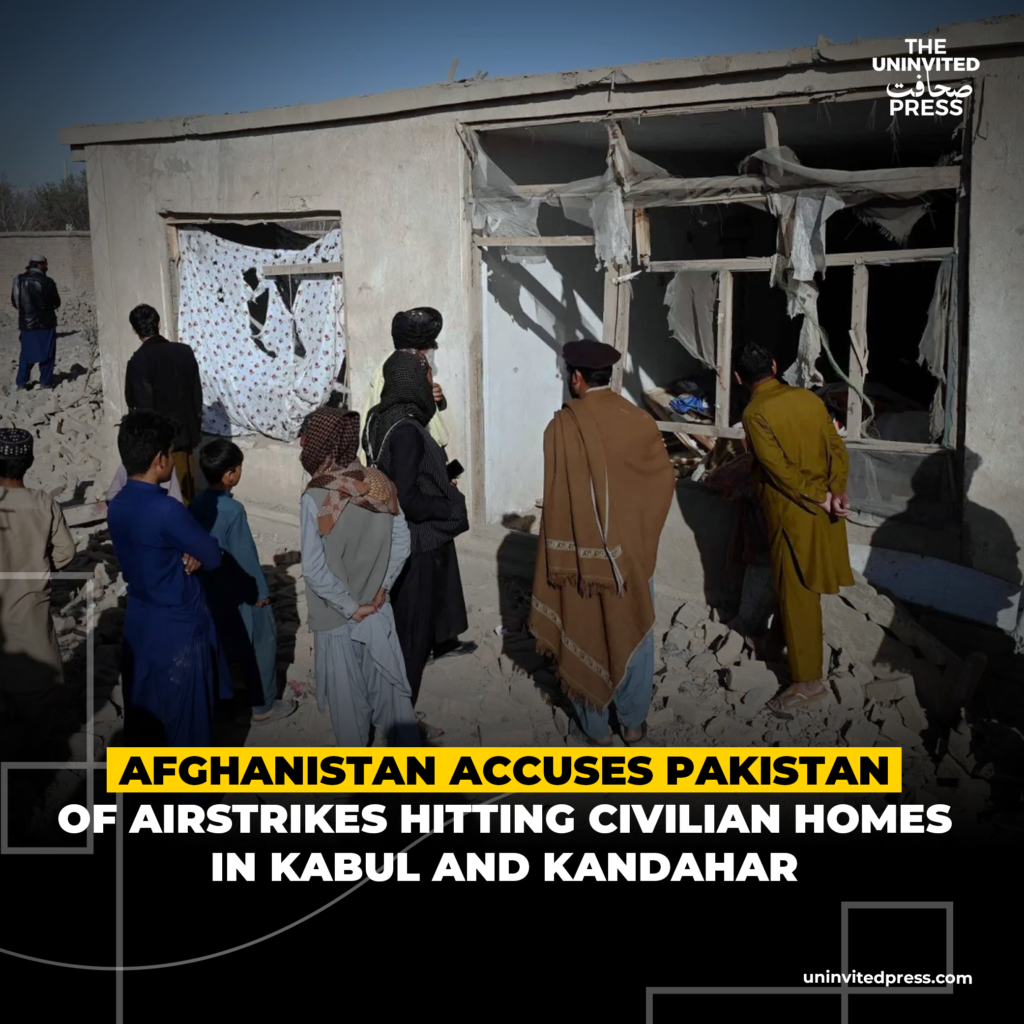
Taliban government claims women and children among dead as cross-border fighting enters third week, while Islamabad says it targeted militant hideouts.
Afghanistan’s Taliban-led government has accused Pakistan of carrying out overnight airstrikes on civilian homes in the capital Kabul and the southern province of Kandahar, killing at least four to six people, including women and children, as tensions between the two neighbours continue to escalate.
Government spokesman Zabihullah Mujahid said Pakistani aircraft struck residential areas in Kabul as well as fuel depots belonging to the private airline Kam Air near Kandahar airport. He described the attacks as a violation of Afghan sovereignty and vowed a response.
“Pakistan’s military targeted civilian homes and uninhabited locations in Kabul, Kandahar, Paktia and Paktika provinces,” Mujahid posted on X, adding that the strikes caused civilian casualties and damaged infrastructure used for civilian and humanitarian flights.
The accusations come amid ongoing cross-border clashes that erupted in late February 2026, triggered by Pakistani strikes on alleged militant camps linked to the Tehreek-e-Taliban Pakistan (TTP) and other groups operating from Afghan soil. Fighting has since intensified, with both sides exchanging accusations of targeting civilians and military sites.
Pakistan Defends Cross-Border Strikes Amid Afghanistan Civilian Claims:
Pakistani security sources and the military have maintained that their operations are “precise and intelligence-based,” aimed at terrorist hideouts and infrastructure used by militants to launch attacks inside Pakistan. Islamabad has denied deliberately striking civilian areas, claiming successful hits on four terrorist locations and related support facilities.
The Pakistani Information Ministry described the strikes as part of efforts to counter cross-border terrorism following deadly attacks in Pakistani cities, including Islamabad, Bajaur and Bannu. Officials insist the targets were militant camps and not residential zones.
The conflict has overshadowed broader regional developments, including the US-Israel war on Iran, and raised fears of further destabilisation along the porous 2,600km Durand Line border.
Background of escalating tensions:
Tensions between Kabul and Islamabad have simmered for years over accusations that the Taliban government harbours or fails to curb anti-Pakistan militants, particularly the TTP. Pakistan has repeatedly conducted cross-border operations, while the Taliban denies providing safe haven to such groups and has accused Islamabad of interfering in Afghan affairs.
The latest round of violence began with Pakistani airstrikes in eastern Afghan provinces, prompting Afghan retaliatory actions. Subsequent strikes have hit areas near Kabul and Kandahar, marking a significant escalation as Pakistan has described the situation at times as approaching “open war.”
International calls for restraint have so far had limited effect. Analysts warn that continued airstrikes risk civilian casualties, displacement and a wider humanitarian impact in a country already grappling with economic hardship and restricted aid under Taliban rule.
Rising Pakistan-Afghanistan Tensions Trigger Civilian Damage and Retaliation Fears:
Local residents in affected areas reported damage to homes and infrastructure, with images circulating of destroyed buildings and families inspecting rubble. Afghan officials have highlighted the presence of women and children among the victims, framing the strikes as indiscriminate.
Human rights groups and observers have expressed concern over the potential for war crimes if civilian targets are deliberately or recklessly hit, though verification remains difficult amid restricted access to conflict zones.
The escalation also disrupts cross-border trade and movement, with major border crossings often closed during heightened tensions, further straining the economies of both nations.
As the fighting continues into its third week, both sides appear locked in a cycle of retaliation. The Taliban has warned that Pakistani actions “will not go unanswered,” while Islamabad insists its operations will persist until threats from Afghan soil are neutralised.