

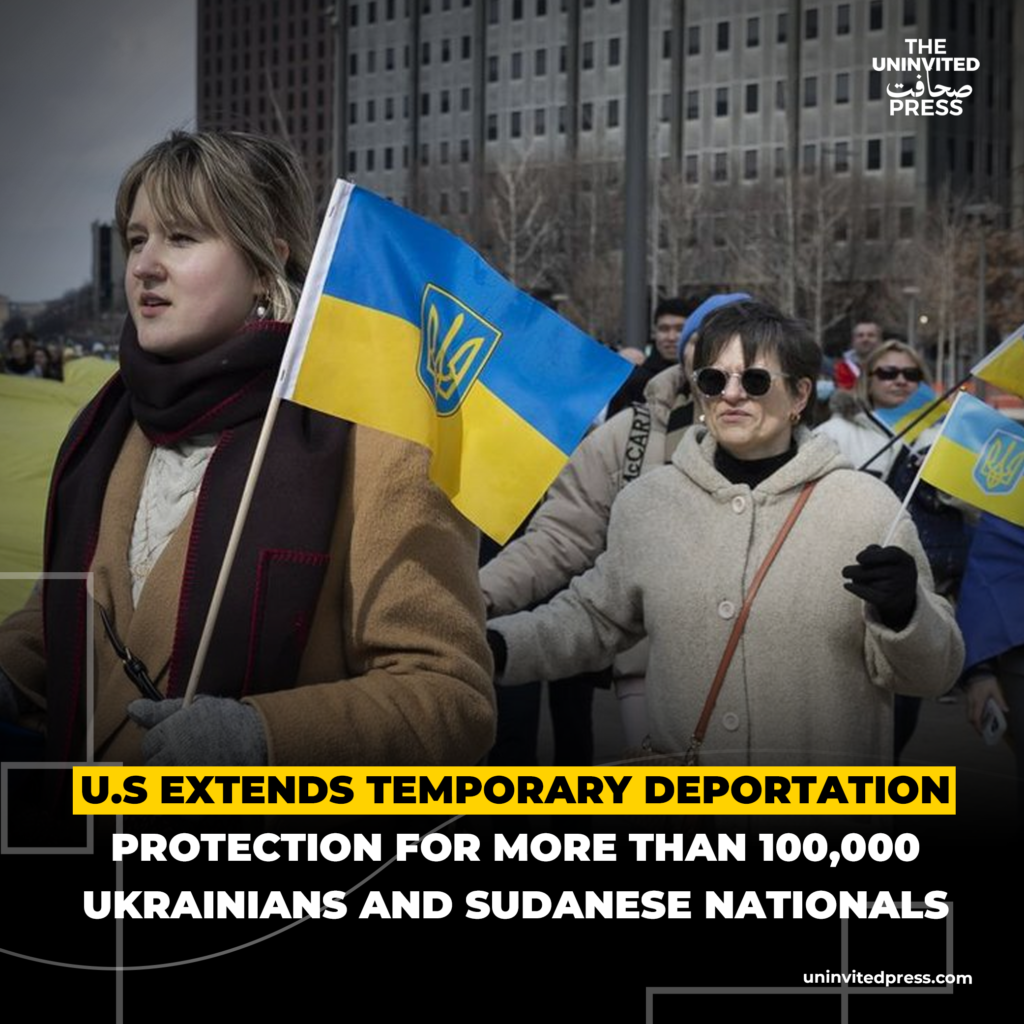
Department of Homeland Security says nationals from both countries will ‘retain protection’ after Temporary Protected Status was set to expire, amid ongoing wars and broader immigration crackdown.
The United States Department of Homeland Security (DHS) has said that more than 100,000 people from Ukraine and Sudan currently living in the country under Temporary Protected Status (TPS) will retain their deportation protections and work authorisation for now, after the designations were set to expire on Monday.
In statements issued over the weekend and on Monday, a DHS spokesperson said announcements on the future of TPS for both countries “will be made at the appropriate time.” Until then, Ukrainians and Sudanese nationals covered by the programme “retain protection including work authorization.”
Estimates of those affected vary slightly across reports, but figures commonly cited put the number of Ukrainian TPS holders at more than 100,000 (with some earlier data showing about 101,000 to 103,700 enrolled) and Sudanese beneficiaries at roughly 1,800 to 1,900. Separate tallies have noted that around 240,000 Ukrainians have registered for TPS at some point, though the active beneficiary count is lower.
US Extends Protections for Ukrainians and Sudanese:
TPS is a humanitarian programme that allows foreign nationals already present in the United States to remain and work legally when their home countries face armed conflict, natural disasters or other extraordinary conditions that make safe return impossible. Ukraine was first designated for TPS in April 2022 following Russia’s full-scale invasion. The Biden administration later extended the designation, most recently through October 2026. Sudan has held TPS designations on and off since the late 1990s, with successive administrations citing prolonged conflict and instability; the latest designation period was also set to end on 19 October 2026.
Both countries continue to experience severe crises. Ukraine remains embroiled in a war that has displaced millions and entered its fifth year. Sudan has endured a devastating civil war between the army and a rival paramilitary force for more than three years, producing one of the world’s worst humanitarian emergencies, including widespread displacement and a severe food crisis.
The decision to maintain protections for now mirrors a similar move by the Trump administration last month regarding TPS holders from El Salvador. It stands in contrast to the administration’s broader approach of terminating TPS for numerous other countries, including Haiti, Venezuela, Somalia, Ethiopia, Syria and others, as part of a hardline immigration agenda that has sought to end what officials describe as overly prolonged “temporary” protections.
TPS Uncertainty Persists for Ukrainians and Sudanese in US:
Advocates have welcomed the short-term reprieve but expressed concern over the lack of a formal extension and the resulting uncertainty for families who rely on the status to live and work safely. “Families who depend on this status to stay safe and keep working deserve a formal decision in writing, not a weekend statement to press,” said one refugee advocacy group. Some legal observers note that, in the absence of a timely termination notice, statutory provisions can effectively extend TPS for six months, though DHS has not confirmed the precise duration.
The timing comes just two weeks before US midterm elections, in which immigration policy remains a central issue. The Trump administration has framed repeated TPS extensions under previous governments as a form of de facto permanent status that encourages irregular migration, while critics argue that ongoing conflicts in Ukraine and Sudan still meet the legal criteria for protection and that abrupt terminations risk returning people to dangerous conditions.
For now, the more than 100,000 Ukrainians and several thousand Sudanese under TPS can continue living and working in the United States without immediate fear of deportation. A definitive decision on whether the designations will be formally extended, terminated or allowed to lapse under statutory rules is still pending.