

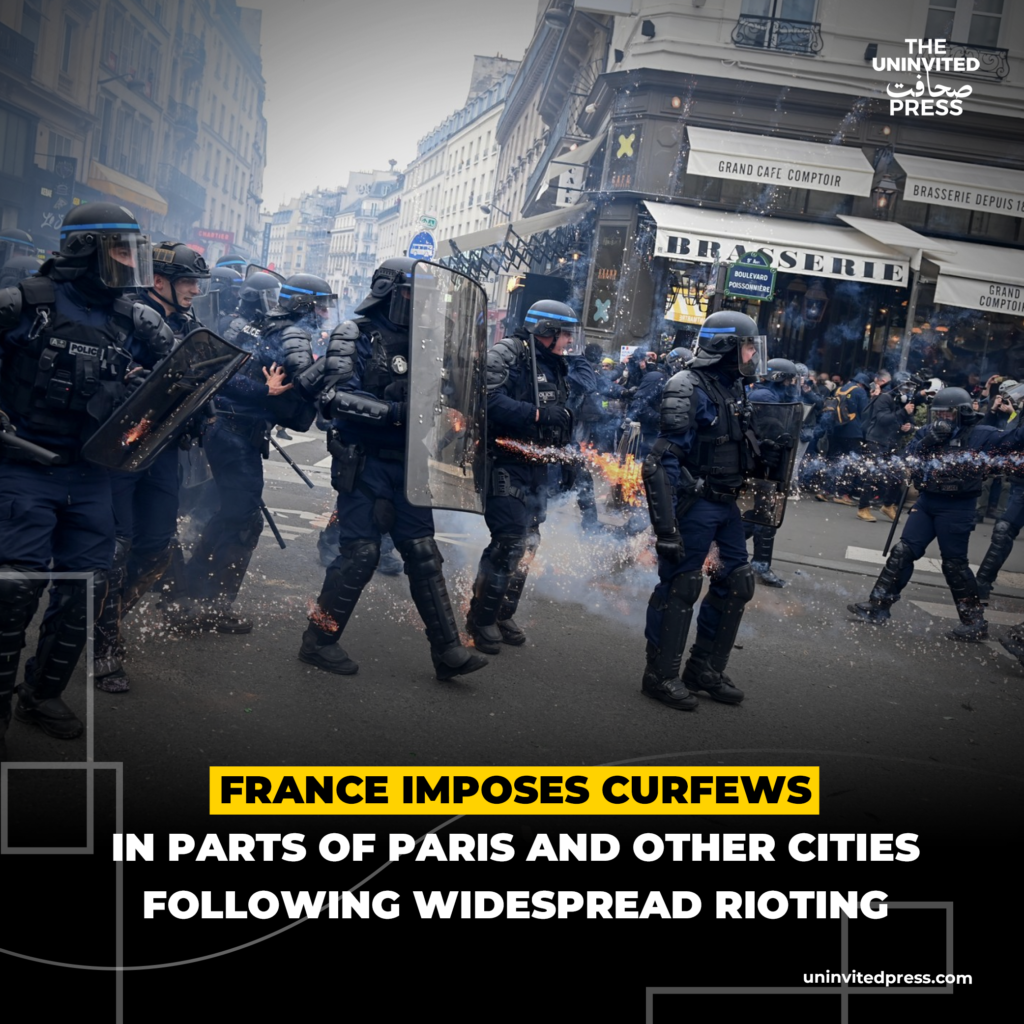
Authorities order overnight restrictions following cost-of-living protests that escalated into violence, looting and clashes, as government faces criticism over security response.
French authorities have imposed overnight curfews in parts of Paris and several other cities after a weekend of rioting and looting that authorities described as the worst unrest in years, stemming from nationwide protests against rising living costs and poor conditions in schools.
Paris police ordered a curfew from 11pm local time (9pm GMT) on Monday until 6am on Tuesday in two central areas hit hard by the disorder: Place de la République, where protesters had gathered, and the Les Halles shopping neighbourhood, which saw extensive looting. Gatherings and demonstrations were also banned from 8pm in parts of the city centre.
Similar partial and localised measures were announced in other cities. In Lyon, a curfew applied to the central zone from 9pm, with a public-gathering ban earlier in the evening. Curfews targeting minors were put in place in Nice, Lille and nearby towns such as Douai, Wattignies and Denain, typically running from 8pm or 9pm until 6am. Restrictions were also reported in Marseille, Bordeaux and elsewhere.
France Considers Curfews After Violent Protests and Mass Arrests:
Prime Minister Sébastien Lecornu said local mayors and regional authorities had been given powers to impose the curfews “where they need” to protect people, property and businesses. “I am absolutely determined to restore public order,” he said, while ruling out a blanket curfew across all of Paris and indicating that a state of emergency remained an option if necessary, though partial measures were preferred at this stage.
The unrest erupted on the sidelines of large, mostly peaceful demonstrations held across France on Saturday. Hundreds of thousands of people-estimates ranged from about 500,000 to more than 600,000-took part in rallies that began weeks earlier with high-school students protesting overcrowding, underinvestment and deteriorating conditions in schools. The movement broadened into wider anger over inflation, high energy prices and the cost of living.
What started as organised protests spilled into violence in multiple cities. Masked groups clashed with police, set fire to cars, rubbish bins and barricades, looted shops and attacked public buildings, including city halls. Authorities reported more than 2,000 arrests over the weekend, with some figures reaching around 2,400. About 1,000 police officers were injured. At least two deaths were reported, along with serious injuries, including cases in which demonstrators lost hands, one attributed to a police crowd-control grenade. Thousands of businesses were damaged or looted.
French Government Faces Backlash as Curfews Bring Relative Calm:
Interior Minister Laurent Nuñez acknowledged that police had “lost control” in some cities and admitted the force had not been prepared for the scale of the riots. He offered his resignation to President Emmanuel Macron, who declined it. Justice Minister Gérald Darmanin also spoke of an “undeniable failure” and problems with intelligence.
The government has come under sharp criticism from opposition politicians for its handling of the crisis. Macron addressed the nation on Sunday, praising the professionalism of law enforcement while condemning the violence. Organisers have called for further protests, including a new round of strikes and rallies in early November.
Neighbouring European countries have watched the events closely. Smaller-scale protests and clashes linked to cost-of-living pressures were reported in places such as Italy, Belgium, Spain and Portugal over the same weekend.
As the first night of curfews took effect, officials reported that the measures, combined with a heavy police presence, helped maintain relative calm. Further restrictions may be decided on a case-by-case basis depending on the evolving situation. The unrest comes just months ahead of France’s next presidential election, adding political urgency to the government’s efforts to reassert control.