

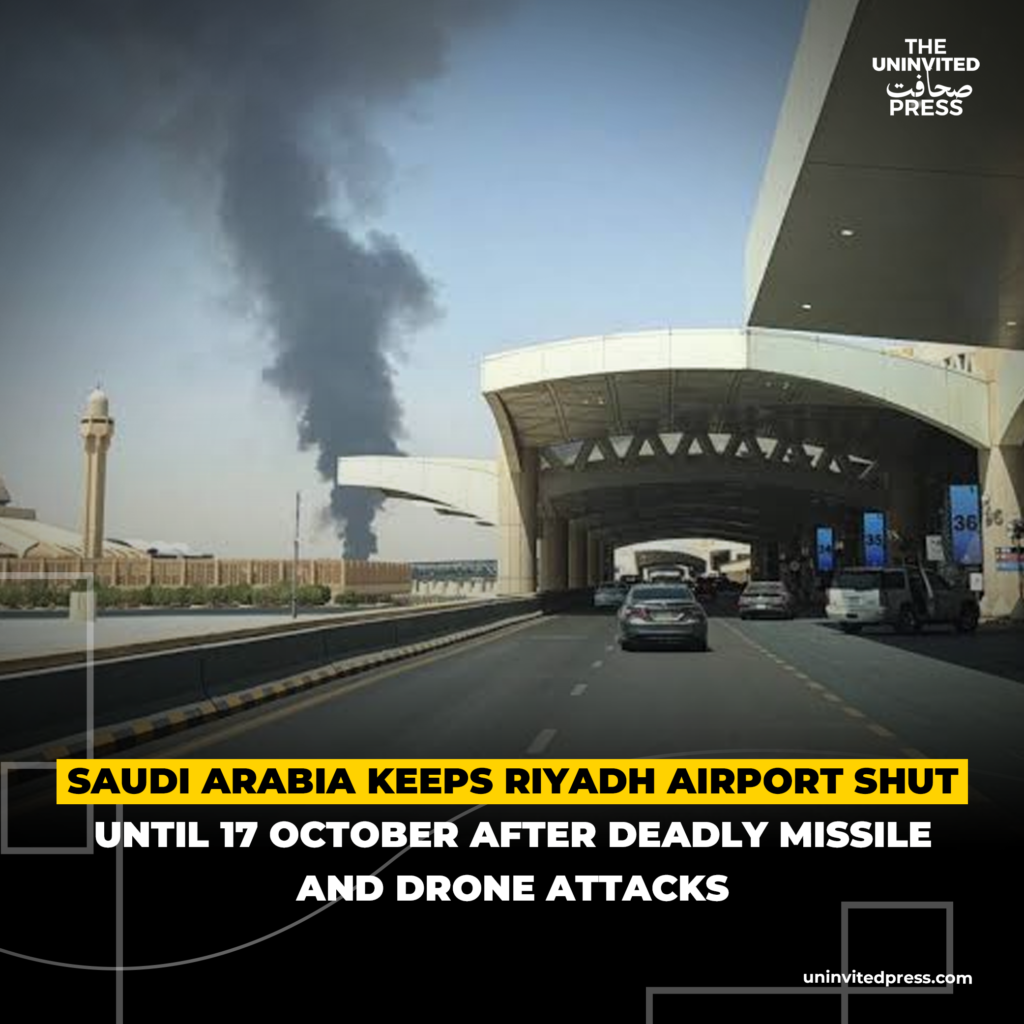
King Khalid International remains shut as Yemen’s Iran-aligned group launches successive missile and drone strikes, killing at least 14 and wounding hundreds.
Saudi authorities have extended the complete suspension of operations at King Khalid International Airport in the capital until 17 October, following a series of deadly missile and drone attacks claimed by Yemen’s Houthi movement that have left the skies over Riyadh largely empty.
The General Authority of Civil Aviation (GACA) said the extended shutdown was necessary “to allow for the completion of procedures to ensure the safety and operational readiness of the airport’s facilities.” A Notice to Airmen (NOTAM) confirms the airport will remain closed until 21:00 GMT on 17 October.
The decision comes after the deadliest attack on Saudi soil in more than a decade. On Saturday, 10 October, a strike on the airport killed 13 people and wounded more than 300 others. Closed-circuit television footage showed passengers queuing at a departure gate when a blast caused part of the ceiling to collapse, sending debris and smoke through the terminal. Among the dead were Saudi citizens as well as nationals from Bangladesh, the United States, Jordan, Palestine, Syria, Sudan and Egypt.
Houthi Attacks on Saudi Airports Disrupt Flights and Kill One:
A second attack the following day struck Terminal 4, killing one Pakistani resident and injuring 11 others, according to Saudi authorities. The Saudi-led coalition reported that an unidentified projectile caused a fire at the terminal while air defences intercepted a cruise missile nearby. Further strikes and interceptions continued into Monday, with Saudi forces saying they destroyed three ballistic missiles-one over Riyadh and two over Khamis Mushait in the southwest.
The Houthis, who control large parts of Yemen and receive support from Iran, claimed responsibility for the attacks. Military spokesperson Yahya Saree said the group had targeted the airport and other sites, including facilities linked to oil giant Saudi Aramco and Dammam’s King Fahd International Airport. The group renewed warnings to international airlines against operating flights to or over Saudi Arabia, declaring the kingdom’s airports a “theatre of operations.”
The disruption has been severe. Cirium data showed nearly half of all scheduled departures across Saudi Arabia cancelled or unoperated on Monday. Airlines including Lufthansa Group, Air France-KLM, Etihad and others have extended flight suspensions to Riyadh, Jeddah and Dammam, some lasting until the end of the month. European aviation regulators have widened airspace warnings, and aviation analysts have advised carriers to avoid southern Middle East corridors entirely.
The attacks mark a sharp escalation in the long-running conflict in Yemen. Saudi Arabia leads a military coalition that has backed the internationally recognised Yemeni government against the Houthis since 2015. A fragile ceasefire that had reduced hostilities in recent years has unravelled, with the Houthis intensifying cross-border strikes on Saudi infrastructure after advances on the ground.
Houthi Attacks Deepen Saudi Airport Crisis:
Saudi officials have sought to project continuity, allowing a major energy conference in Riyadh to proceed despite the airport closure. Yet the strikes have exposed vulnerabilities in the kingdom’s air defence systems, which have struggled to intercept mixed waves of drones and missiles. Regional analysts note that the use of drones to saturate defences may have helped subsequent missiles penetrate.
The human and economic toll continues to mount. Hundreds of wounded remain in hospitals, some in critical condition. Airlines and passengers face widespread cancellations, while the broader Middle East aviation network absorbs secondary delays and route diversions. For ordinary Saudis and expatriates, the once-routine journey through Riyadh’s main gateway has become fraught with uncertainty.
As the airport remains shuttered and Houthi threats persist, the crisis underscores the fragile security environment across the Arabian Peninsula and the enduring human cost of a conflict that has already devastated Yemen for more than a decade.