

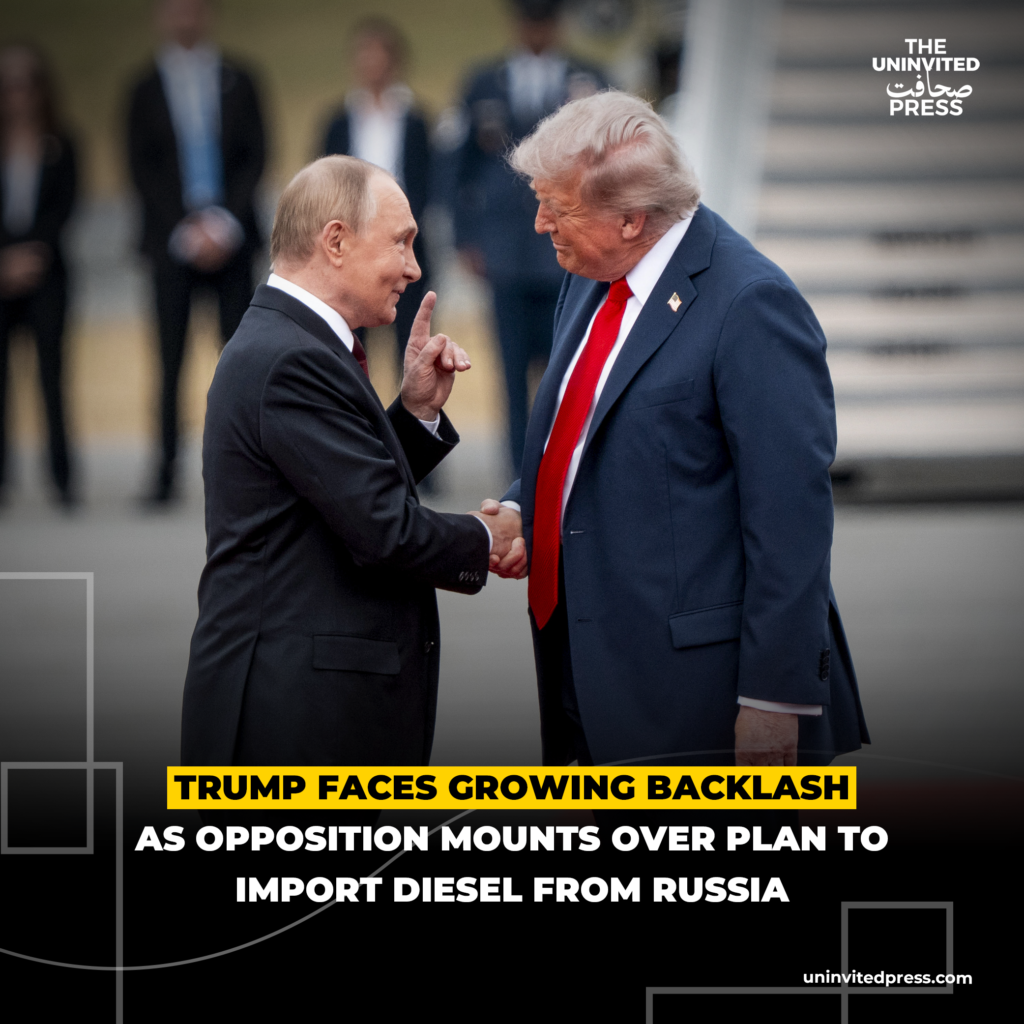
Bipartisan lawmakers, Ukraine and European allies condemn deal that eases sanctions and risks funding Moscow’s war effort amid soaring fuel prices.
United States President Donald Trump is confronting intensifying bipartisan criticism and international condemnation over his administration’s decision to allow large-scale imports of Russian diesel, a move critics say undermines years of sanctions policy and provides a financial boost to Moscow while its war in Ukraine continues.
Trump announced on Truth Social that he had held a “highly successful discussion” with Russian President Vladimir Putin, during which Moscow agreed to release more than 300,000 tonnes of diesel “immediately” to the American and global marketplace. Further shipments of 500,000 tonnes in November and one million tonnes shortly thereafter were promised, with an additional three million tonnes potentially following “within a short period,” depending on the condition of Russian refineries damaged by Ukrainian attacks.
US Senators Oppose Trump’s Russian Fuel Deal:
The US Treasury Department quickly issued a temporary general licence suspending certain sanctions on Russian diesel exports until 7 April 2027, enabling the sales, deliveries and imports. Trump framed the arrangement as essential for lowering diesel prices that have surged amid the ongoing conflict involving Iran, Israel and the United States, as well as disruptions linked to the Russia-Ukraine war. “Lower prices for Americans, especially our Great Farmers, Ranchers, and Truckers, is my Greatest Priority,” he wrote.
The announcement has triggered sharp pushback at home and abroad. A bipartisan group of seven US senators-Republicans Susan Collins, Lisa Murkowski, Thom Tillis and John Curtis, alongside Democrats Jeanne Shaheen, Richard Blumenthal and Ron Wyden-issued a joint statement on Sunday demanding that the administration “immediately reverse course.” They argued the deal violates a 2022 congressional ban on Russian energy imports, enacted specifically “to prevent American dollars from financing Putin’s brutal war against Ukraine.”
“The United States should not provide Putin with a financial lifeline while Russia continues to kill Ukrainian civilians,” the senators said. They noted that the administration had neither consulted Congress nor provided the required justification under the statute. Senator Tillis went further in public comments, suggesting the arrangement may be illegal and warning of “deadly consequences” by signalling reduced pressure on Moscow.
Republican Representative Don Bacon of Nebraska, a consistent critic of Russia’s invasion, called buying Russian fuel “the wrong answer” even while acknowledging the need for lower prices for farmers and truckers. House members have begun circulating draft legislation, including a proposed “Ronald Reagan Peace Through Strength Act,” aimed at blocking purchases of Russian oil and related products.
Trump’s Russian Diesel Deal Sparks Backlash from Ukraine and Europe:
Ukrainian President Volodymyr Zelenskyy denounced the deal as a “gift to Putin” and “an investment in a war that must be ended, not prolonged.” He warned that Russia would “repay” any easing of pressure “with further terror and perfidy.” European officials echoed the concern. The EU’s foreign policy chief, Kaja Kallas, stated that suspending sanctions “provides Moscow with more revenues to wage war” and affirmed that Europe would not follow suit, with foreign ministers preparing additional sanctions packages.
The timing is politically sensitive. Diesel prices in the United States have climbed sharply-reaching levels around $6.28 per gallon in recent days according to industry data-driven largely by the wider Middle East conflict that began earlier in 2026, compounded by constraints on Russian refining capacity. Trump has repeatedly prioritised bringing energy costs down ahead of the 3 November midterm elections, in which Republicans are fighting to retain control of Congress. Analysts, however, have expressed scepticism that the volumes promised will meaningfully ease global tightness, noting that Russia has at times restricted its own diesel exports and that its refineries remain under pressure from Ukrainian strikes.
The deal marks a stark reversal of policy. Just weeks earlier, Trump signed legislation authorising fresh sanctions and tariffs on nations importing Russian oil and gas. The 2022 ban on direct Russian energy imports into the United States had stood largely intact under both the previous and current administrations until the new licence was issued. Critics argue the move undercuts the very leverage Washington has sought to apply against Moscow’s war economy.
Russian officials have welcomed the development. Deputy Prime Minister Alexander Novak confirmed the volumes and said Moscow was lifting export restrictions ahead of schedule, while Kremlin statements emphasised readiness to supply oil and petroleum products to US and global markets. An envoy for Putin publicly praised the emerging energy cooperation. As opposition hardens in Congress and among key allies, the White House has so far pointed back to Trump’s public statements emphasising price relief for American consumers and industry.