

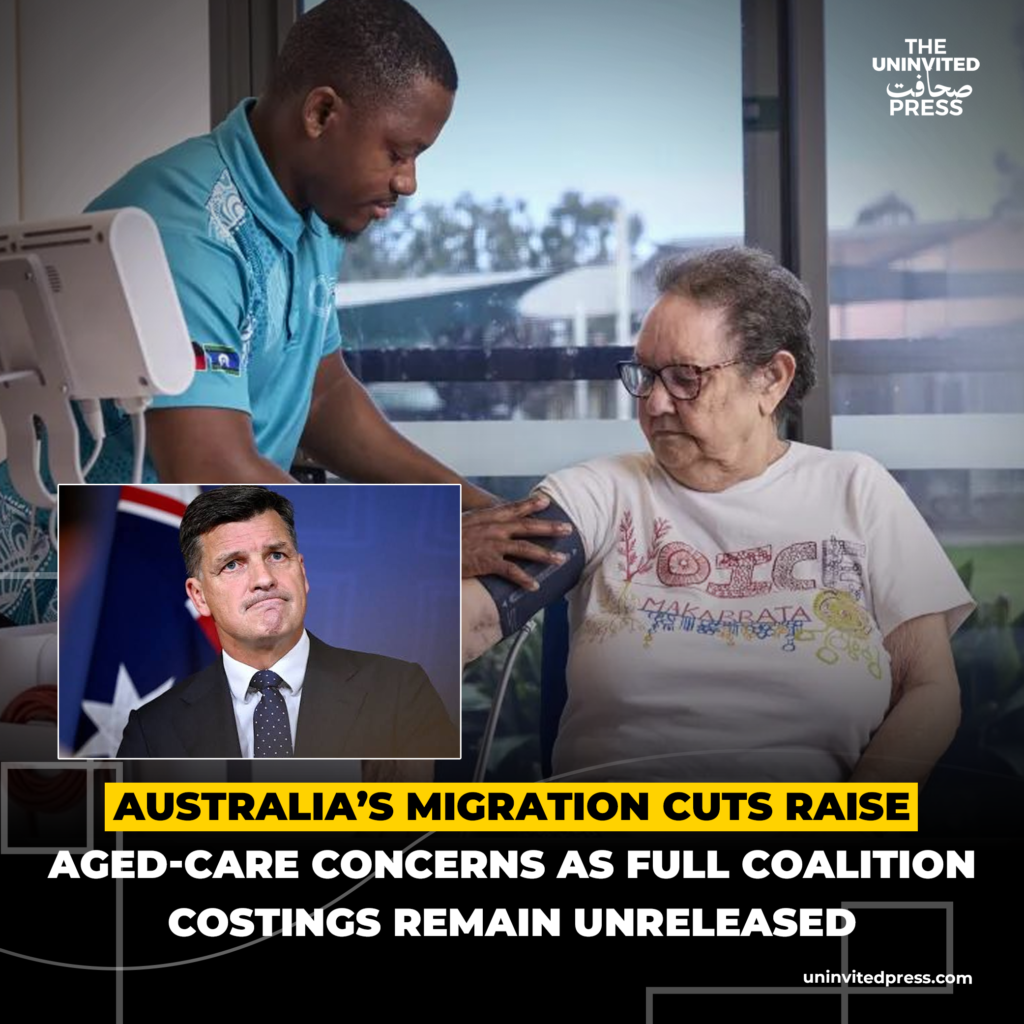
Opposition’s plan to slash net overseas migration to 100,000 and cut temporary visas by 650,000 sparks warnings of deeper workforce shortages in a sector already heavily reliant on migrant labour.
Australia’s opposition Coalition has unveiled plans for what it describes as the biggest cut to immigration in the country’s history, proposing to slash net overseas migration to about 100,000 people a year for its first two years in office. The policy has immediately raised alarms in the aged-care sector, which relies heavily on temporary migrant workers, while questions mount over the absence of full independent costings to support the Coalition’s claim that the plan would be budget-neutral.
Opposition Leader Angus Taylor announced the policy this week, aiming to reduce the stock of temporary migrants by roughly 650,000 over four years. Net overseas migration would later rise to 130,000 in the third year and about 160,000 in the fourth, after which it would be tied to the pace of housing completions. The permanent migration programme would remain steady at around 185,000 places, while the Coalition says it would expand higher-skilled temporary visas by about 100,000, including new specialist and project-specific pathways. Temporary graduate visas would be abolished, international student commencements cut, and bridging visas sharply reduced.
Aged Care Faces Migrant Worker Shortage:
Taylor has insisted the plan would protect critical sectors. “We’ve created transition arrangements and exemptions for health and aged care workers as part of the plan,” he told reporters. He later confirmed that aged-care workers would be included in a limited cohort of post-study transitional visas (around 10,000 places a year, also covering certain PhD and regional students) and that more skilled visa places would be directed toward the sector. Many temporary visa holders, however, would still need to leave Australia and reapply offshore, and future workers would have to qualify under skilled visa criteria.
Aged-care leaders say the details remain worryingly thin. Ageing Australia CEO Tom Symondson has warned that the sector “couldn’t exist” without its migrant workforce. A 2024 Department of Health survey found that more than one in five aged-care workers held temporary visas; about 20 percent of those were on temporary graduate visas, the category the Coalition plans to scrap. Symondson has estimated that roughly 70,000 direct-care staff are on temporary visas of one form or another. The sector also depends on large numbers of non-direct-care staff such as cleaners and kitchen workers, whose visa status under the new rules is unclear.
Business groups, universities and some economists have echoed the concerns, arguing that deep cuts risk worsening existing skills shortages, slowing economic growth and damaging Australia’s ability to attract talent. Acting Prime Minister Richard Marles has accused the Coalition of “policy chasing One Nation rather than policy in the national interest,” warning of impacts on agriculture, aged care and even defence.
Migration Plan Faces Budget and Aged-Care Concerns:
The Coalition maintains the overall package would be budget-neutral or slightly positive, claiming the loss of lower-tax-paying temporary graduates and other temporary migrants would be offset by higher-earning skilled workers who, on average, contribute significantly more in tax. Taylor has said the party worked with the Parliamentary Budget Office during the policy’s development and that full costings will be released before the next federal election. Coalition MPs have acknowledged, however, that a complete independent costing of the final package has not yet been published. Earlier PBO modelling on sustained reductions in net overseas migration suggested that cutting the intake by 40,000 people a year could worsen the federal budget bottom line by tens of billions of dollars over a decade, though the Coalition argues its shift toward higher-skilled migration changes the arithmetic.
Australia’s aged-care system faces structural pressure regardless of migration settings. The population is ageing rapidly, and independent analysis has projected a need for hundreds of thousands of additional workers in the coming decades. Domestic training pipelines have not kept pace with demand, leaving the sector dependent on overseas labour, particularly in regional areas. Existing pathways such as the Aged Care Industry Labour Agreement have so far delivered only limited numbers of new sponsored workers, many of them people already in Australia.
Labor’s approach differs. The government is targeting net overseas migration of 245,000 this financial year and 225,000 by 2027-28, with priority processing for healthcare, construction, education and other critical occupations. It has also emphasised retaining workers already in the country.
The Coalition’s plan arrives against a backdrop of broader political competition on migration. One Nation has proposed even deeper cuts, including periods of net-negative migration. Public debate has focused on housing pressures, infrastructure strain and living standards, with the opposition framing its policy as restoring balance after years of high temporary migration.
Critics counter that abrupt reductions without clear, detailed protections risk leaving vulnerable older Australians short of carers. The aged-care sector continues to press for greater clarity on exactly how many workers would be affected, what the transition arrangements would look like in practice, and how non-direct-care roles would be treated. Until full costings and operational details are released, those questions are likely to remain at the centre of the political contest.