

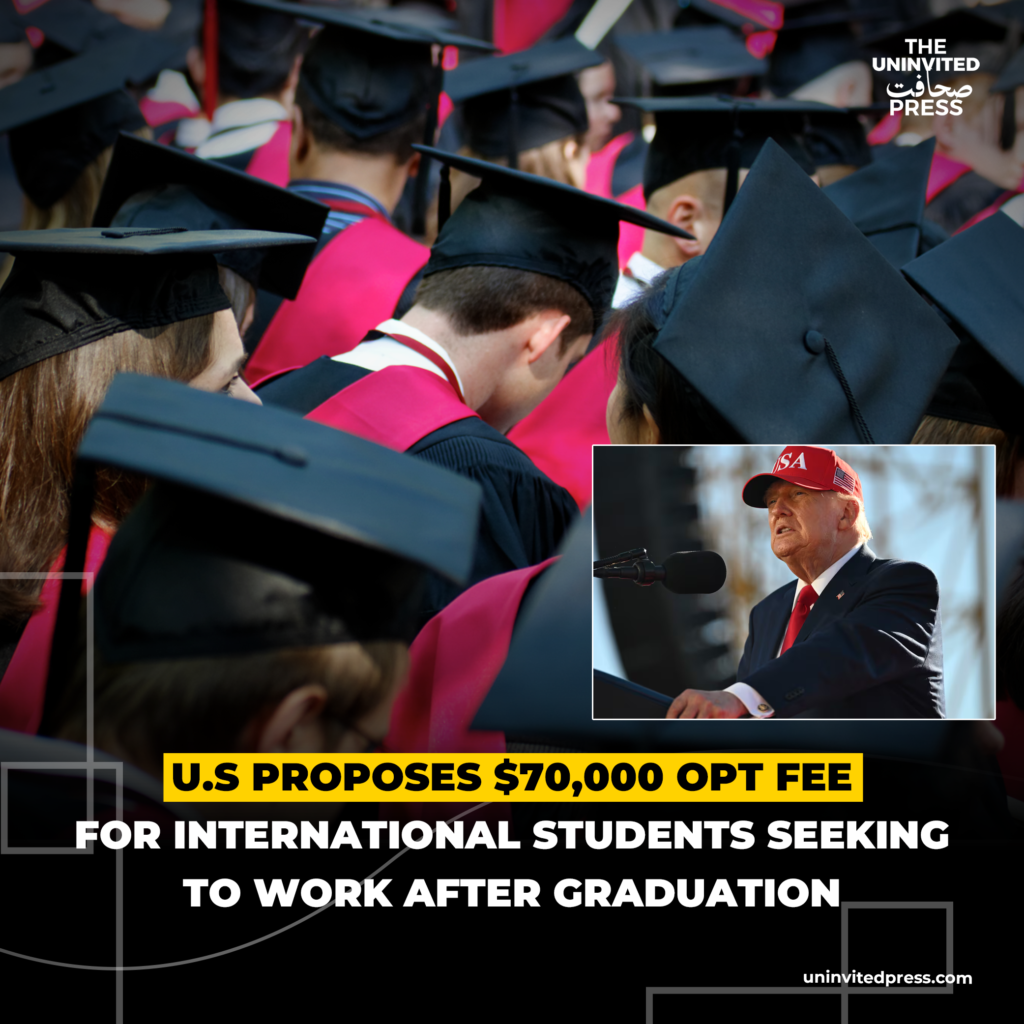
Trump administration move would require universities to pay steep charges for Optional Practical Training recommendations, sparking concerns over impact on higher education and foreign talent pipeline.
The United States Department of Homeland Security has proposed requiring universities and colleges to pay a $70,000 fee for each international student they recommend for Optional Practical Training (OPT), a popular programme that allows foreign graduates to work in the country in jobs related to their field of study. An additional $30,000 would apply for subsequent recommendations, including the 24-month extension available to graduates in science, technology, engineering and mathematics (STEM) fields.
US Proposes $70,000 OPT Fee for International Students:
The proposed rule, announced on Wednesday, marks one of the most significant attempts by the Trump administration to restrict pathways for international students to remain and work in the US after completing their degrees. Under current rules, F-1 visa holders can generally receive up to 12 months of temporary work authorisation through OPT, with eligible STEM graduates able to extend that period by two years. Students currently face only modest filing fees of roughly $470-$520.
If finalised, schools certified under the Student and Exchange Visitor Program would have to pay the new fees before designated school officials could enter OPT recommendations into the government’s tracking system. US Citizenship and Immigration Services would not approve employment authorisation without proof of payment. The fees would apply prospectively to new recommendations and would take effect 60 days after any final rule is published. DHS has opened a public comment period, typically lasting 30 to 60 days.
DHS framed the measure as necessary to combat fraud and abuse, strengthen the integrity of the immigration system and protect American workers. In a statement, the department described OPT as having become a “pipeline for cheap foreign labor” and said the programme was “never meant to be a back door into the American workforce, a subsidy for cheap labor, or a prize for those who game the system.” Officials argued the higher costs would force institutions to exercise greater oversight and selectivity when recommending students for the programme.
Critics, including higher-education associations and business groups, warn the fees could severely curtail access to OPT and damage the competitiveness of US universities and industries that rely on international talent. American colleges and universities recruit large numbers of overseas students, who contribute significant tuition revenue. Tech companies and other employers frequently hire OPT participants for technical roles, viewing the programme as a pipeline for skilled workers who later transition to H-1B visas or other long-term status.
OPT Fee Proposal Raises Concerns for International Students:
Fanta Aw, chief executive of NAFSA: Association of International Educators, said the proposal creates “deep uncertainty for international students” and noted research showing that international graduates often create jobs for US workers rather than displacing them. Industry observers point out that roughly 300,000 to more than 400,000 students have participated in OPT in recent years, with India the largest source country, accounting for around 31 percent of all international students in the US in the 2024-25 academic year.
Although the formal obligation to pay rests with the schools, the proposal allows institutions to recover the costs from students, employers or other sources. In practice, many universities may become far more selective in recommending OPT or pass the expense on, potentially pricing out large numbers of graduates. A student pursuing both standard OPT and a STEM extension could effectively trigger up to $100,000 in fees.
The move forms part of a broader Trump administration effort to tighten rules around international students and temporary work visas. It follows earlier proposals for large H-1B fees and other restrictions, some of which have already faced legal challenges. Higher-education groups, business associations and advocacy organisations are expected to submit strong comments opposing the OPT fees and may pursue court action if the rule is finalised.
The proposal is not yet in force. DHS must review public feedback before deciding whether to issue a final rule. Until then, the existing OPT framework remains unchanged, but the announcement has already heightened anxiety among international students, universities and employers who depend on the programme as a bridge between study and employment in the United States.