

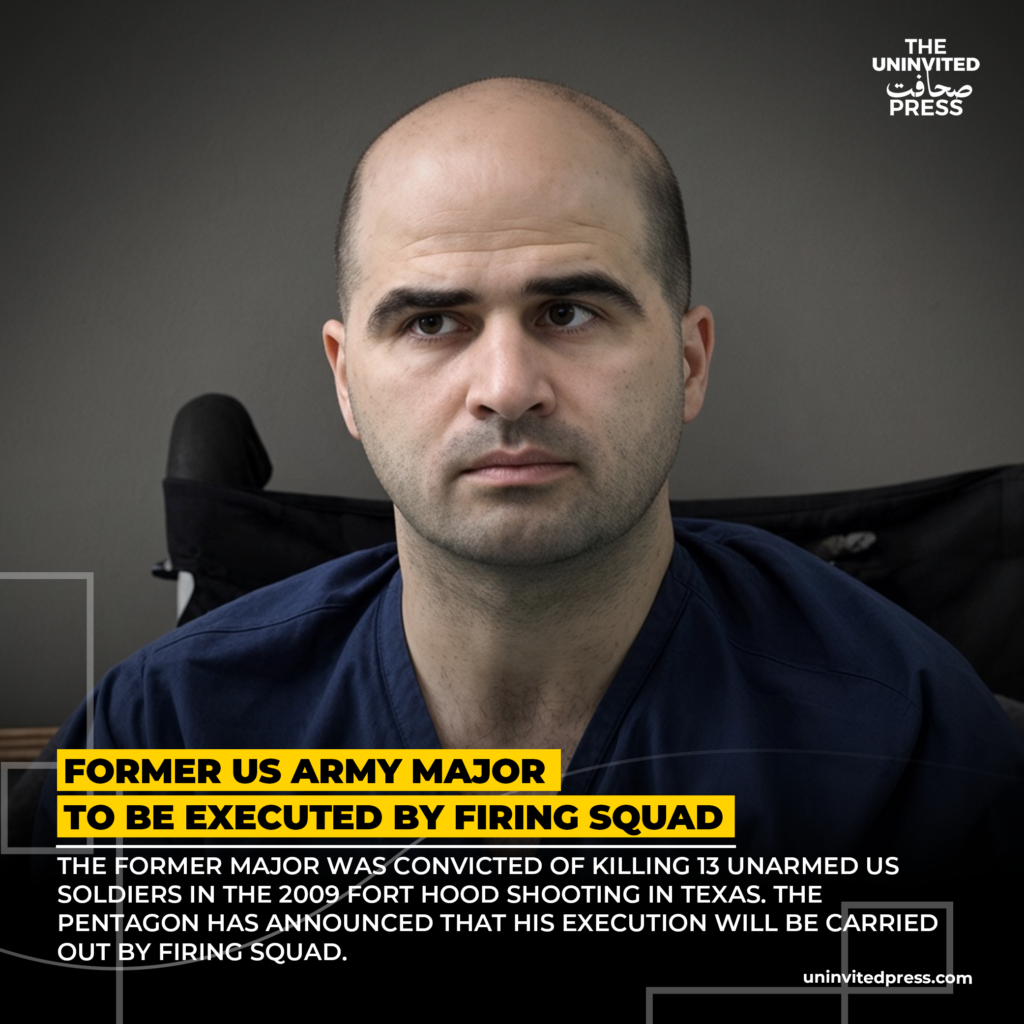
Nidal Hasan, convicted of killing 13 in 2009 attack, faces first Army firing-squad execution since World War II after presidential approval.
The United States military is preparing to carry out its first execution in more than six decades, with former Army Major Nidal Malik Hasan set to die by firing squad for the 2009 mass shooting at Fort Hood, Texas, that killed 13 people and wounded dozens more.
Pentagon spokesperson Sean Parnell announced on Monday that Defence Secretary Pete Hegseth recommended the method and President Donald Trump approved it. “Judgement day for Hasan has finally come,” Parnell wrote on social media, describing Hasan as a “convicted terrorist” and “jihadist” who opened fire on unarmed American soldiers while shouting “Allahu Akbar.”
Hasan, a US-born citizen of Palestinian descent and former Army psychiatrist, was 39 at the time of the attack. On 5 November 2009, he walked into the Soldier Readiness Processing Center at the sprawling central Texas base, where troops were undergoing medical checks ahead of deployment to Afghanistan and Iraq. Armed with a laser-sighted semiautomatic handgun, he opened fire, killing 12 active-duty soldiers and one civilian employee and injuring 32 others. He was shot and partially paralysed by responding police officers.
Hasan’s Death Sentence Moves Forward:
During his 2013 court-martial, Hasan largely conducted his own defence, admitted he was the gunman, and made little effort to contest the charges. He told the military court that he had “switched sides” and acted to protect Muslims and the Taliban leadership from what he described as an illegal US war. A panel of 13 officers convicted him of 13 counts of premeditated murder and 32 counts of attempted premeditated murder, unanimously recommending the death penalty. He has remained on military death row at Fort Leavenworth, Kansas, ever since.
Under the Uniform Code of Military Justice, a death sentence imposed by court-martial cannot be carried out without presidential approval. Hasan’s case wound through years of military appeals. The US Court of Appeals for the Armed Forces upheld the conviction and sentence, and the Supreme Court declined to review the matter in March 2025. In September 2025, Hegseth publicly stated he was seeking presidential authorisation for the execution.
The choice of firing squad marks a significant departure. The US military has not executed anyone since 1961, when Army Private John Bennett was hanged at Fort Leavenworth for the rape and attempted murder of an 11-year-old girl. The last use of a firing squad by the Army occurred during World War II, when Private Eddie Slovik was executed in France in 1945 for desertion. Recent changes under the Trump administration expanded permissible federal execution methods to include firing squad, electrocution and gas asphyxiation alongside lethal injection.
Hasan Faces December Execution:
Acting Army Secretary Adam Telle has been tasked with setting the precise time and place. Subsequent reports indicated the execution is scheduled for 3 December 2026 at Fort Hood itself-the same base where the original attack occurred-according to communications shared with victims’ families.
Human rights organisations that oppose capital punishment have criticised the decision. Groups such as Death Penalty Action described the move as reflecting a broader embrace of the state’s power to kill. The United States remains one of the few Western countries that retains the death penalty, a practice long condemned by many international bodies and most of its European allies as incompatible with human rights standards.
Hasan, now 56 and confined to a wheelchair, could still attempt further legal challenges in civilian federal courts, a step that has delayed previous military death sentences. Whether those efforts succeed remains unclear. For the families of the victims and for the broader debate over military justice and capital punishment in the United States, the case of Nidal Hasan has reached a decisive and highly unusual stage.