

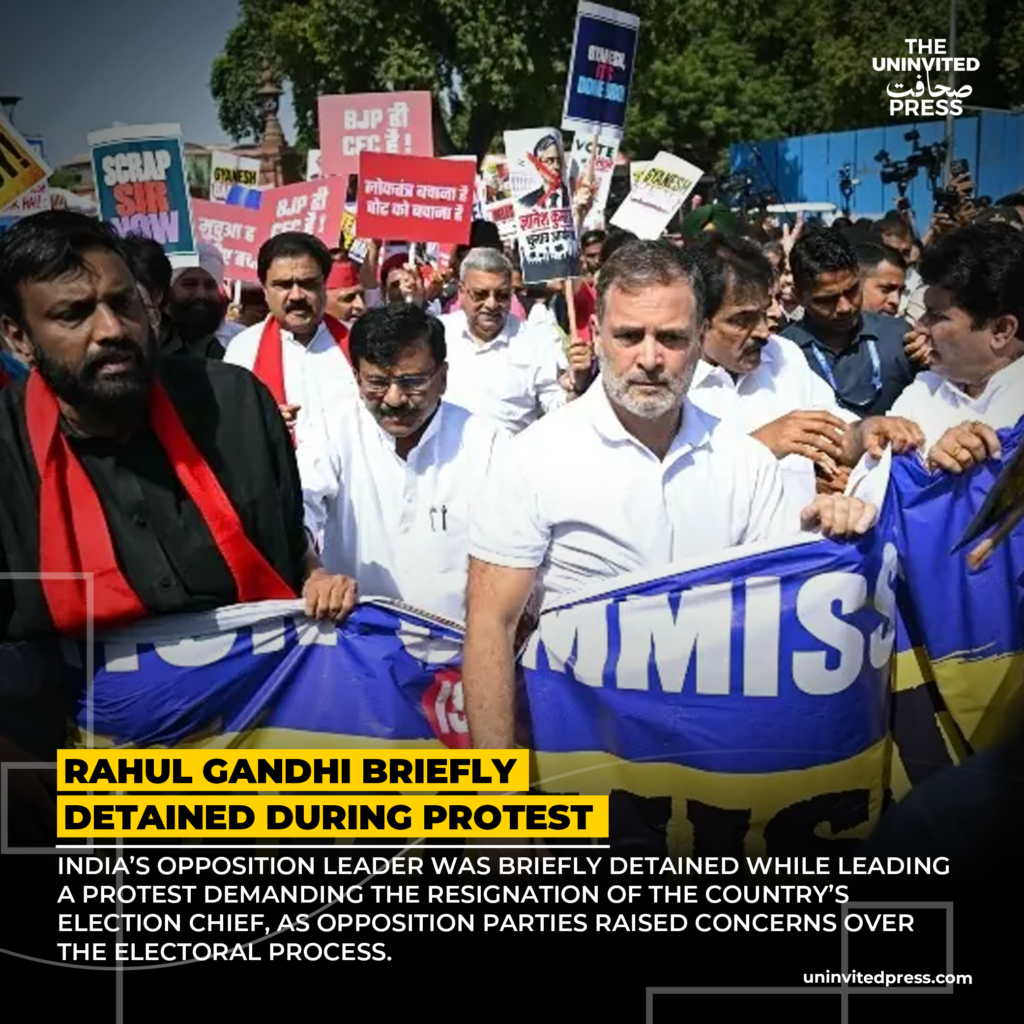
Congress leader and other lawmakers held after sit-in demanding resignation of Chief Election Commissioner over alleged voter list irregularities.
Indian opposition leader Rahul Gandhi was briefly detained by Delhi police on Tuesday after leading a protest march and hours-long sit-in demanding the resignation of the country’s Chief Election Commissioner, as opposition parties raised fresh concerns over the integrity of the electoral process.
Gandhi, the leader of the opposition in the Lok Sabha and a senior figure in the Congress party, along with his sister Priyanka Gandhi Vadra and dozens of other lawmakers from the opposition INDIA bloc, attempted to march from Parliament towards the Election Commission of India (ECI) headquarters in central New Delhi. The protesters were stopped by heavy police barricades near the NITI Aayog office and the All India Radio (Akashvani Bhawan) complex, adjacent to the election commission’s offices.
Police later moved in after a prolonged standoff lasting eight to nine hours. Gandhi, Priyanka Gandhi Vadra and several other members of parliament were taken into custody and transported to the New Police Lines at Kingsway Camp. They were released after approximately two hours. Delhi Police said the detentions were carried out “in accordance with the law to maintain peace and in the interest of public safety.”
Opposition March Targets India Election Chief:
The demonstration centred on demands for the resignation of Chief Election Commissioner Gyanesh Kumar. Opposition parties accused the election body of irregularities in a Special Intensive Revision (SIR) of electoral rolls, claiming large-scale deletions of voter names and additions that they say disproportionately benefit the ruling Bharatiya Janata Party (BJP) of Prime Minister Narendra Modi. Gandhi and other leaders have repeatedly described the process as “vote chori”-vote theft-and alleged it undermines India’s democratic foundations.
Before the detention, Gandhi climbed multi-layered steel barricades, waved the national flag, and posted on social media: “Gyanesh, it’s done bro. Time to resign.” He and other Congress leaders then entered the Akashvani Bhawan premises, sat on mattresses under a tree, and refused to disperse, insisting on a meeting with the election commissioners. “We will sit as long as we have to,” Gandhi said. “I am standing here to protect democracy.”
Leaders from parties including the Trinamool Congress, Samajwadi Party, Nationalist Congress Party (Sharad Pawar faction), Shiv Sena (UBT), the Left and the Rashtriya Janata Dal took part in the march. Some parties within the broader opposition, such as the DMK and Aam Aadmi Party, stayed away. The Biju Janata Dal, which is not part of the INDIA bloc, also joined.
The BJP dismissed the protest as an attempt to mislead the public with “baseless claims.” Party spokesperson Sudhanshu Trivedi accused Congress lawmakers of creating unnecessary controversy. The Election Commission later stated that it had received a request for a meeting late on Tuesday but that the proposed venue did not conform to its protocol.
Election Row Deepens Political Tensions:
The incident marks a significant escalation in the opposition’s campaign against the election commission. Critics of the government have long raised questions about institutional independence under the Modi administration, particularly regarding electoral processes. Supporters of the government and the election commission maintain that revisions to voter lists are routine administrative exercises aimed at improving accuracy and that the opposition is seeking to deflect attention from its own political setbacks.
Gandhi has framed the issue in stark terms, calling the alleged manipulation of voter rolls “treason” and accusing the government of having “stolen votes to hijack the country.” The opposition is demanding the scrapping of the SIR exercise, the restoration of deleted voter names, and greater transparency in the electoral process.
As India continues to navigate intense political polarisation ahead of future elections, Tuesday’s detentions highlight deepening tensions over the credibility of the institutions meant to safeguard the world’s largest democracy.