

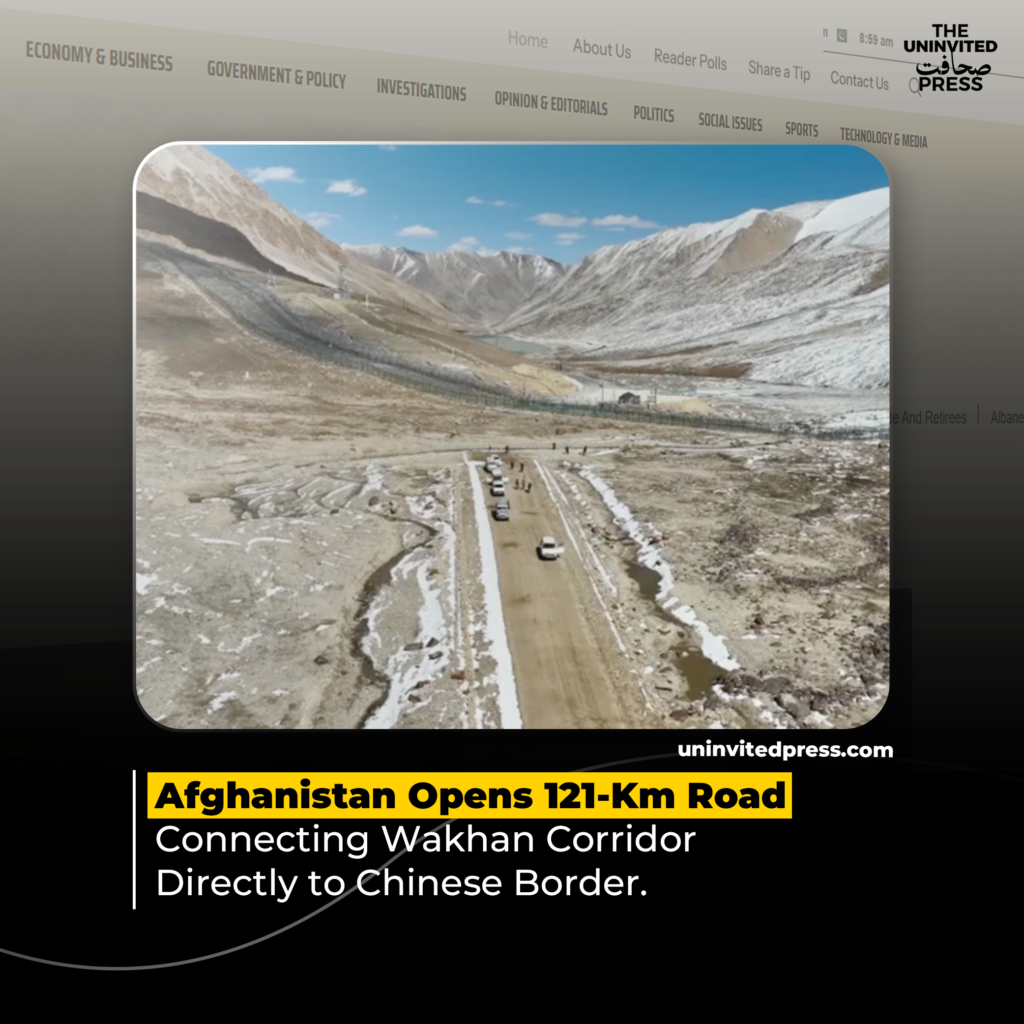
Taliban authorities inaugurate gravel route in remote Badakhshan province, hailing it as a step toward direct land links and local development, though full commercial use remains distant.
Afghanistan’s Taliban administration has inaugurated a 121-kilometre gravel road through the remote Wakhan Corridor, establishing a direct overland connection from the country’s northeastern Badakhshan province to the Chinese border.
The road, which runs from the Broghil (also known as Baroghil or Sarhad-e Broghil) area through the Waghjir Valley in the Pamir region to the zero point near the Chinese border at the Wakhjir Pass, was officially opened on Sunday, 4 October 2026. Officials described the project as a significant step for economic development, regional connectivity and improved access for isolated communities.
Wakhan Road Built for $5.5 Million to Boost China Link:
According to the Ministry of Rural Rehabilitation and Development, the road was built in two phases at a total cost of 365 million Afghanis (approximately $5.5 million) drawn from the Islamic Emirate’s development budget. Construction was carried out by Afghan engineers without foreign advisers, officials said. The route includes 66 culverts, four major bridges and between 3,100 and 4,000 metres of retaining walls to stabilise the difficult mountainous terrain. The gravel road is reported to be between seven and 10 metres wide.
The inauguration ceremony was attended by Mullah Abdul Latif Mansour, the minister of rural rehabilitation and development; Mullah Rahmatullah Najib, the governor of Badakhshan; and other senior officials. Deputy spokesperson Hamdullah Fitrat confirmed the road’s completion and opening for use, noting that it provides practical benefits for local residents.
Mansour described the project as holding political, strategic and economic importance. He said it would ease the hardships of people living in the Wakhan and Pamir areas and could eventually support wider transit and trade links with China. Local officials, including the district governor of Wakhan, expressed satisfaction that a road once considered unimaginable had been completed, while calling for further development projects, particularly in health services.
Afghanistan Opens Wakhan Road to China Border:
The Wakhan Corridor is a narrow strip of Afghan territory in Badakhshan that forms Afghanistan’s only direct geographical border with China. For decades, successive Afghan governments have viewed the high-altitude region as a potential gateway for trade and transit that could reduce dependence on traditional routes through Pakistan and other neighbours.
Taliban officials have presented the road as the first overland transit link between Afghanistan and China, arguing it could expand commercial ties and strengthen regional connectivity. The corridor also holds tourism potential, with officials suggesting visitor numbers may rise as further infrastructure is developed.
However, analysts and some reports caution that the road alone does not create a fully operational commercial corridor. The absence of official customs posts, loading facilities and related border infrastructure means regular trade traffic is not yet feasible. China has previously indicated that security conditions would need to improve before major investment or formal border arrangements proceed. Badakhshan has experienced sporadic security incidents in recent years, though provincial officials insisted the area is now secure.
The opening comes as the Taliban administration continues to prioritise domestic infrastructure projects in remote provinces amid limited international recognition and constrained external funding. Some Afghan officials have framed the road as a demonstration of self-reliance and progress in reconstruction.
Reports have also noted Pakistani concerns about the corridor, with references to potential impacts on the China-Pakistan Economic Corridor (CPEC). Taliban ministers have rejected suggestions of security threats in the area and criticised what they described as external interference in Afghan development efforts. While the new road marks a tangible improvement in physical connectivity for one of Afghanistan’s most isolated regions, its transformation into a meaningful trade artery will depend on additional investment, bilateral arrangements with China, and sustained security.