

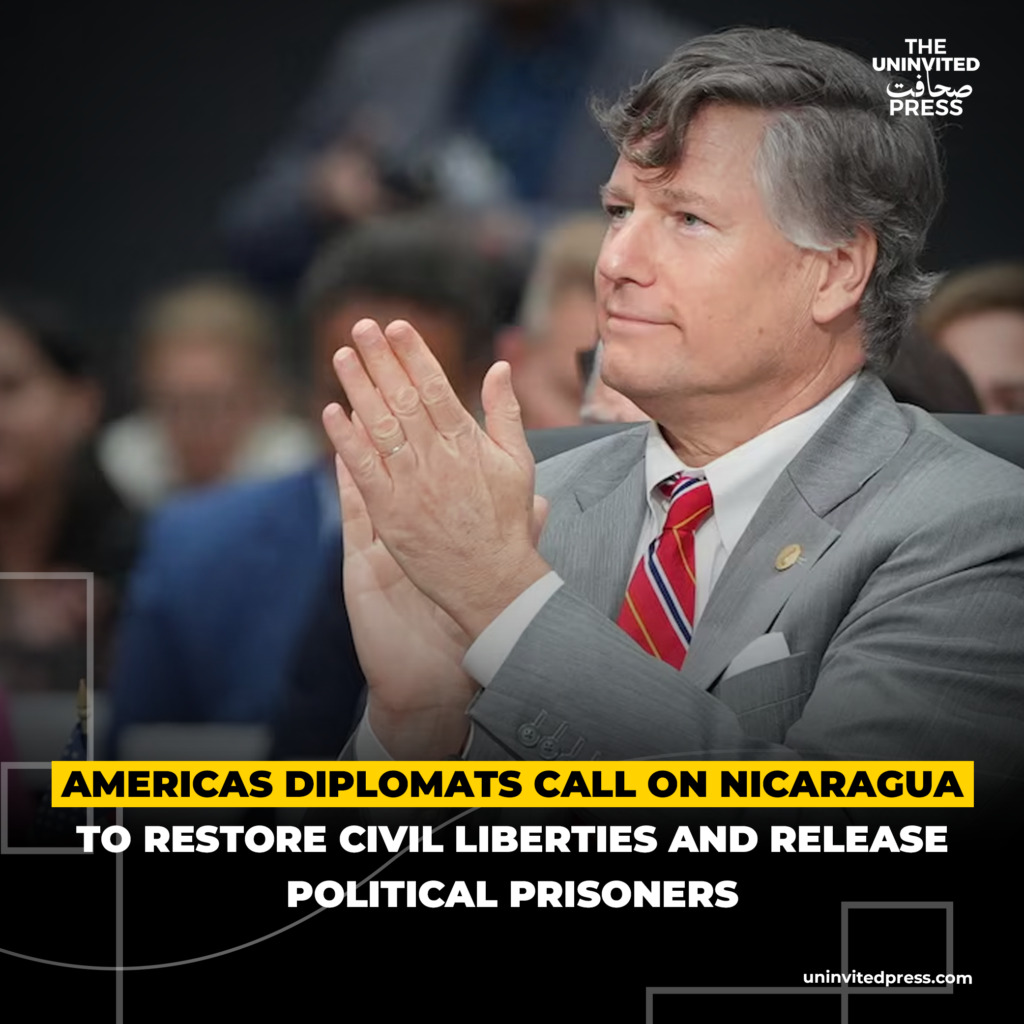
OAS approves resolution after Managua bans opposition from elections, creating task force to push for democratic reforms and accountability.
Diplomats from across the Americas have issued a joint call for Nicaragua to release all political prisoners, restore fundamental civil liberties and create conditions for free and fair elections, approving a resolution that opens the door to potential coordinated regional action.
The Organization of American States (OAS) adopted the measure on Friday during a rare meeting of foreign ministers in Washington-the first such gathering in seven years. The resolution demands that authorities under co-presidents Daniel Ortega and Rosario Murillo take “immediate, concrete and verifiable steps” to free detainees held on political grounds, disclose the whereabouts of people who have been forcibly disappeared, restore citizenship to those stripped of nationality, and reverse constitutional changes that have further concentrated power.
It also calls for the reinstatement of freedoms of expression, association, religion and peaceful assembly, and for independent media, civil society groups and cancelled institutions to resume operations. A ministerial follow-up group will engage with Nicaraguan officials and exiles before returning with recommendations for concrete measures within 90 days.
US Calls for Nicaragua to Restore Civil Liberties:
The decision comes after the Nicaraguan government last month barred the opposition from participating in future elections and following Ortega’s earlier declaration that the country would hold no further votes. Civil liberties have been tightly restricted since a wave of protests in 2018 that were met with a harsh crackdown. Human rights organisations have documented arbitrary detentions, forced exile, denationalisation of critics, confiscation of property and the near-total dismantling of independent civic space.
Nicaragua withdrew from the OAS in 2023 and has largely ignored previous regional and international criticism. The government maintains that its actions defend national sovereignty against external interference.
United States Deputy Secretary of State Christopher Landau, who attended the meeting on behalf of Washington, framed the crisis as a hemispheric security concern. “We all understand that the democratic crisis in Nicaragua isn’t solely an internal matter; to the contrary, the dictatorship endangers the peace and security of our hemisphere,” he said. Landau also accused “non-hemispheric” security services of training Nicaraguan police and sharing intelligence, and noted that Managua had rejected a newly appointed US ambassador.
OAS Urges Stronger Action on Nicaragua Crisis:
OAS Secretary-General Albert Ramdin expressed hope that the resolution would move beyond repeated verbal condemnations. “That has been said many times already. It is good to say this again collectively, but that cannot be the only outcome,” he told Media.
Attendance at the meeting was limited; most of the organisation’s 32 member states sent deputies or ambassadors rather than foreign ministers. The resolution itself stops short of imposing immediate sanctions, reflecting differences among member states over the strength of language and the framing of Nicaragua as a regional threat.
For Nicaraguan opposition figures and human rights defenders living in exile, the vote represents a renewed international focus on a country where independent political activity has been systematically dismantled. Yet previous diplomatic pressure has yielded only limited and often temporary results. Whether the new task force can translate collective concern into meaningful change on the ground remains an open question as the Ortega-Murillo government continues to consolidate control.
The resolution underscores growing regional unease over the erosion of democratic norms in Central America, even as Nicaragua maintains security cooperation with powers outside the Western Hemisphere. For the thousands of Nicaraguans who have fled repression or remain behind bars, the OAS call offers a formal statement of solidarity-but one whose practical impact will depend on the willingness of member states to follow words with sustained action.