

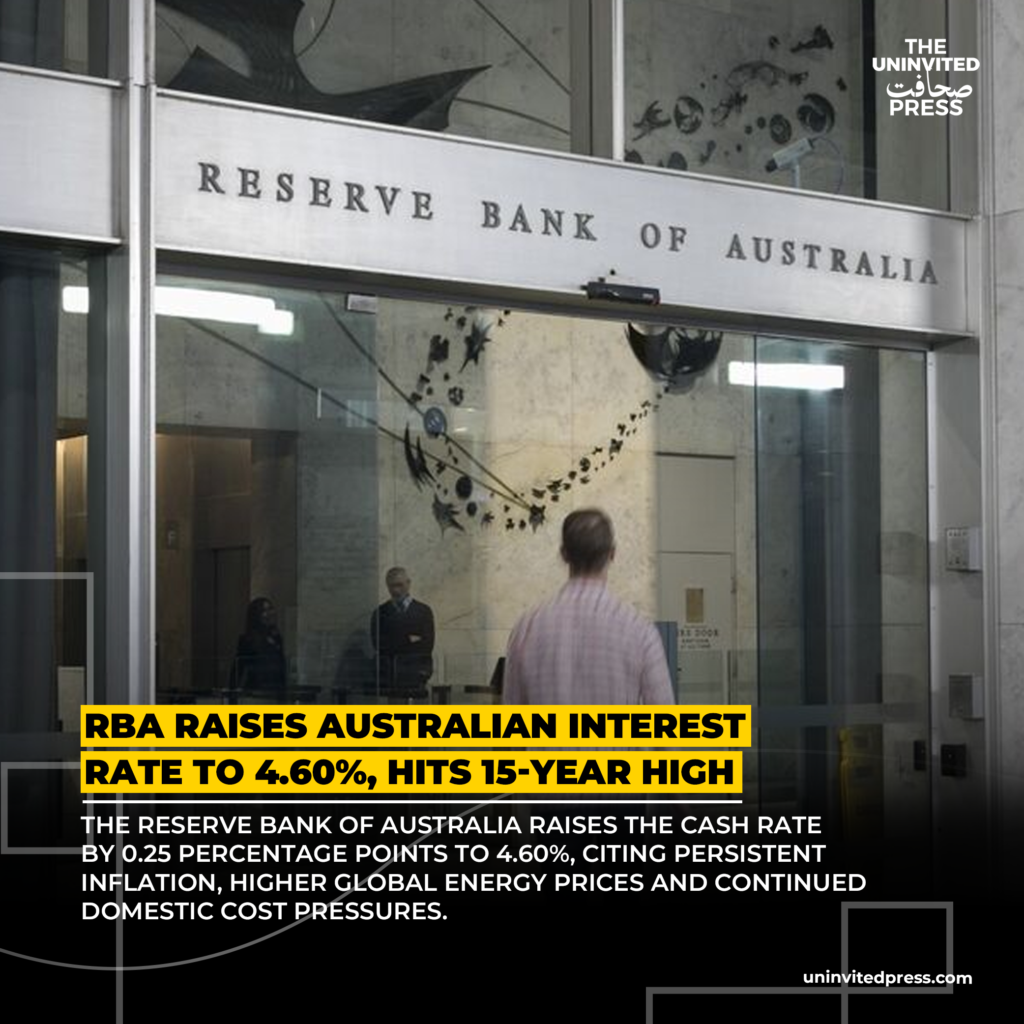
Reserve Bank lifts cash rate by 0.25 percentage points to 4.60%, citing elevated prices, higher global energy costs and domestic pressures.
Australia’s central bank has raised its benchmark interest rate to the highest level in 15 years, delivering a fourth increase of 2026 as it battles stubborn inflation.
The Reserve Bank of Australia (RBA) on Tuesday lifted the cash rate target by 25 basis points to 4.60 percent, up from 4.35 percent. The decision, which was unanimous, takes borrowing costs to their highest point since late 2011.
RBA Raises Rates as Inflation Remains High:
In its statement, the Monetary Policy Board said inflation remained elevated and that some of the upside risks flagged in August were materialising. It pointed to a broadening conflict in the Middle East that has pushed global energy prices much higher than earlier forecasts, rapid growth in global prices for technology-related goods driven by artificial intelligence demand, and continuing pressure on domestic capacity.
“Since the previous meeting, some of the upside risks to inflation are materialising,” the board said. “There remains pressure on domestic capacity.” It also noted weak productivity growth and uncertainties surrounding the housing market.
The three previous rate increases this year had already tightened financial conditions and the economy appeared to be slowing, the RBA said. However, inflation was still too high, and the board judged that a further tightening was warranted to support a return of inflation to its 2-3 percent target within a reasonable period.
“The Board will continue to do what it considers necessary to bring inflation sustainably back to target, including increasing the cash rate target further if needed,” the statement added.
The hike is expected to increase monthly mortgage repayments for many Australian households. Analysts estimated that an average owner-occupier loan of around $800,000 could see repayments rise by approximately $120 a month.
Core inflation has been running at about 3.6 percent, well above the RBA’s target range, while headline inflation has remained outside the band for an extended period. Australian firms continue to face cost pressures, with many either raising prices or considering doing so, according to the central bank’s consultations with businesses. Short-term inflation expectations have also stayed elevated.
Higher RBA Rates Add Pressure on Australian Households:
Governor Michele Bullock acknowledged the impact on households, saying the board knew the decision would hit some people hard, but expressed hope that once inflation is brought under control, the measures would prove worthwhile.
Markets had widely anticipated the move. The Australian dollar held steady after the announcement, while attention now turns to whether further increases will be required later in the year. The RBA’s remaining meetings are scheduled for early November and December.
The decision comes against a backdrop of global economic uncertainty, including elevated energy prices linked to geopolitical tensions and strong demand for technology goods. Domestically, the combination of resilient demand, capacity constraints and weak productivity has complicated the path back to price stability.
For millions of mortgage holders and businesses, the higher cash rate will translate into tighter financial conditions at a time when the housing market is already showing signs of softness. The RBA has signalled it will remain data-dependent and prepared to act further if inflation does not ease sufficiently.