

High court grants temporary win for key immigration policy while setting December arguments on its legality.
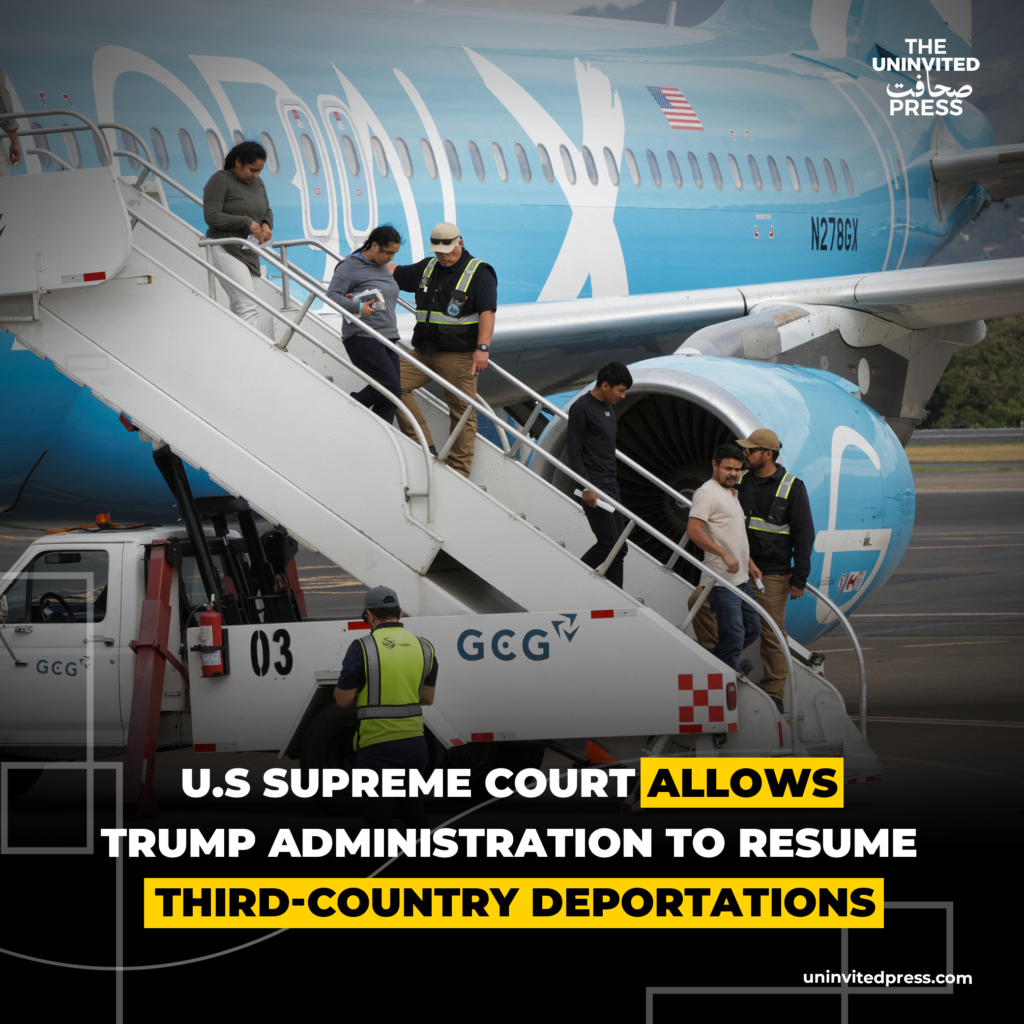
The United States Supreme Court has cleared the way for President Donald Trump’s administration to resume deporting migrants to countries other than their own, temporarily lifting a lower-court block on the controversial practice.
In an unsigned emergency order issued on Tuesday, the justices granted the Justice Department’s request to pause a ruling by a Boston-based federal appeals court that had found the “third-country” removal policy unlawful. The decision allows the Department of Homeland Security to continue sending people with final removal orders to nations where they may have no ties, without providing what lower courts described as meaningful notice or an opportunity to raise fears of persecution or torture.
The court’s three liberal justices-Sonia Sotomayor, Elena Kagan and Ketanji Brown Jackson-indicated they would have denied the administration’s request. The majority offered no explanation for its decision, which is typical in emergency rulings.
While the order restores the policy for now, the Supreme Court also agreed to fast-track the case and hear full oral arguments in December. A final ruling is expected next year.
Trump’s Third-Country Deportation Policy Faces Legal Challenge:
The third-country deportation programme has been a central tool in the Trump administration’s mass deportation agenda since early 2025. Under the policy, migrants who cannot be returned to their home countries-often because those nations refuse to accept them or because of protection claims-are sent instead to third countries that have agreed to receive them. Officials say destination countries provide assurances that the deportees will not face persecution or torture.
Human rights groups estimate that more than 25,000 migrants have been removed under the policy to about 29 countries, including Mexico, Costa Rica, Honduras, Liberia, Equatorial Guinea, the Central African Republic and South Sudan. The vast majority have gone to Mexico. Critics have raised serious concerns about conditions in some destination countries, citing reports of mistreatment, including allegations that some deportees in Equatorial Guinea were hooded, bound and beaten by police.
The legal challenge began with a class-action lawsuit filed by noncitizens who argued the policy violated due process and federal immigration law by denying them a meaningful chance to contest removal to a specific third country. In February, US District Judge Brian Murphy in Massachusetts ruled that affected immigrants were entitled to notice and an opportunity to raise protection claims. The First US Circuit Court of Appeals largely upheld that decision earlier this month, prompting the administration to seek emergency relief from the Supreme Court after flights were cancelled and operations disrupted.
Supreme Court Allows Trump’s Third-Country Deportations to Resume:
Solicitor General D. John Sauer told the justices that the lower-court rulings interfered with “an essential tool to remove certain aliens, including some of the worst criminal aliens.” Administration officials argued that the block created logistical problems, added expense, potential diplomatic complications and hindered the removal of people they described as dangerous.
Immigrant rights advocates condemned the Supreme Court’s temporary decision. “The court has allowed the administration to resume sending people to third countries where they face persecution or torture,” one advocate said, while noting that Tuesday’s order does not decide the policy’s ultimate legality.
The administration has portrayed the policy as a necessary response to countries that refuse to take back their nationals and as a means of accelerating removals. Rights organisations counter that it risks chain refoulement-the practice of sending people to places from which they may be further returned to danger-and undermines longstanding protections under US and international law.
The December arguments will address key questions, including whether the district court had jurisdiction, whether the policy violates federal statutes, due process guarantees or anti-torture protections, and the scope of presidential authority in immigration enforcement. The outcome is expected to shape a significant aspect of the administration’s immigration strategy and test the limits of executive power in this area. For now, the temporary green light enables the Trump administration to restart the rapid third-country removals that have become a hallmark of its immigration crackdown.