

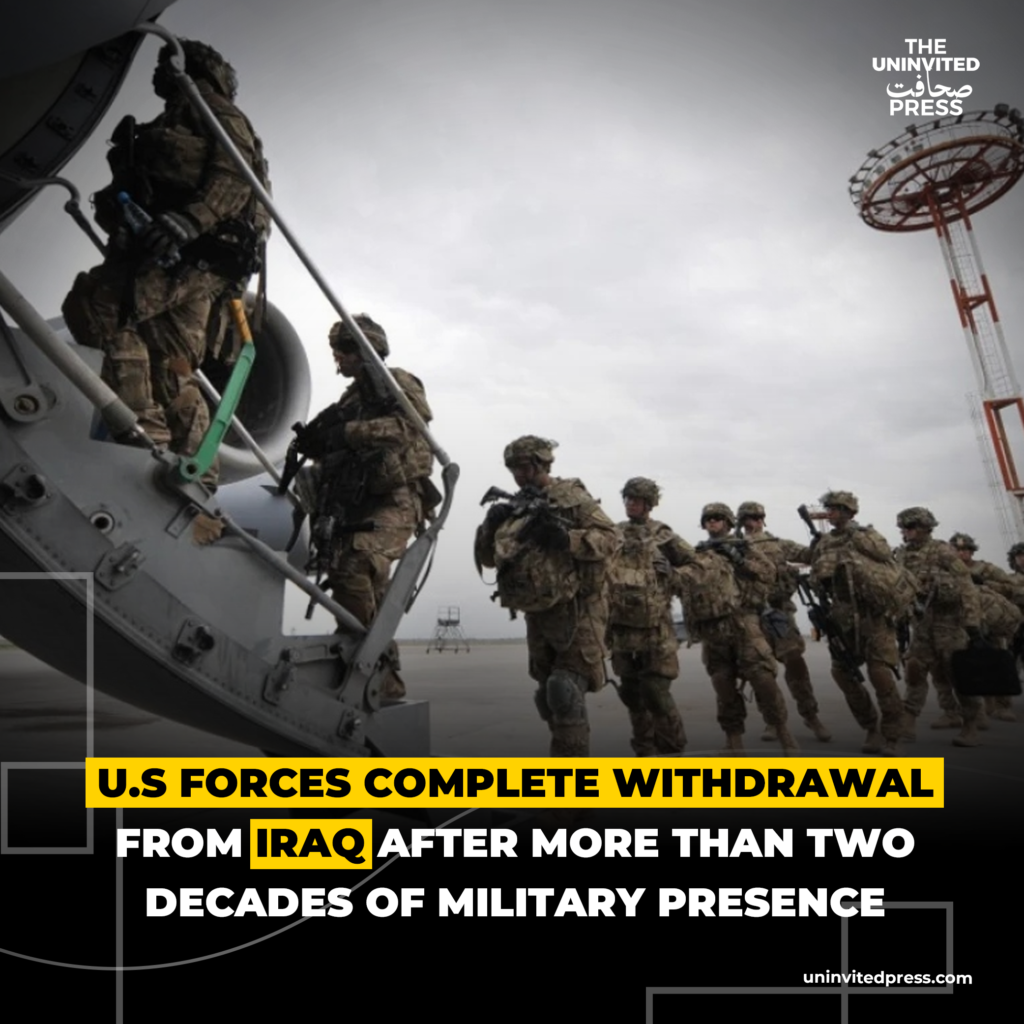
Final American troops depart as Baghdad marks ‘Sovereignty Days’ and faces questions over militias and regional influence.
United States forces have completed their withdrawal from Iraq, ending a military presence that lasted more than two decades and began with the 2003 invasion that toppled Saddam Hussein.
The final troops left on Wednesday under a 2024 agreement between Washington and Baghdad that phased out the US-led coalition’s mission against the Islamic State of Iraq and the Levant (ISIL), also known as ISIS. Iraqi Prime Minister Ali al-Zaidi declared the moment a restoration of national sovereignty, announcing four official public holidays starting October 1 to mark what the government is calling “Independence Day” or “Sovereignty Days.”
“October 1 will be a new day in the course of the Iraqi state, with the country free of any foreign military presence and the completion of national sovereignty over its territory,” al-Zaidi said in a statement.
US Completes Iraq Withdrawal After Two Decades:
The departure closes the chapter of Operation Inherent Resolve, the US-led campaign launched in 2014 after ISIL seized large parts of Iraq and Syria. At its peak, the American presence in Iraq exceeded 170,000 troops. In recent years, the number had fallen to about 2,500, mostly advisers and support personnel concentrated in the semi-autonomous Kurdistan region in the north after earlier consolidations.
The withdrawal fulfills an agreement reached under the previous US administration and continued by President Donald Trump’s government. Trump and al-Zaidi reaffirmed the September 30 deadline during a White House meeting in July, with the Iraqi leader stating that US forces would leave while American companies remained engaged in the country.
Approximately 4,500 US service members died during the long involvement in Iraq, the vast majority between 2003 and 2011. A previous full withdrawal in 2011 was reversed in 2014 when ISIL’s rapid advances prompted the return of American troops. Iraqi and coalition forces eventually dismantled the group’s territorial caliphate, reducing it to a low-level insurgency.
Iraqi officials have emphasised that their security forces, including the Peshmerga in the Kurdistan region, are now capable of leading the fight against remaining ISIL cells. However, security analysts have voiced concerns that the pullout could create openings for the group to regroup or for other actors to expand influence.
Iran and its allied armed groups in Iraq have welcomed the American exit, describing it as a victory for the “axis of resistance.” Tehran has long sought the removal of US forces from the region. Powerful Iran-aligned militias, which have repeatedly targeted American installations in past years, now face renewed pressure from Baghdad to disarm and integrate into state structures.
Iraq Enters New Era After US Military Exit:
Al-Zaidi had initially set a parallel September 30 deadline for these groups to hand over weapons, but that timeline has been extended to June 2027. The revised plan includes a 90-day period of restraint from attacks in exchange for assurances that remaining foreign forces would not target the factions, followed by a gradual weapons handover.
The US exit occurs against the backdrop of heightened regional tensions, including the ongoing conflict involving Iran. Iraqi officials have sought assurances from both Washington and Iran-aligned groups to avoid immediate escalation after the departure.
Baghdad has framed the withdrawal as the end of an era of foreign military presence while signalling that bilateral security and commercial cooperation with the United States will continue in other forms. For many Iraqis, the departure carries deep symbolic weight after years of occupation, insurgency, sectarian conflict and the fight against ISIL.
As the last American troops leave, Iraq enters a new phase in which its government must navigate internal militia politics, residual extremist threats and the competing influences of regional powers without the direct presence of US forces on its soil.