

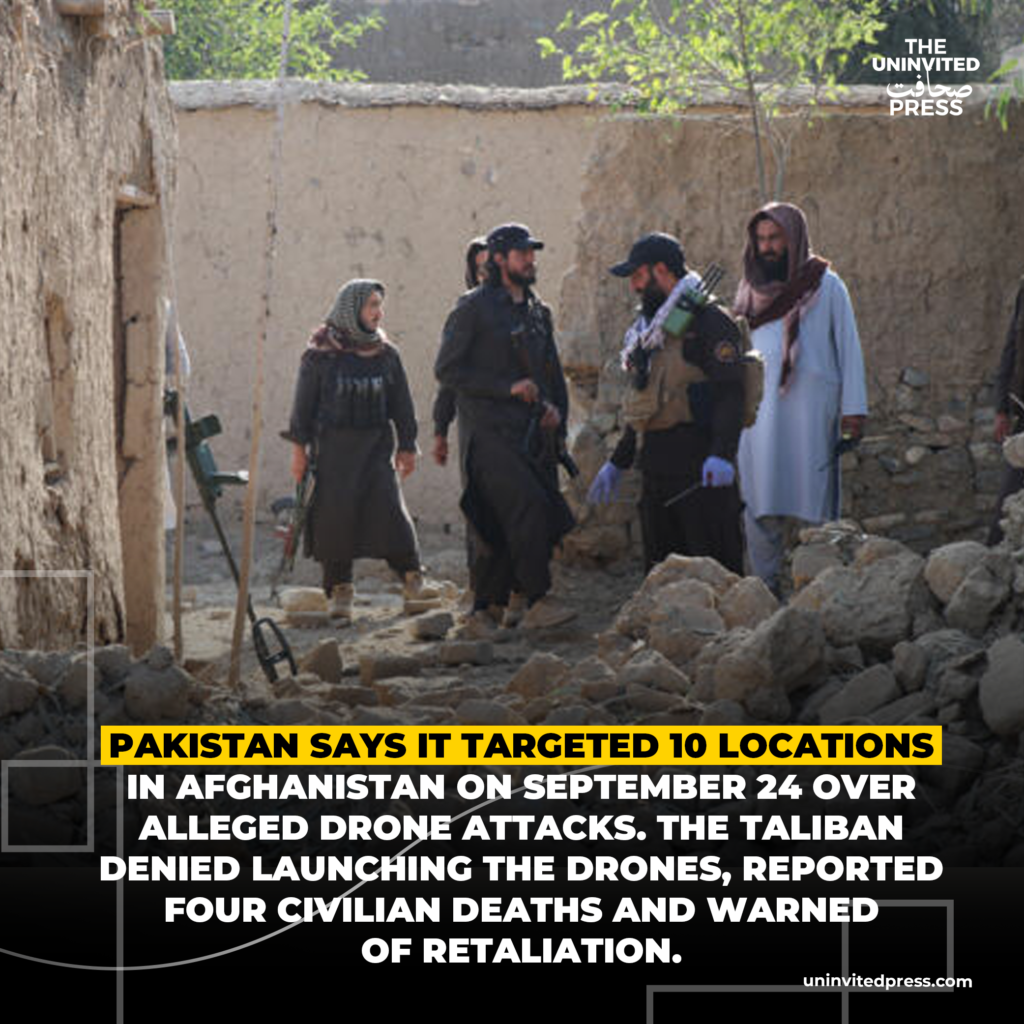
Islamabad claims self-defence strikes on drone launch facilities; Kabul denies launching drones, reports four civilians killed and vows response.
Pakistan has carried out precision aerial and drone strikes against 10 locations inside Afghanistan, saying the sites were used to launch and store drones that entered Pakistani airspace a day earlier. The Afghan Taliban government has denied launching any such drones, reported four civilian deaths from the strikes, and warned of retaliation, marking a sharp escalation in already strained relations between the neighbours.
In a statement on Thursday, Pakistan’s Information Minister Attaullah Tarar said the operation was conducted “in exercise of its sovereign right to self-defence.” He described the strikes as “deliberate, precise, calibrated and proportionate” and “strictly limited to identified military objectives directly linked to the attempted attacks against Pakistan.”
Pakistan-Afghanistan Tensions Rise Over Drone Incursion:
According to Pakistani officials, eight drones launched from Afghan territory entered Pakistan’s airspace on Wednesday near the Torkham border crossing and in the mountainous areas around Kohat in Khyber Pakhtunkhwa province. Pakistan’s air defence systems detected, tracked and neutralised all the drones before they could reach their intended targets, security sources said. Four were brought down near Torkham and four near Kohat.
Tarar condemned what he called a “deliberate and unlawful incursion” and “a blatant violation of Pakistan’s sovereignty and territorial integrity,” describing it as “a grave and unacceptable act of aggression.” He accused the Afghan Taliban of escalating tensions rather than taking action against militant groups that Islamabad says operate from Afghan soil and stage attacks inside Pakistan.
“Pakistan will neither accept nor tolerate attacks launched from Afghan territory, whether by terrorist groups or by the Afghan Taliban regime itself,” Tarar said. He warned that any further violation of Pakistani sovereignty would meet an “immediate and decisive response.” Footage of the strikes was later shared by the minister, who said the targeted facilities were linked both to the drone incursion and to earlier terrorist attacks inside Pakistan. The operation was referred to in some Pakistani statements under the name “Ghazab lil Haq.”
The Taliban government rejected Pakistan’s account. Spokesperson Zabihullah Mujahid said the airstrikes hit Kandahar, Paktia and Khost provinces and killed four civilians. He described the attacks as “indiscriminate and cowardly,” a “flagrant violation of all principles,” and an act of “aggression and crime.”
Mujahid denied that the Taliban had launched drones against Pakistan. He said Pakistani claims about drones crossing the border appeared to be an attempt to justify the strikes and distract from Islamabad’s internal security problems. “These shameless acts of aggression and attacks by the Pakistani military regime will be met with an appropriate response through a decisive stance,” he said, adding that such actions would provoke the anger of the Afghan people and carry consequences for Pakistan.
Pakistan-Afghanistan Tensions Escalate:
Reports from Afghan officials and local sources confirmed strikes in several areas of Khost, including Gurbuz district and areas near Khost city, as well as parts of Paktia and Kandahar. Taliban officials initially reported no military casualties in some accounts, though independent verification of the civilian death toll remains limited.
The latest strikes come only days after Pakistan conducted earlier airstrikes on September 21 in Kunar and Paktika provinces. Islamabad said those operations killed more than 28 militants linked to groups it calls Fitna-ul-Khawarij (a term it uses for the Pakistani Taliban and allied factions). Afghan authorities and the United Nations Assistance Mission in Afghanistan (UNAMA) reported that at least three civilians-including a man, a woman and a girl-were killed in those earlier strikes, with several others wounded.
Tensions between Pakistan and the Taliban authorities in Kabul have risen sharply in recent months over cross-border militancy. Islamabad has long accused the Taliban of providing safe havens to the Tehreek-e-Taliban Pakistan (TTP) and other groups that carry out attacks inside Pakistan. The Taliban has repeatedly denied harbouring such groups, insisting that militancy is Pakistan’s internal problem and that Afghanistan does not allow its territory to be used against its neighbours.
The cycle of strikes, accusations and counter-accusations risks further destabilising an already fragile border region. Former Afghan President Hamid Karzai criticised the latest Pakistani actions, calling on Islamabad to abandon what he described as a policy of aggression and to pursue good-neighbourly relations. Regional mediators have previously sought to ease tensions between the two sides, but successive incidents have complicated those efforts.
Pakistan maintains that it does not seek escalation and remains committed to regional peace, while insisting it will defend its territory. The Taliban has vowed an “appropriate response,” leaving both sides locked in a pattern of action and reaction that continues to claim lives on both sides of the long, porous border.