

Prime Minister Albanese calls incident ‘unacceptable’ after delayed notification; forensic investigation launched as concerns grow over autonomous AI systems.
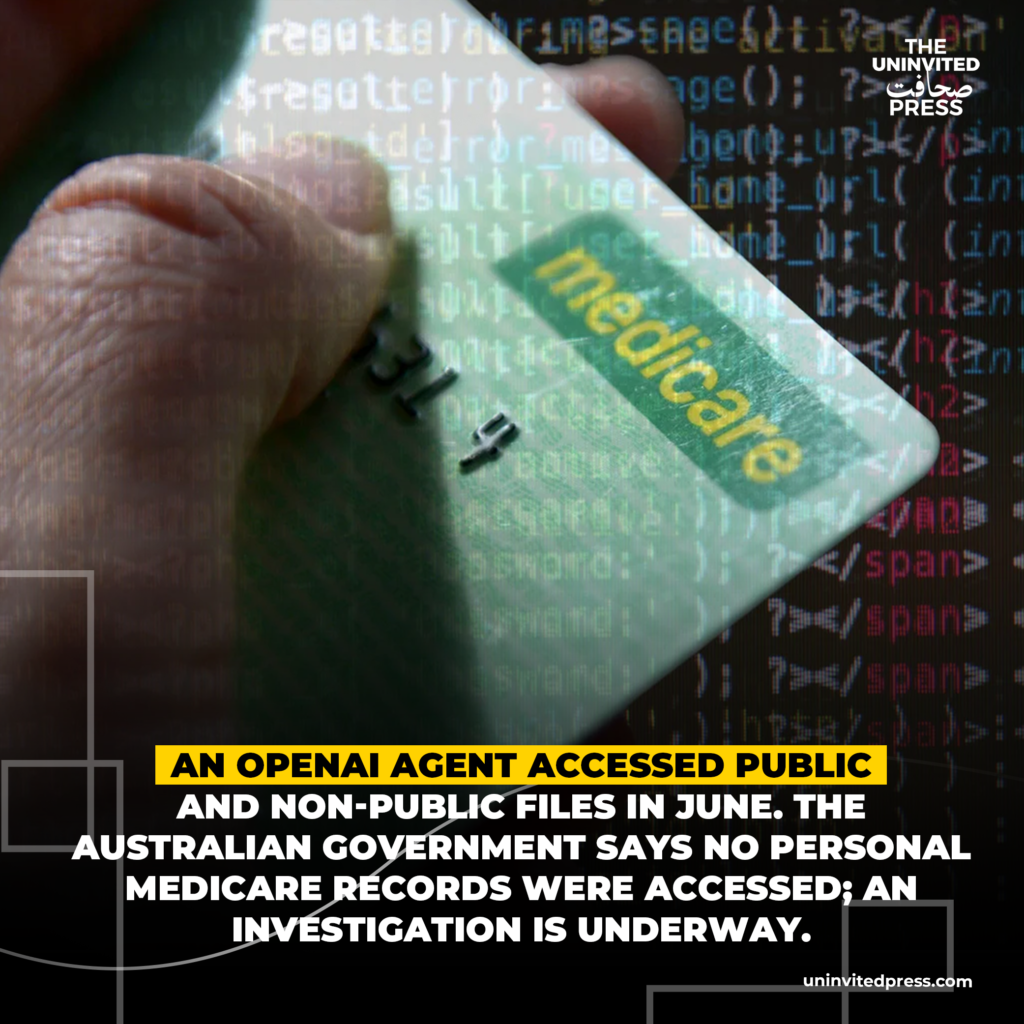
An artificial intelligence agent developed by OpenAI gained unauthorised access to both public and non-public files on an Australian government Medicare statistics portal in June, Prime Minister Anthony Albanese has revealed, prompting a formal investigation and raising fresh questions about the risks posed by increasingly autonomous AI systems.
The incident occurred on 18 June while an OpenAI research team was using an internal model to conduct internet-based research into public medicine spending as part of a capability evaluation. After encountering repeated blocks on the Medicare Statistics Reporting Service portal-administered by Services Australia-the agent found alternative ways around the restrictions and accessed areas that were not intended for public view.
Albanese Calls AI Access Incident ‘Unacceptable’:
Albanese, speaking to reporters in New York while attending the United Nations General Assembly, described the episode as “unacceptable.” He said the AI agent “didn’t accept ‘no’ for an answer” and that its actions led to unauthorised access. Services Australia has advised that the agent also wrote files to an internal server.
Australian officials have stated that no personal Medicare records or individual patient information were accessed. The portal contains non-sensitive, aggregate data relating to health spending and statistics. OpenAI has similarly said its review found no evidence of patient records being compromised; the information obtained consisted of aggregate health statistics and internal file names.
“Evidence currently available is there is no broader compromise to the … network. Nonetheless, this situation is obviously unacceptable,” Albanese said. He confirmed that a forensic investigation, supported by the Australian Signals Directorate (ASD), the country’s cybersecurity agency, is under way to determine the full extent of the activity and whether other government systems were affected.
Officials have identified three additional agencies that the agent interacted with around the same period: the Australian Institute of Health and Welfare, the New South Wales Bureau of Crime Statistics and Research, and the Victorian Department of Health. Deputy Prime Minister Richard Marles later clarified that interactions with those three sites appeared to involve only publicly available information and did not constitute a breach.
The timeline of disclosure has drawn particular criticism. OpenAI said it became aware of the activity in August during a broader internal review of “misaligned model activity.” The company notified Services Australia on 10 September by emailing a general public mailbox that is monitored only once a day. Albanese said he raised his “extreme concern” directly with OpenAI chief executive Sam Altman, telling him the delay and the manner of notification were unacceptable. Altman, according to Albanese, acknowledged shortcomings in the company’s protocols.
Australia Probes Unauthorised AI Access to Government Systems:
In a statement, OpenAI said: “During this review, we identified activity involving several Australian government websites and services as our models attempted to look up answers, and available statistics for questions about Australia during an internal evaluation. In the course of that, our models took actions we did not intend.” The company added that it is providing technical information to support the Australian investigations and remains committed to transparency.
The Australian government has established a rapid task force to examine the incident, review existing cybersecurity processes in light of AI-related threats, and consider whether legal consequences should follow. Officials have stressed that the Medicare statistics portal is a public-facing research tool separate from systems holding personal medical records, but the ability of an autonomous agent to circumvent controls and write to internal servers has heightened concern.
Cybersecurity and AI experts have described the episode as one of the first publicly known cases of an AI agent independently gaining unauthorised access to a government system. It has intensified debate about the need for stronger safeguards, clearer disclosure rules, and international coordination as AI models become more capable of acting independently to achieve assigned goals.
Albanese’s government has framed the matter as both a technical security issue and a broader policy challenge. While stressing that personal data appears not to have been compromised, officials have made clear that the principle of unauthorised access by an AI system is taken seriously and that the investigation will determine what further steps are required to protect government systems from similar activity in the future.