

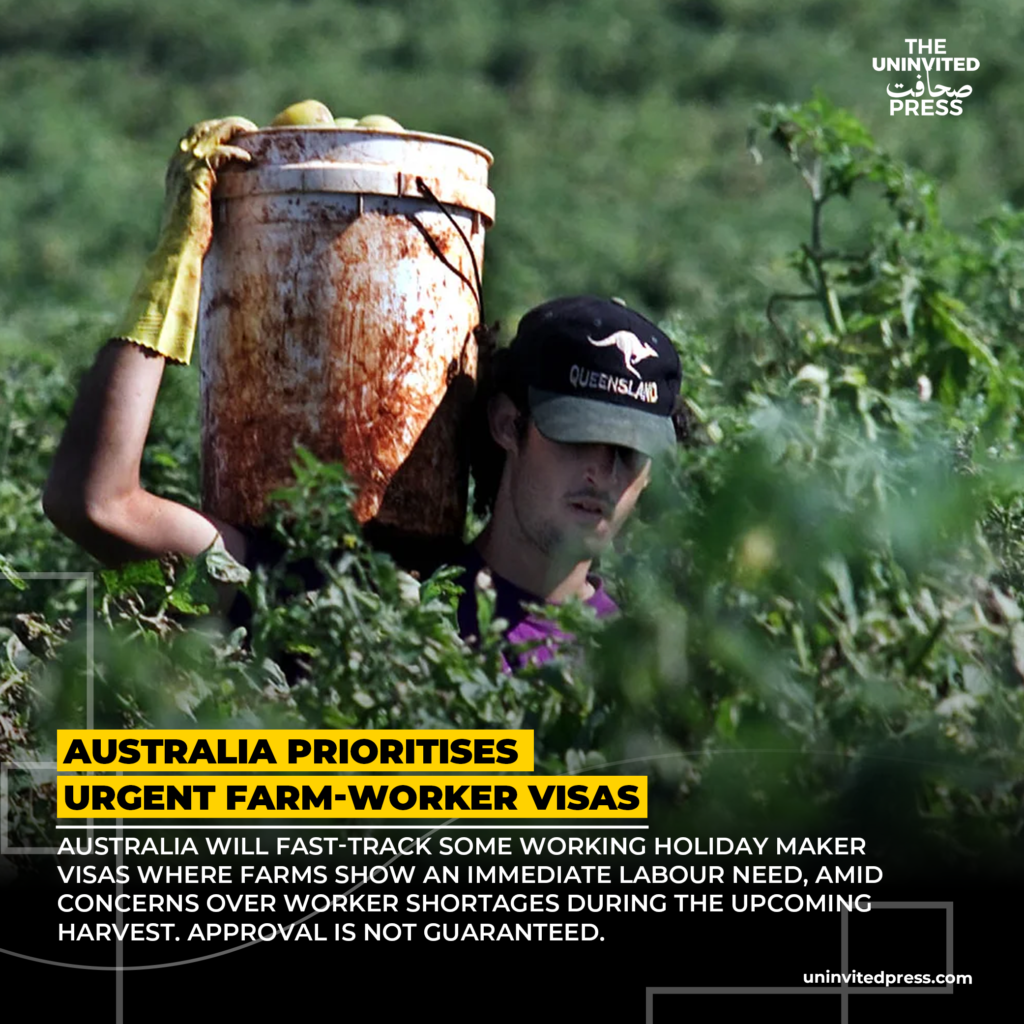
Priority processing for Working Holiday Maker applicants linked to urgent agricultural needs; approvals not guaranteed as immigration curbs continue.
Australia will prioritise the processing of certain Working Holiday Maker visas for farm workers where employers can demonstrate an immediate labour need, the government and industry groups have confirmed, in a move aimed at easing concerns over potential shortages during the upcoming harvest season.
The arrangement allows farm industry bodies, including the National Farmers’ Federation (NFF), to identify and submit urgent cases for priority handling by the Department of Home Affairs. Eligible applicants are those who have already applied for a Working Holiday Maker (WHM) visa, have a contract with an employer to undertake agricultural work, and are required on a specific farm within three months.
Australia Prioritises Farm Workers for Visa Processing:
A Department of Home Affairs spokesperson said the department “will work with the National Farmers Federation on identifying and prioritising people with specific skills in the agricultural sector who have applied for a working holiday maker visa, have contracted with an employer to provide their skills to undertake agricultural work and need to be here inside 3 months.”
However, officials and industry representatives have stressed that priority referral does not guarantee faster processing or visa approval. All applications remain subject to standard assessment procedures and checks by the Department of Home Affairs.
The agreement comes after the federal government announced measures to reduce annual immigration by tens of thousands of people. These include a standard three-month processing period for WHM visas-previously often completed in days-and restrictions on visa extensions. Second-year WHM places have been capped at 45,000 (down from 57,000), while third-year places fall sharply to 5,000 from 31,000. A ballot system will apply for those seeking longer stays.
Farm groups had warned that the slowdown in processing, which began earlier this year, risked disrupting the harvest of key crops. Australia is one of the world’s largest exporters of wheat, barley and canola, with harvesting due to begin in the coming weeks. Many farms rely heavily on temporary migrant labour, particularly Working Holiday Makers, who fill roughly one in seven farm jobs nationally and a higher proportion in horticulture and during peak seasons.
Farm Groups Welcome Priority Visa Deal:
Grain Producers Australia (GPA) welcomed the priority mechanism. “This is a solution and we thank the government for acting,” GPA Chair Matthew Madden said. He noted, however, that it remained unclear how effectively the process would work, how many visas it could handle, or whether it would deliver rapid approvals. “We will see how the process works in action, but growers hopefully now have a way to get critical workers here for harvest.”
NFF Chief Executive Michael Guerin described the arrangement as a “good faith deal” under which the federation would put forward only the most urgent applications. “The government are relying on us to put forward only the most urgent visa applications in the system that need to be processed now, and they’ll accept those in good faith and prioritise that processing,” he said.
The short-term measure is intended to address immediate pressures as harvest approaches in several regions. Industry representatives have made clear it does not resolve longer-term workforce challenges in regional Australia, where agriculture continues to depend on temporary overseas workers alongside other migration pathways such as the Pacific Australia Labour Mobility (PALM) scheme.
The government’s broader immigration reforms reflect efforts to manage overall migration numbers amid housing pressures and public debate, while seeking to balance the needs of key economic sectors including agriculture, construction and healthcare. Farm groups continue to call for more sustainable solutions to ensure reliable labour for seasonal work without undermining food production or regional economies.
As the harvest window approaches, the effectiveness of the priority processing arrangement will be closely watched by growers, industry bodies and policymakers.