

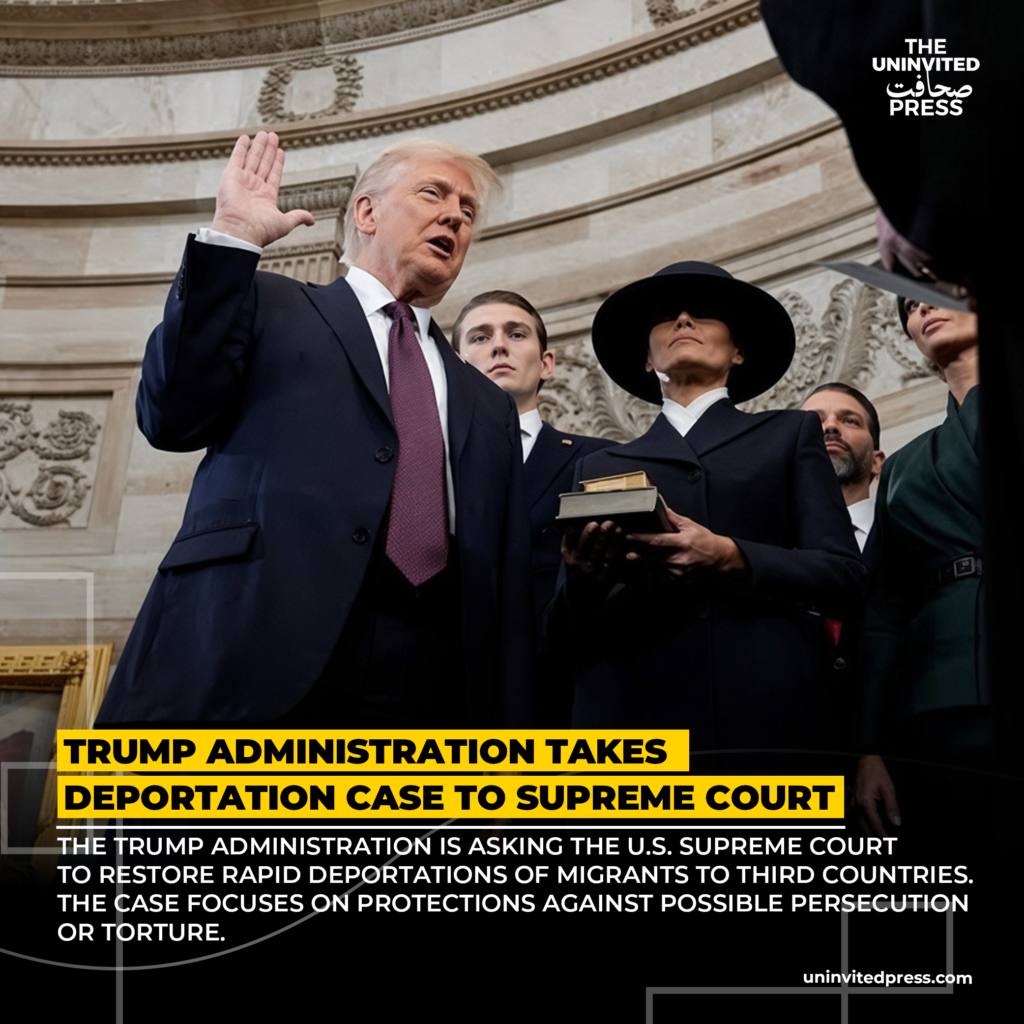
Case centres on whether migrants must receive notice and a chance to raise fears of persecution or torture before being sent to countries that are not their own.
The Trump administration has asked the US Supreme Court to reinstate its policy of rapidly deporting migrants to third countries, arguing that lower court rulings have disrupted an essential tool in its immigration enforcement agenda.
In an emergency filing on Thursday, Solicitor General D. John Sauer requested that the justices stay a lower court order requiring the government to give noncitizens notice and a meaningful opportunity to assert claims that they face persecution or torture in the destination country. The administration described the restrictions as causing “chaos” and said they had already forced the cancellation of a flight carrying about 70 people with criminal convictions to three countries.
Trump Administration Seeks Supreme Court Relief on Deportations:
The case stems from a class-action lawsuit challenging the Department of Homeland Security’s (DHS) third-country removal policy. Under the policy, immigration authorities can send people to countries other than their homeland-often nations with which they have no prior ties-when return to their country of origin is not immediately feasible. The government typically relies on diplomatic assurances from the receiving country that deportees will not be persecuted or tortured.
US District Judge Brian Murphy in Massachusetts ruled in February that the policy was unlawful because it failed to provide adequate notice or a real chance for individuals to raise fear-based claims before removal. On September 18, the US Court of Appeals for the First Circuit largely upheld that ruling, finding that the government’s guidance conflicted with statutory and regulatory protections against removal to places where a person risks torture. Late on Wednesday, the appeals court dissolved a previous stay, putting the restrictions into immediate effect.
Attorney General Todd Blanche said the First Circuit’s order, issued “in the dark of night,” blocked “all third-country removals of illegal aliens, an entirely legal and invaluable tool to stem the tide of illegal immigration.” He announced that the administration would immediately seek relief from the Supreme Court, which has previously intervened in the same case.
The Supreme Court has already sided with the administration twice on related emergency requests. In June 2025, the justices paused a preliminary injunction that required meaningful notice and process before third-country removals. The court later allowed the government to proceed with the deportation of a group of men to South Sudan despite objections that the removals violated earlier court orders.
Immigrant Advocates Challenge Third-Country Deportations:
Advocates for immigrants argue that the policy exposes people to serious harm. Human rights groups say more than 25,000 individuals have been removed to third countries during the current Trump administration under formal or informal agreements with dozens of nations, including Mexico (the primary destination), as well as countries in Central America, Africa and elsewhere. Critics contend that many of these destinations have poor human rights records and that deportees have faced arbitrary detention, physical abuse or onward transfer to places of danger-a practice known as chain refoulement, which is prohibited under international law.
US law and the United Nations Convention Against Torture prohibit the government from returning or transferring anyone to a country where they are likely to face persecution or torture. Plaintiffs and their lawyers maintain that the rapid removal process-sometimes with as little as six or 24 hours’ notice-does not give people a realistic opportunity to consult lawyers or present evidence of risk.
The administration counters that third-country removals are necessary when home countries refuse or delay repatriation, particularly for individuals with criminal records. Officials say receiving governments provide assurances against persecution and torture, and that the policy allows the removal of people who would otherwise remain in the United States indefinitely.
The latest emergency application has been directed to Justice Ketanji Brown Jackson, who handles matters from the First Circuit. She has ordered the plaintiffs to respond by Monday. Jackson may act alone or refer the request to the full court. The outcome will determine whether the government can resume fast-track third-country deportations while the broader legal challenge continues, or whether migrants must first be given a clearer chance to raise protection claims before being sent to countries that are not their own.