

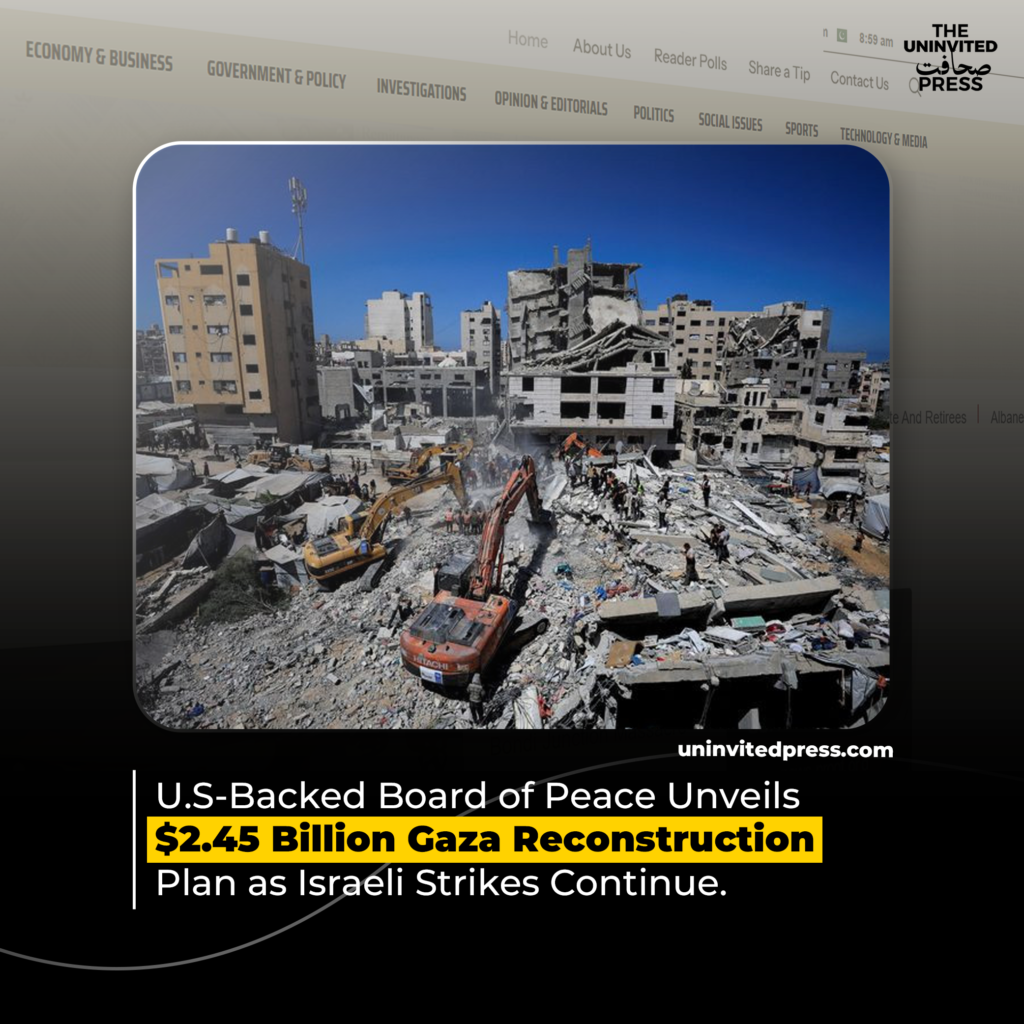
Six-month programme of 66 projects faces major hurdles over funding, security and stalled ceasefire implementation while attacks kill civilians in the enclave.
The US-backed Board of Peace has unveiled a $2.45 billion six-month recovery plan for Gaza, outlining 66 projects aimed at beginning reconstruction of the war-ravaged territory, even as Israeli strikes continue and key conditions for implementation remain unmet.
The proposal was presented on Wednesday on the sidelines of the United Nations General Assembly in New York by board officials, including senior envoy Nickolay Mladenov, former British Prime Minister Tony Blair, Jared Kushner and US envoy Steve Witkoff. It focuses on urgent needs such as temporary housing, rubble and unexploded ordnance clearance, hospital repairs, restoration of basic services and preparations for a multinational security force.
Infrastructure accounts for the largest share of the initial funding, roughly $1 billion, including about $400 million for temporary shelters to replace tents, $275 million for debris clearance, $50 million for hospital rehabilitation and smaller sums for roads and other works. Security-related elements, including sites for an international stabilisation force and training of Palestinian police, form another substantial portion. The board estimates physical damage across Gaza at $35.2 billion, with full recovery and reconstruction projected to require about $71.4 billion over the next decade.
Gaza Plan Faces Funding and Political Hurdles:
Board officials acknowledged significant challenges. While up to $18 billion has been pledged by donors and private sources, only around $280 million has actually been transferred so far. The plan calls on international partners for political support, removal of obstacles and pooled resources behind a single coordinated effort.
Implementation is heavily conditioned on progress in the broader US-brokered ceasefire framework. That includes Hamas disarmament and handover of governance to a Palestinian technocratic body overseen by the Board of Peace, further Israeli military withdrawals, and the deployment of an international stabilisation force. Hamas agreed to a disarmament roadmap in July, according to board statements, but Israel has rejected key elements, leaving the process stalled. Israeli forces currently control large parts of the territory, and political uncertainty surrounding Israel’s upcoming elections adds further complications.
“We do not want Gaza to go back to the way it was before the war,” Mladenov said, emphasising a focus on sustainable recovery rather than a return to pre-conflict conditions. Kushner described the presentation as a demonstration of commitment despite “different delays on different things.”
$2.45B Gaza Reconstruction Plan Announced:
The announcement came against the backdrop of ongoing violence. Israeli strikes have continued in Gaza despite the ceasefire that took effect in October 2025. Palestinian health authorities report that more than 1,300 people, including hundreds of children, have been killed in Israeli attacks since the truce began. On the day of the plan’s unveiling, strikes killed several people, including a Hamas official, according to local reports.
Most buildings in Gaza have been destroyed or severely damaged. More than two million residents remain confined largely to a fraction of the enclave, living in tents or overcrowded damaged structures among the ruins. Humanitarian conditions have improved somewhat under the ceasefire, with increased aid deliveries, but the situation for many remains severe, particularly with winter approaching.
The Board of Peace, chaired by US President Donald Trump and involving more than two dozen member countries, was established to oversee the ceasefire and postwar arrangements under Trump’s 20-point plan. It includes a National Committee for the Administration of Gaza of Palestinian technocrats and plans for an international force with contributions from countries such as Kosovo, Morocco and others.
Critics have questioned the board’s structure and its ability to deliver amid deep mistrust between the parties. Supporters present the $2.45 billion package as a concrete first step that could provide hope if political and security conditions allow work to begin.