

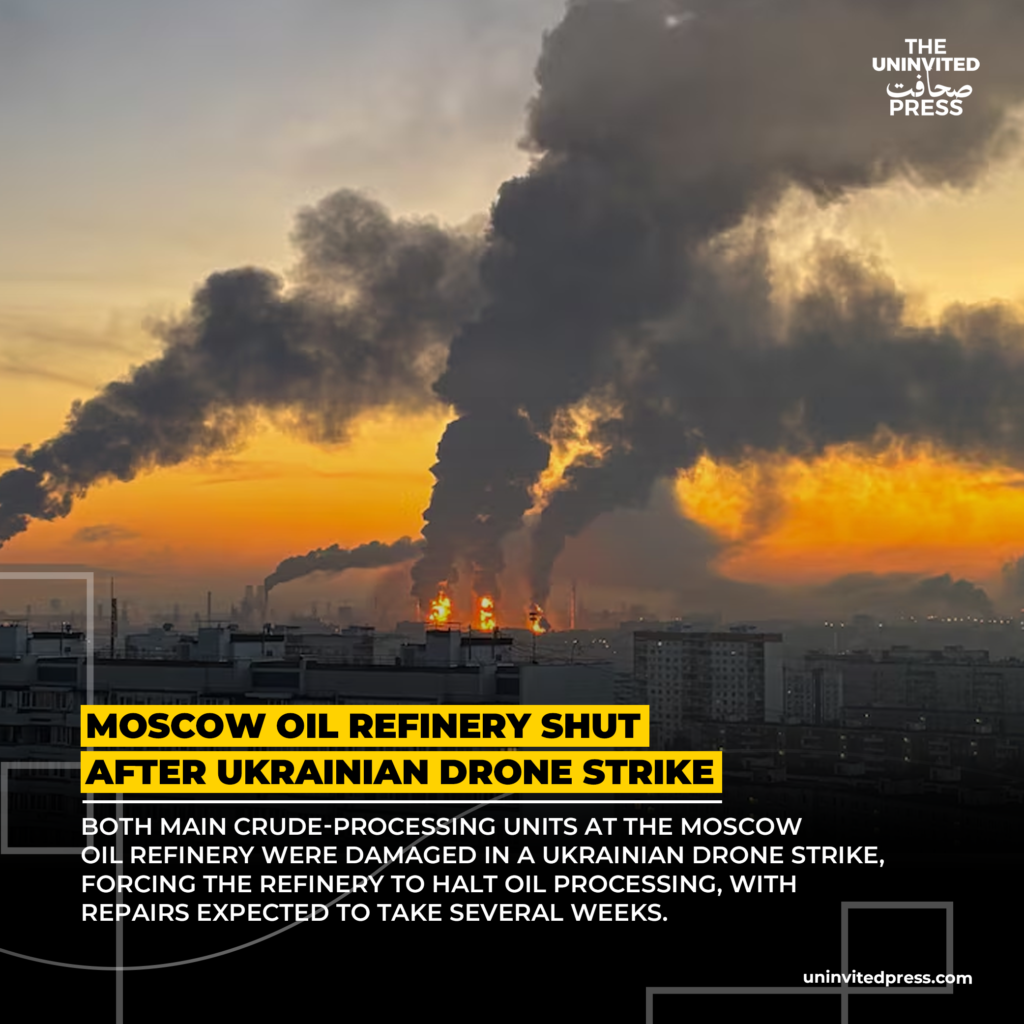
Gazprom Neft facility in Kapotnya forced offline; industry sources say repairs could take several weeks.
Russia’s major Moscow Oil Refinery, owned by Gazprom Neft, has suspended crude oil processing after a Ukrainian drone attack on 20 September damaged both of its primary crude distillation units, according to industry sources cited by Media.
The sources said fires broke out at the two main processing units after drones struck the site in the Kapotnya district on the southeastern outskirts of the Russian capital. The AVT-6 unit, which accounts for about 53 percent of the refinery’s capacity at 21,400 metric tons per day, and the EURO+ combined crude processing facility, which handles the remaining 47 percent at 18,800 tons per day, were both affected. With both units offline, the plant has lost its ability to refine crude oil.
Moscow Refinery Faces Weeks-Long Shutdown:
Moscow Mayor Sergei Sobyanin confirmed that an industrial facility on the refinery’s premises was damaged during the overnight drone raid, which Russian authorities described as one of the largest attacks on the capital. He said emergency services responded to the scene and that no one was injured. Gazprom Neft has not publicly commented on the extent of the damage or the duration of the shutdown.
Industry sources told Media that repairs could take several weeks before operations can resume. Fuel produced by the Moscow refinery has not been offered for sale on the St. Petersburg International Mercantile Exchange since 21 September.
The facility is one of Russia’s key refining assets, processing approximately 11.6 million tons of crude oil in 2024-equivalent to around 230,000 barrels per day-and producing 2.9 million tons of gasoline, 3.2 million tons of diesel and 1.3 million tons of bitumen. It supplies a significant share of fuel to the Moscow region.
Ukraine Targets Russia’s Energy Infrastructure:
The strike forms part of Ukraine’s ongoing campaign targeting Russian energy infrastructure. Ukrainian forces have conducted repeated long-range drone attacks on oil refineries and related facilities across Russia, aiming to disrupt fuel supplies and reduce revenue that supports Moscow’s war effort. The Moscow refinery itself has been hit multiple times this year, including in June, when earlier attacks also forced temporary suspensions of operations.
Russian air defences claimed to have intercepted large numbers of drones during the latest assault, with Sobyanin reporting hundreds directed toward the capital. Ukraine has framed such strikes as legitimate responses to Russian attacks on its own energy and civilian infrastructure.
The halt at the Moscow plant adds to existing pressures on Russia’s refining sector, which has faced cumulative disruptions from Ukrainian drone campaigns throughout 2026. These outages have contributed to domestic fuel shortages and higher prices in various regions, prompting measures such as export restrictions on certain petroleum products.