

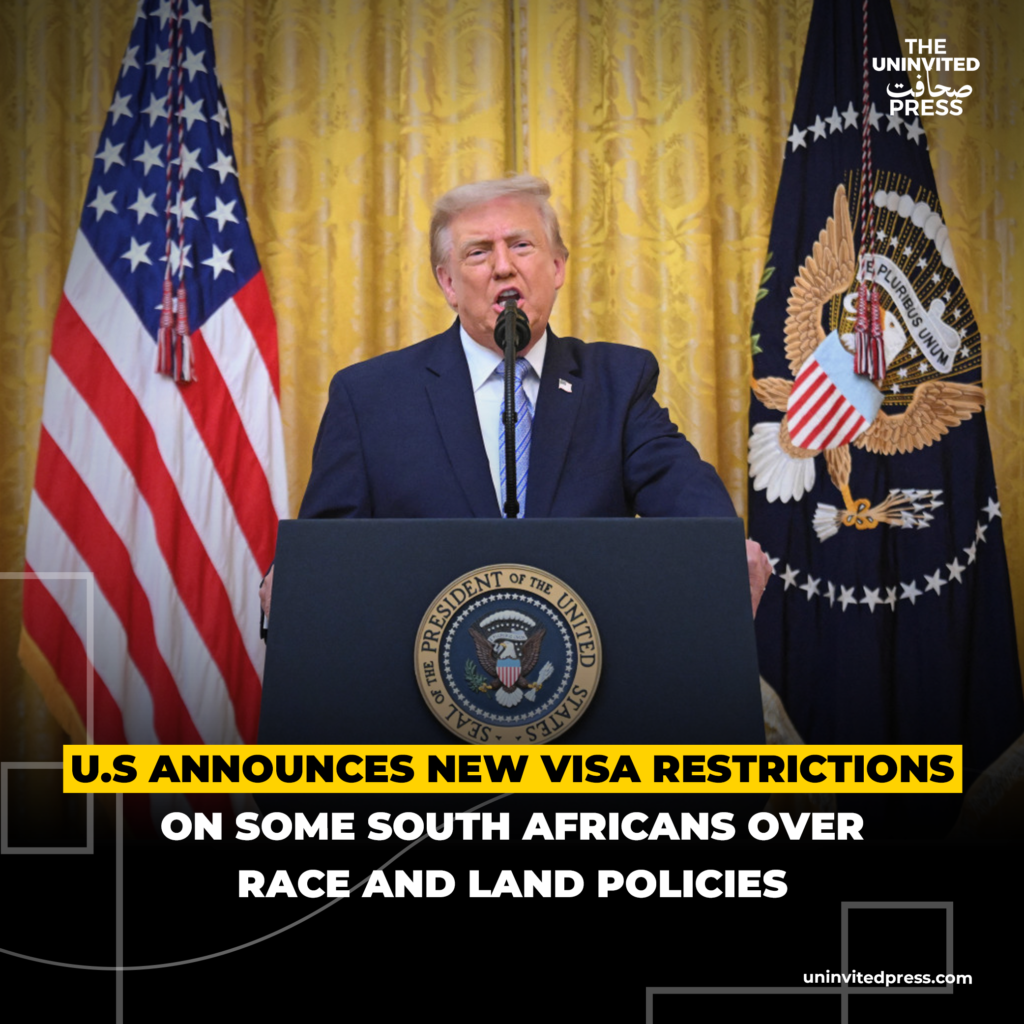
Washington escalates pressure on Pretoria, citing alleged discrimination against Afrikaners and threats of uncompensated land seizures.
The United States has imposed new visa restrictions on certain foreign nationals linked to South Africa, targeting those it deems responsible for or complicit in policies involving uncompensated land seizures, race-based discrimination, and the incitement of violence against minority groups.
US Secretary of State Marco Rubio announced the measures on Tuesday, invoking Section 212(a)(3)(C) of the Immigration and Nationality Act. The policy allows the Secretary of State to deem individuals inadmissible if their entry would have potentially serious adverse foreign policy consequences for the United States. Certain family members may also be covered.
US Tightens Visa Restrictions on South African Officials:
In a statement, Rubio referenced President Donald Trump’s Executive Order 14204, titled “Addressing Egregious Actions of the Republic of South Africa.” He said the US remains “gravely concerned about racially motivated crime and government-sponsored discrimination occurring against the Afrikaners and other minority populations,” including “race-based discriminatory legislation, threats of land expropriation without compensation, and incitement of racial violence through dehumanizing chants and slogans.”
“The South African government has not adequately addressed the previously laid out concerns,” Rubio said. “The United States will not allow such behavior to go unchecked. These actions directly undermine peace, economic stability, and the rule of law, and they are incompatible with the pillars of America’s foreign policy. We once again strongly urge the South African government to quickly address these egregious actions.”
The restrictions are not a blanket ban on all South African citizens. They focus on individuals involved in the enactment or implementation of the contested laws and policies. No specific names were released in the initial announcement.
The move marks a further cooling of relations between Washington and Pretoria under the Trump administration. The White House has previously criticised South Africa’s land reform efforts, cut certain forms of assistance, prioritised refugee admissions for white Afrikaners, and clashed with Pretoria over its positions at international forums, including a case brought against Israel at the International Court of Justice.
US-South Africa Tensions Grow Over Land Reform and Rights:
South Africa’s government has long rejected claims of systematic persecution of white citizens. Officials maintain there is no evidence of discrimination or a campaign against Afrikaners, and that narratives of “white genocide” or widespread persecution are false and harmful to post-apartheid national unity. Pretoria frames land reform as a necessary response to the enduring legacy of colonialism and apartheid, under which Black South Africans were systematically dispossessed of land. A 2017 land audit showed white South Africans, who make up less than 8 percent of the population, still owned the large majority of privately held farms and agricultural land.
The Expropriation Act of 2024, which the US has repeatedly highlighted, allows for expropriation in the public interest and, in limited and specified circumstances, without compensation when it is deemed just and equitable. South African authorities stress the law is not yet fully operational and includes due process protections. Critics of the US position, including South African leaders, argue that Washington is interfering in domestic efforts to redress historical injustices and that focusing on minority grievances while downplaying broader inequality risks inflaming racial tensions.
The South African embassy in Washington did not immediately comment on the latest visa announcement. President Cyril Ramaphosa has previously called for efforts to counter what he describes as disinformation about the treatment of white South Africans.
Analysts note that the policy fits a broader pattern of US pressure on Pretoria, which has also included scrutiny of Black Economic Empowerment policies and rural crime. Supporters of the restrictions in Washington argue they defend property rights, the rule of law and minority protections. Opponents see them as an ideologically driven intervention that ignores South Africa’s democratic processes and the scale of historical dispossession.