

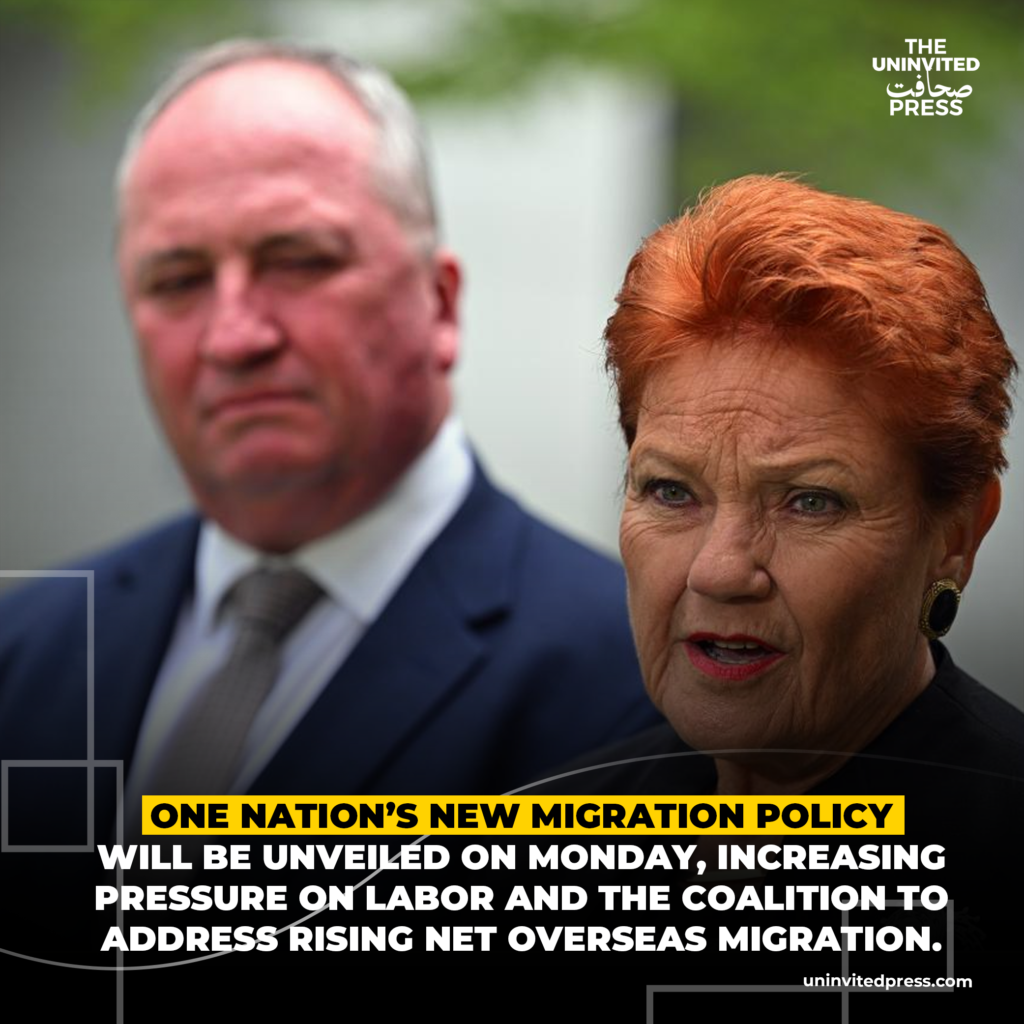
Far-right party proposes three-year ‘net-negative’ reset targeting students and migrant families as Australia grapples with housing and service strains.
Australia’s far-right One Nation party has unveiled a sweeping new migration policy that aims to cut the number of temporary visa holders by more than 750,000 over three years, intensifying pressure on the Labor government and the Coalition to respond to rising net overseas migration.
Announced on Monday by party leader Pauline Hanson, the plan seeks a temporary “net-negative” migration period to return the temporary migrant population to roughly 2017 levels of about 2.1 to 2.2 million people. After the three-year reset, One Nation would impose an annual net overseas migration ceiling of 130,000, subject to yearly review.
Hanson Unveils Tougher Migration Plan:
The policy targets international students, graduate visa holders, family members of temporary skilled workers, bridging visa holders and unlawful non-citizens. Student visas would be capped at 100,000 a year, with tighter eligibility rules and an end to “temporary visa hopping.” A new limited “high-value” postgraduate visa would be created for select science, engineering and medical research students.
Temporary skilled visas for primary workers would remain demand-driven and uncapped, but secondary visas for dependants would be sharply restricted. Unlawful non-citizens-estimated at around 70,000 to 80,000-would be given three months to leave voluntarily, after which those remaining face enforcement action and a lifetime ban on re-entry. Seasonal programmes such as the Pacific Labour Mobility Scheme would be retained.
Hanson framed the proposal as a necessary response to the consequences of high migration levels, including housing shortages, strained public services and cost-of-living pressures. “Australians have had enough of mass migration,” she said, arguing that career politicians are insulated from the daily impacts felt by ordinary citizens.
The announcement comes as net overseas migration remains a contentious issue. The Albanese government has previously set targets aiming for lower levels in coming years, while both major parties face growing public concern over infrastructure, rental affordability and access to healthcare. One Nation’s detailed plan is designed to capitalise on that discontent ahead of the next federal election.
Labor has condemned the proposal, warning it would inflict severe damage on key sectors including construction, aged care, healthcare, disability services and agriculture by removing essential workers. Coalition figures have questioned the underlying modelling for the 750,000 figure.
Migration Debate Intensifies in Australia:
Critics argue that abrupt reductions in temporary migration risk labour shortages in industries reliant on overseas workers, potentially harming economic growth and regional communities. Supporters of tighter controls, however, contend that current levels have outpaced housing supply and public infrastructure, exacerbating inequality for lower-income Australians.
One Nation positions itself as the only party with credibility on the issue, contrasting its approach with what it calls the failure of successive governments to manage the system. The policy document emphasises restoring “clear limits” and ending practices that allow temporary stays to become de facto pathways to longer-term residence.
As Australia’s major parties prepare their own responses on migration settings, One Nation’s hardline stance has raised the political stakes. The debate underscores deep divisions over how the country balances economic needs, social cohesion and the capacity of its cities and services to absorb population growth driven by overseas arrivals.