

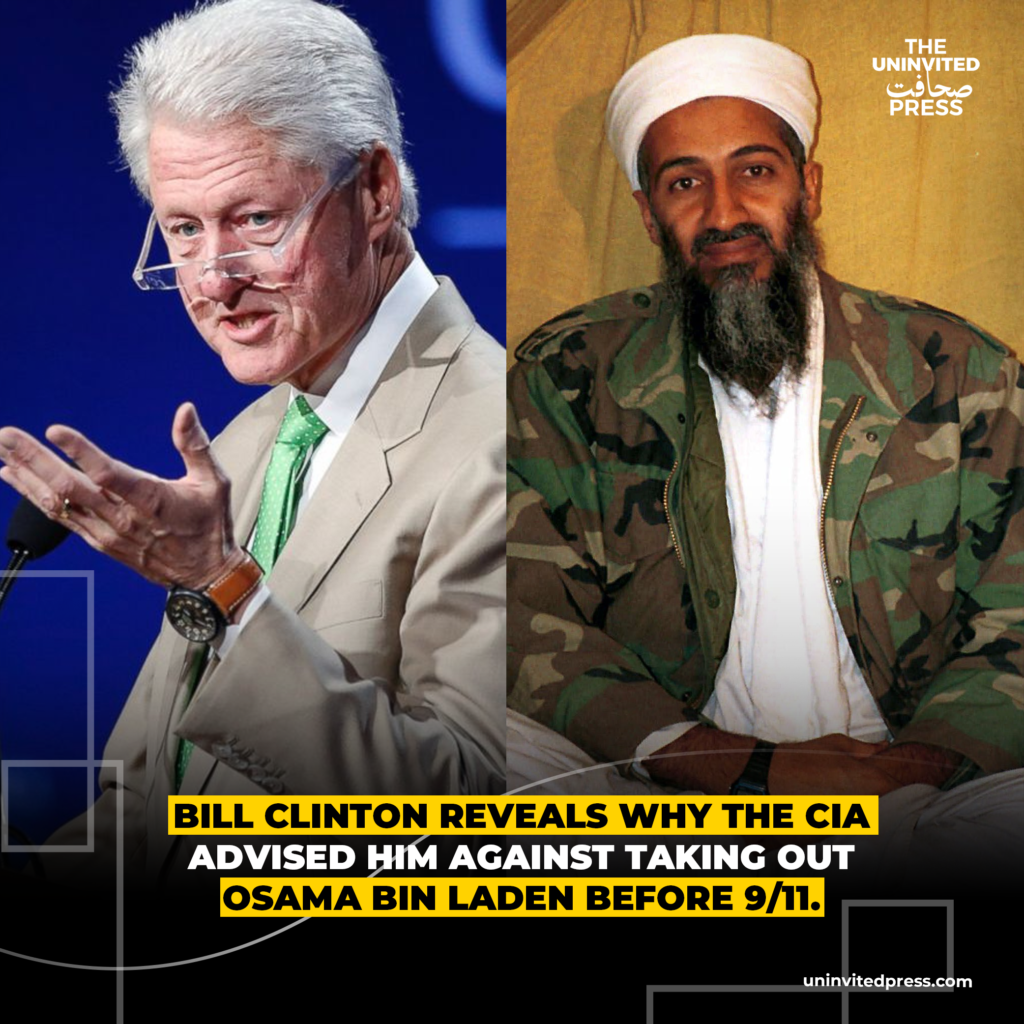
Former US president says agency abandoned authorised operation at the last minute, citing risk of killing innocent people.
Former US President Bill Clinton has disclosed that the Central Intelligence Agency (CIA) abandoned a plan to take out Osama bin Laden before the September 11, 2001 attacks because of concerns that the operation could result in the deaths of large numbers of innocent civilians.
Speaking on Sunday during an interview on WABC Radio’s “Cats Roundtable” with host John Catsimatidis, Clinton said he had authorised the CIA to pursue the al-Qaeda leader. While he preferred capturing bin Laden alive, the overriding goal was to stop him.
“I had authorised the CIA to try to take him out,” Clinton stated. “I was scared, and I was mad because we tried to get him before, and the CIA at the last minute killed the plan that I think might well have succeeded.”
Clinton Recalls Missed Chance to Target Bin Laden:
According to the former president, agency officials ultimately decided the risks were too high. “They were afraid that if they missed, they’d kill a lot of innocent civilians. They didn’t want to run the risk. I didn’t second-guess them,” he said.
Clinton reflected that bin Laden was determined to carry out attacks and possessed significant resources and capability. “I wish we had done even more to get him. I always thought he was our biggest threat … I wanted to get him, and I did what I could to do that,” he added.
The comments come more than two decades after the attacks that killed nearly 3,000 people in New York, Washington and Pennsylvania. Clinton also recalled that he immediately identified bin Laden as the likely perpetrator while watching the second plane strike the World Trade Center on television from Australia, where he was at the time. He noted that his daughter Chelsea was in lower Manhattan that day, heightening family concern.
Clinton’s account aligns with earlier public reflections on missed opportunities during his administration. Historical records, including the 9/11 Commission Report, have documented several instances in the late 1990s when US intelligence considered operations against bin Laden, including proposed strikes and tribal-assisted efforts in Afghanistan. Concerns over intelligence certainty, potential civilian deaths, diplomatic repercussions and operational risks frequently led to decisions not to proceed.
Clinton Revisits Pre-9/11 Bin Laden Decisions:
The former president has previously acknowledged one specific case involving a potential strike near Kandahar that was rejected partly due to expected civilian casualties. In the latest interview, he framed the CIA’s last-minute cancellation of the plan he had authorised as a source of lasting frustration, while accepting the agency’s judgment at the time.
The revelations reopen long-standing debates about pre-9/11 counterterrorism efforts, the balance between operational risk and the imperative to neutralise threats, and the limitations faced by US intelligence and policymakers in the years leading up to the attacks. Clinton emphasised that despite authorising action, the combination of risk aversion and bin Laden’s determination allowed the al-Qaeda leader to continue plannind.
As the 25th anniversary of the attacks approaches, the former president’s remarks serve as a reminder of the complex decisions that shaped the trajectory of US national security policy in the period before September 11.