

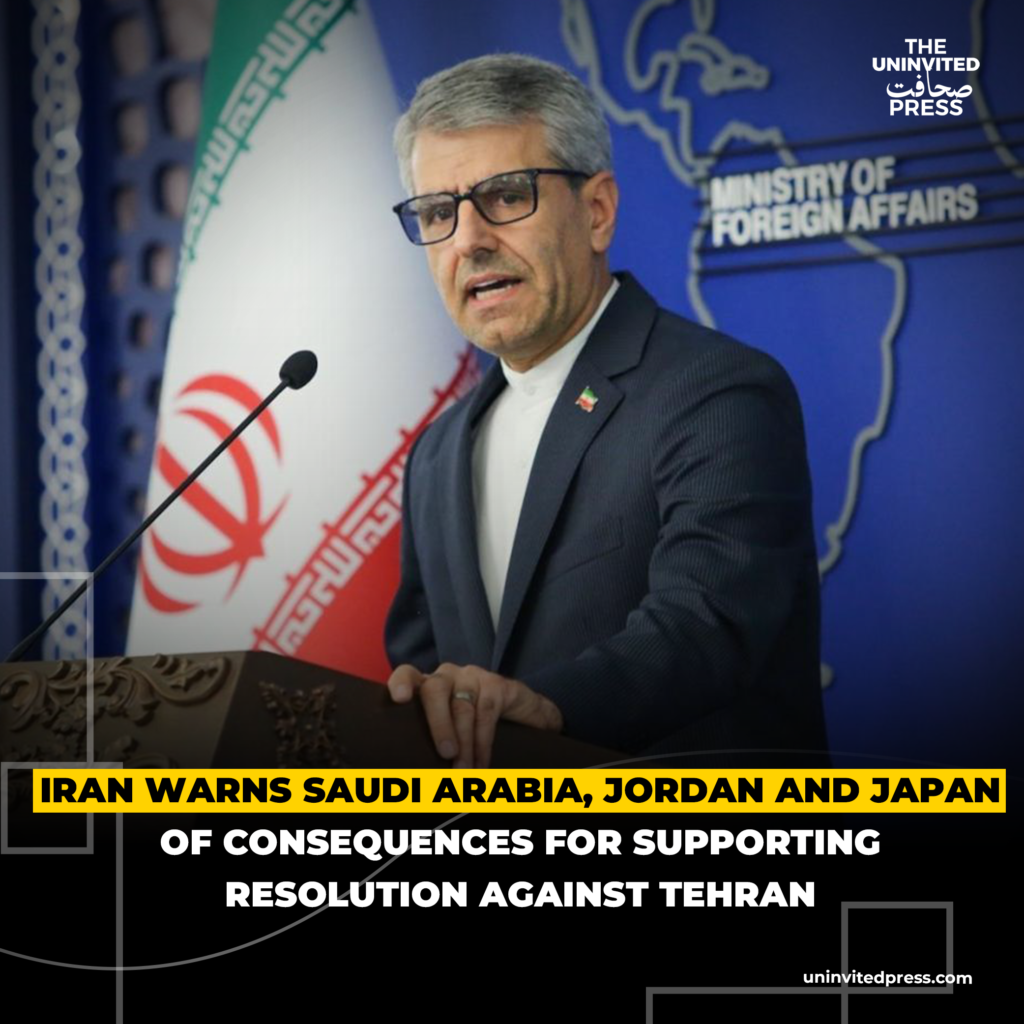
Foreign Ministry spokesperson says countries supporting measures against Iran must face the results of their decisions amid heightened regional tensions and Strait of Hormuz concerns.
Iran has issued a sharp warning to Saudi Arabia, Jordan and Japan, saying the three countries will face consequences for supporting a resolution directed against Tehran.
Iranian Foreign Ministry spokesperson Esmail Baghaei made the remarks while responding to a meeting involving Gulf countries, according to Iranian state media. He said nations that back measures against Iran “should understand that their decisions could carry consequences,” specifically naming Saudi Arabia, Japan and Jordan for their support of the anti-Iran resolution.
Baghaei’s comments come as diplomatic and military tensions surrounding Iran, the Gulf region and the strategic Strait of Hormuz remain elevated. The spokesperson also blamed the United States for the sharp rise in global fuel prices, arguing that Washington should be held responsible for the economic pressure felt in international energy markets.
US-Iran Tensions Escalate Amid Nuclear Dispute:
The warning follows months of heightened confrontation that began in late February 2026, when the United States and Israel launched large-scale airstrikes on Iran. Tehran responded with missile and drone attacks that targeted not only Israel but also US military assets and facilities in several neighbouring countries, including Saudi Arabia, other Gulf Cooperation Council (GCC) states and Jordan.
In March, the UN Security Council adopted Resolution 2817, which condemned Iran’s attacks on Bahrain, Kuwait, Oman, Qatar, Saudi Arabia, the United Arab Emirates and Jordan. The resolution, presented on behalf of the GCC and Jordan and backed by a record number of co-sponsors, demanded an immediate halt to the attacks and any interference with maritime navigation through the Strait of Hormuz.
More recently, on 9 September, the International Atomic Energy Agency (IAEA) Board of Governors voted to refer Iran to the UN Security Council over alleged non-compliance with nuclear safeguards obligations-the first such referral in two decades. The resolution was advanced by the United States, Britain, France and Germany. Russia, China and Niger opposed it.
Iran has rejected both the Security Council resolution and the IAEA referral as politically motivated. Tehran maintains that its nuclear programme is peaceful and argues that Western powers and regional states that host or facilitate attacks against it share responsibility for the escalation.
Iran Warns Regional States Over Support for UN Measures:
Saudi Arabia and Jordan have repeatedly condemned Iranian strikes on their territories and called for full compliance with international law and UN resolutions. Japan, a major energy importer heavily dependent on Gulf oil supplies, has also supported measures aimed at de-escalation and the protection of maritime routes.
Baghaei’s warning underscores Tehran’s view that diplomatic support for resolutions critical of Iran carries potential political or other costs. Iranian officials have previously accused Gulf states and Jordan of allowing their territories to be used in the conflict and have called for accountability and compensation.
The situation continues to affect global energy markets. Disruptions or threats to shipping through the Strait of Hormuz, through which a significant portion of the world’s oil passes, have contributed to volatility in fuel prices. Iran has consistently attributed these pressures to US policy rather than its own actions.