

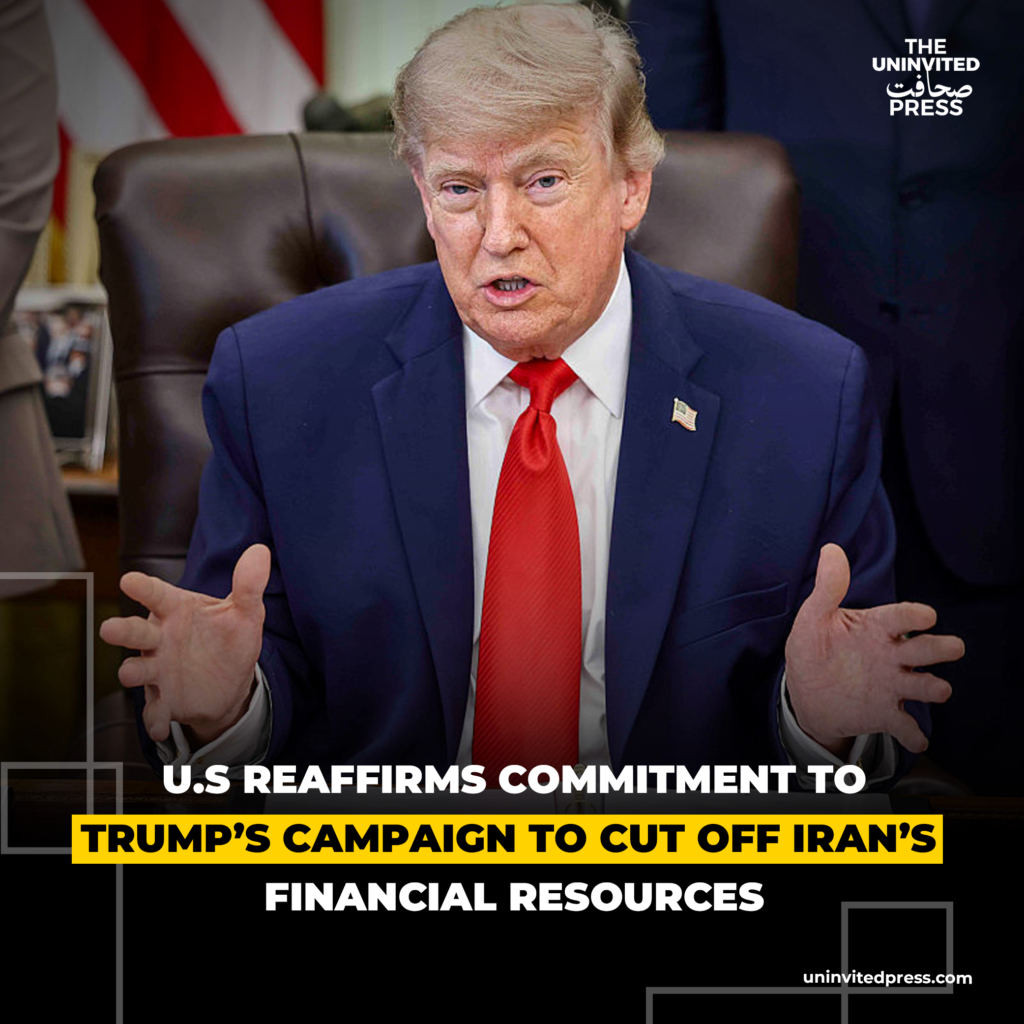
Washington intensifies ‘Operation Economic Outcast’ with fresh sanctions on Iran’s aviation sector, vowing to sever every economic lifeline sustaining Tehran amid ongoing regional conflict.
The United States has reaffirmed its commitment to President Donald Trump’s campaign to starve the Iranian government of financial resources, imposing a new round of sanctions targeting Tehran’s aviation sector as part of a broader economic offensive known as Operation Economic Outcast.
In a statement on Tuesday, State Department spokesperson Tommy Pigott declared that “the United States will not relent in President Trump’s campaign to shut down the Iranian regime’s financial resources.” The latest measures, announced by the Treasury Department, sanctioned 36 entities and individuals accused of aiding Iran’s aviation industry, enabling what Washington describes as proliferation and terrorism worldwide.
US Expands Sanctions on Iran:
The action builds on the formal launch of Operation Economic Outcast in late August, when Treasury Secretary Scott Bessent unveiled what the administration called an “unprecedented campaign” to sever every remaining economic lifeline of the Islamic Republic. Bessent said the goal was to force Tehran into “complete global isolation and a subsistence economy” or compel it to change course. The operation targets key sectors Iran has used to generate revenue and evade previous sanctions, including digital assets, technology, gold, aviation and shipping.
Under the new aviation sanctions, the US expanded restrictions beyond the already blacklisted Mahan Air to cover all remaining Iranian airlines. Officials said the measures also close previous exemptions that had allowed limited transport of safety-related parts, fuel and emergency repairs. Treasury accused Iranian carriers and foreign intermediaries-including firms in Turkey and the United Arab Emirates-of using deceptive practices to obtain US-origin aircraft and sensitive technology.
Bessent warned that any company continuing to do business with Iran’s airlines risked being cut off from the global financial system. “Let this be a warning to anyone doing business with Iran’s remaining airlines, all of which we sanctioned today: You are at risk of being cut off from the global financial system,” he said.
The intensified pressure comes seven months into the US-Israeli war on Iran, during which Washington has combined military action with economic measures aimed at collapsing Tehran’s ability to fund its military, the Islamic Revolutionary Guard Corps (IRGC) and regional allies. US officials argue the campaign is necessary to prevent Iran from rebuilding capacity after sustained strikes and to force concessions on nuclear and regional issues.
US-Iran Sanctions Tighten Economic Pressure:
Critics, including Iranian officials and some international observers, describe the measures as collective punishment that primarily harms ordinary Iranians while failing to achieve stated political goals. Tehran has long denounced US sanctions as illegal economic warfare designed to destabilise the country. Previous maximum-pressure campaigns under Trump’s first term and the current administration have significantly reduced Iran’s oil exports and access to the international banking system, contributing to high inflation and currency depreciation inside the country.
Analysts note that the success of the latest push depends heavily on the cooperation of third countries, particularly China, which remains a major buyer of Iranian oil, and Gulf states that have hosted intermediary networks. Bessent has urged governments worldwide to shutter Iranian bank branches and end all commercial ties, warning that those who continue to facilitate Iranian transactions will face secondary sanctions.
As the Trump administration presses ahead with what it calls an “economic D-Day,” the new aviation sanctions underscore Washington’s determination to maintain maximum pressure even as diplomatic and military dynamics in the region remain fluid. For Iran, the measures represent another tightening of the financial noose at a time of heightened vulnerability, raising the stakes for both sides in a conflict that has already reshaped the Middle East.