

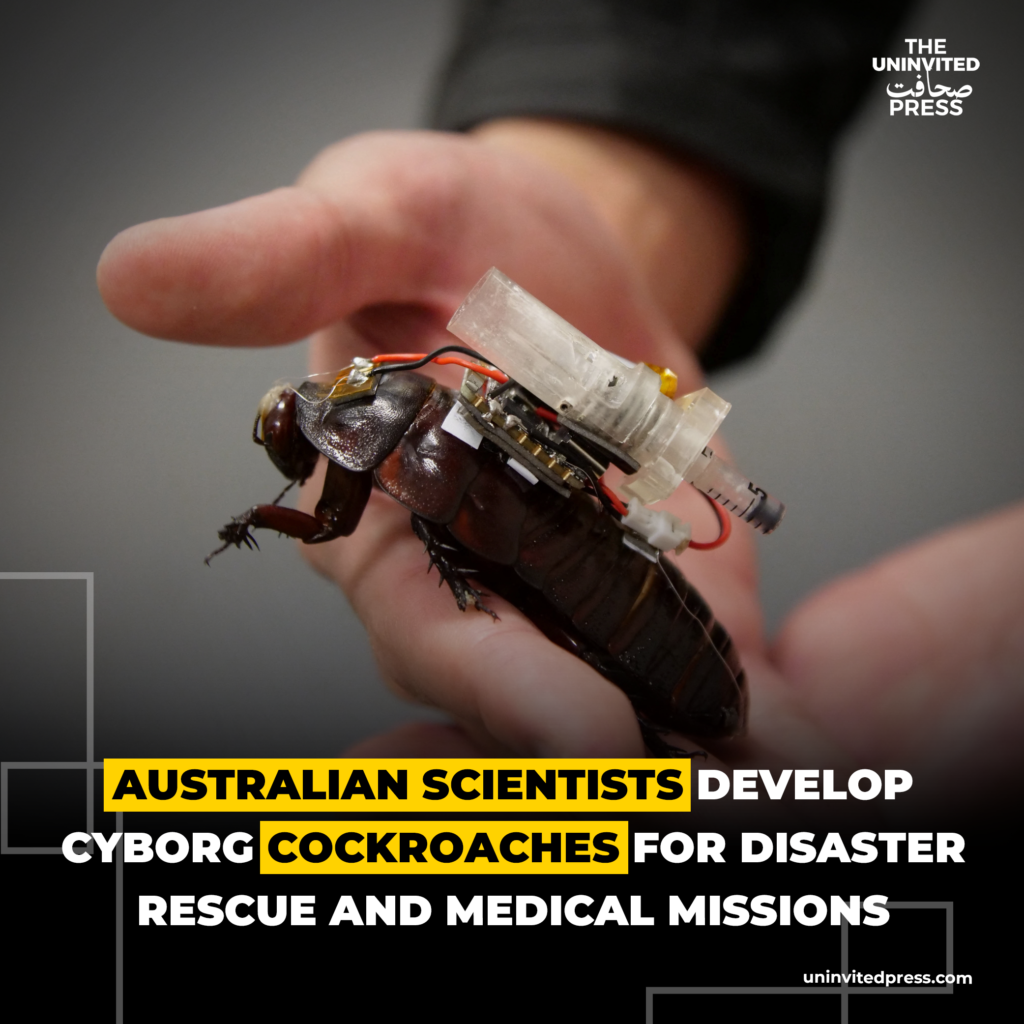
‘Paraborgs’ fitted with cameras and miniature injectors aim to deliver emergency drugs to people trapped in rubble.
Australian researchers have transformed giant burrowing cockroaches into remotely controlled cyborg “paramedics” capable of navigating disaster zones and delivering emergency medication to people trapped in collapsed buildings or other inaccessible spaces.
The project, led by biorobotics engineers at the University of Queensland (UQ) in collaboration with biomedical engineers at the University of New South Wales (UNSW), equips the insects-known as “paraborgs”-with lightweight backpacks containing cameras, navigation systems and auto-injection devices. The goal is to extend search-and-rescue capabilities beyond locating survivors to providing supervised medical assistance before human rescuers can reach them.
Cyborg Cockroaches Become Tiny Rescue Machines:
Previous cyborg insect research over the past two decades has largely focused on using remote-controlled insects as mobile sensors to explore rubble and locate victims after earthquakes or similar disasters. UQ biorobotics engineer Dr Thang Vo-Doan said the new work takes the next step.
“Cyborg insects have been designed for ‘search and explore’ missions for the past couple of decades,” Vo-Doan said. “We wanted to take the next step. Once they find someone, can they actually help?”
The team selected the North Queensland giant burrowing cockroach (Macropanesthia rhinoceros), the world’s heaviest cockroach species. Adults measure up to 8.5 centimetres long and weigh 30-40 grams, giving them the strength and size to carry cameras and miniature medical injectors while traversing complex, debris-filled terrain that conventional robots often struggle with.
The backpacks are removable. Once the electronics are taken off, the cockroaches live as long as their unmodified counterparts, researchers said.
How the system works?
In proof-of-concept tests at UQ’s School of Mechanical and Mining Engineering, operators remotely guided the insects through obstacle courses. One “observer” cockroach equipped with a camera helped locate targets, while a second carried the injection payload.
Results included:
- 100 percent success in reaching designated checkpoints
- 95 percent success rate for close-range injections when positioned within 15 centimetres of the target
- 72 percent overall success for the complete sequence of navigation, stabilisation and drug delivery
The auto-injection mechanism launches a needle-like device to deliver liquid medication under human supervision. Critical medical decisions remain with operators rather than being automated.
PhD candidate Hai Nhan Le noted that accurate positioning of the insects was one of the main engineering challenges. The research was published in the journal Advanced Science.
Cyborg Insects Could Revolutionize Disaster Rescue Operations:
Researchers envision swarms of specialised cyborg insects performing complementary roles at disaster sites-some mapping terrain and locating survivors, others delivering oxygen, pain relief, antibiotics or other emergency treatments to keep people alive until extraction is possible.
Superintendent Tim Hassiotis of Fire and Rescue NSW said the technology could expand the reach of urban search-and-rescue teams. “If cyborg insects can safely enter spaces we can’t, locate casualties and ultimately help deliver emergency care, they could become another valuable tool in the future of urban search and rescue,” he said.
Vo-Doan estimated that specialised groups of the insects could be ready for real-world operations within five to ten years, depending on further development and support. The work highlights how biological systems-with their natural agility, low power needs and ability to adapt to unpredictable environments-can complement traditional robotics in high-stakes emergency response.