

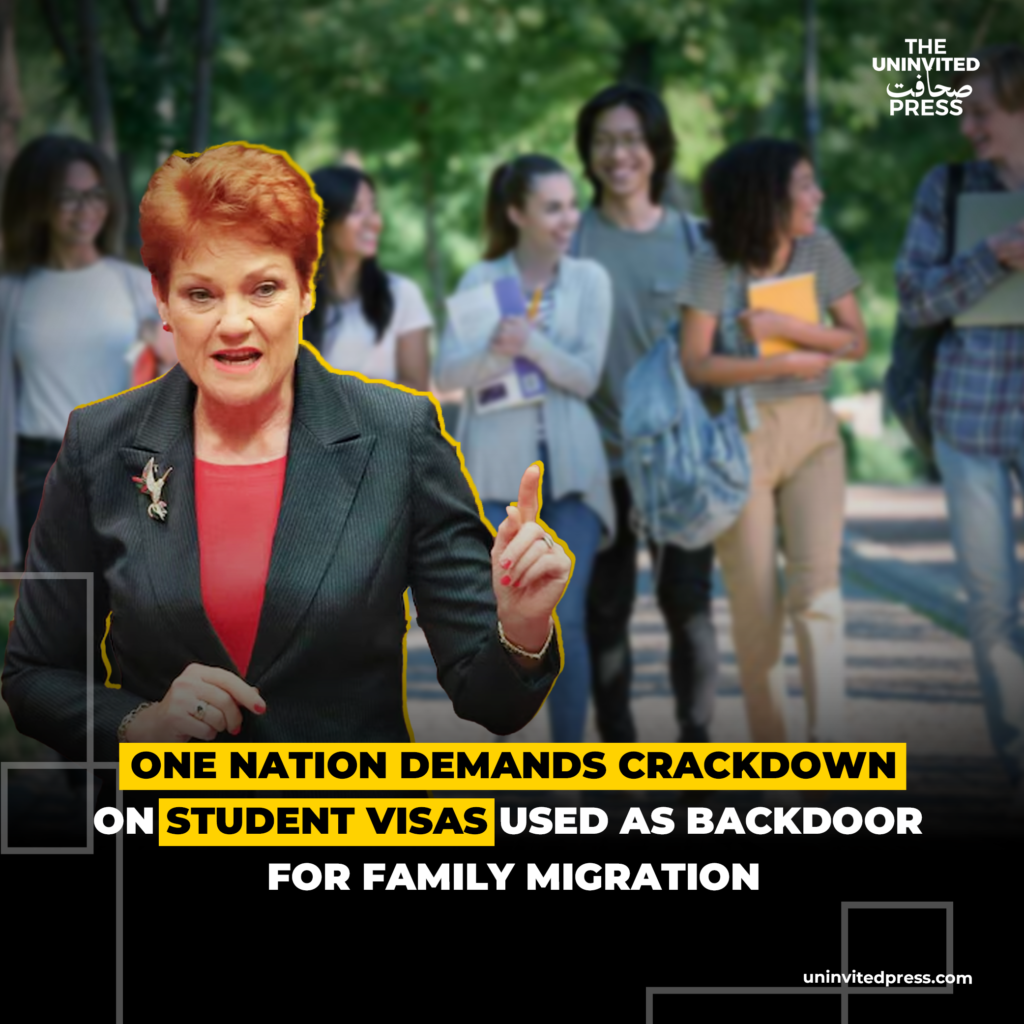
Right-wing party argues international education pathway enables low-skilled work and family relocation as migration debate intensifies amid housing pressures.
Australia’s Pauline Hanson’s One Nation party has stepped up its campaign for a major overhaul of the international student visa system, claiming that study visas are being exploited as a pathway for entire families to relocate, access the labour market and eventually settle rather than pursue genuine education.
In its latest intervention this week, the party said the current system “as it stands is open to abuse,” with some applicants using study primarily as “a backdoor way for whole families to relocate to Australia.” One Nation leader Senator Pauline Hanson has called for substantially lower international student numbers and tighter limits on accompanying family members and temporary graduates. Party statements have argued that the focus for many has often been low-skilled work rather than study, describing enrolment as “a tick box to get them into the country,” with parts of the education sector allegedly willing to facilitate the practice.
One Nation Pushes Major Student Visa Crackdown:
Department of Home Affairs data cited in recent reporting shows that 2.22 million student and Temporary Graduate visas were granted between the 2022-23 and 2025-26 financial years. Of these, 384,735 were secondary visas issued to family members. Temporary graduate visa holders numbered more than 271,000 as of mid-2026, including tens of thousands of secondary applicants. One Nation’s broader immigration platform includes a hard annual cap of around 130,000 visas (framed as net overseas migration in recent clarifications), restrictions on secondary applicants on student and graduate visas, and measures to prevent students from remaining onshore while switching courses or appealing decisions-a practice the party labels “course-hopping.”
Hanson has described the international education industry built around universities as a “farce,” claiming people arrive on student visas, change courses after a short period, apply for residency pathways, and bring spouses or family members. The party wants graduates to leave after completing their studies unless they independently qualify for a skilled visa that matches Australia’s labour needs. It has also linked high temporary migration, including students, to pressure on housing, infrastructure and wages.
The international education sector is one of Australia’s largest export industries, valued in the tens of billions of dollars annually and supporting tens of thousands of jobs in universities, vocational providers, accommodation and related services. Critics of the One Nation proposals, including some education advocates and economic analysts, warn that sharp cuts to student numbers risk severe financial damage to universities that have become heavily reliant on international fees, potential job losses, and reduced soft-power and research capacity. They note that genuine students contribute tuition revenue, part-time labour in sectors facing shortages, and long-term skilled migration pathways when they meet criteria.
The Albanese Labor government has already reduced net overseas migration from post-pandemic peaks (near 550,000) by around 45 percent and is targeting further declines toward roughly 220,000-225,000. Home Affairs Minister Tony Burke has pursued visa integrity measures, including tighter processing and prioritisation of skilled applicants already in the country. Officials have acknowledged rorts and integrity issues in parts of the student and temporary visa systems while defending the overall economic and diplomatic value of international education.
One Nation’s Push to Cut Migration:
Migration remains a highly charged political issue in Australia. One Nation has capitalised on public concern over housing affordability and infrastructure strain in major cities, positioning its “Australians first” stance against both Labor and the Coalition. The Coalition has floated its own crackdowns on temporary visa loopholes, including restrictions on students changing courses or jobs. The Greens have generally opposed overall cuts to migration numbers. Independent experts have questioned the practicality of One Nation’s 130,000 cap, noting legal constraints on family visas for Australian citizens and permanent residents, the demand-driven nature of many temporary categories, and the risk of negative net migration or economic disruption if applied rigidly.
For many international students-particularly from India, China, Nepal and other source countries-the pathway represents opportunity: quality education, work rights during study, and potential post-study work or skilled migration. Secondary visas allow partners and children to accompany primary applicants, a common feature in comparable systems globally. Critics of restrictionist approaches argue that framing family accompaniment as a “backdoor” risks stigmatising legitimate students and their dependents, while underplaying the role of policy design, university recruitment practices, and labour-market incentives in any genuine abuse.
One Nation’s proposals also include deporting unlawful non-citizens (its published target is 75,000 overstayers and similar, though some party figures have spoken of higher numbers of temporary residents and students), an eight-year wait for citizenship and welfare, and ending what it calls student-visa loopholes leading to permanent residency or low-wage work. The party has further called for students who discontinue courses to leave Australia before reapplying, and for limits on bridging visas that currently allow onshore work while new applications are processed. Bridging-visa numbers for former students have risen sharply in recent years according to available data.
The debate sits within a wider global conversation about the dual nature of international education: genuine academic exchange and economic contribution on one hand, and migration pathways that can be gamed when temporary work rights, family accompaniment and post-study options are generous on the other. Australia’s experience mirrors pressures seen in Canada, the United Kingdom and elsewhere, where governments have tightened student and temporary graduate rules in response to housing shortages and public concern.
As federal politics heads toward the next electoral cycle, One Nation’s sharpened focus on student visas and secondary family applicants is forcing both major parties to respond on migration settings. Whether the party’s preferred restrictions-if ever implemented-would primarily restore “integrity,” shrink a major export industry, or simply shift pressures elsewhere remains contested. What is clear is that the intersection of education, temporary migration and family settlement has become a central fault line in Australia’s ongoing struggle to balance economic needs, social cohesion and political demands for lower overall numbers.