

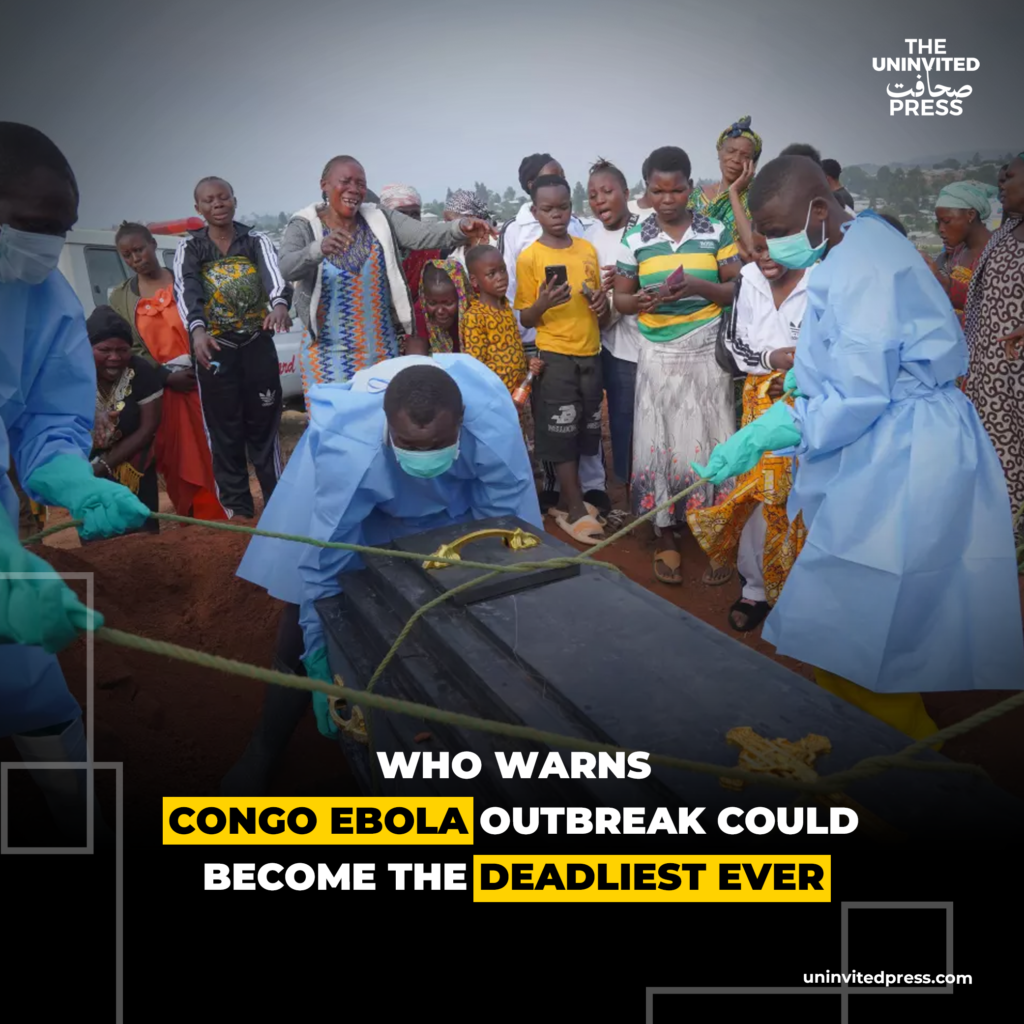
The Bundibugyo strain outbreak in eastern DR Congo has already killed more than 2,000 people and is spreading faster than responders can contain it, the World Health Organization says.
The Ebola outbreak raging in the eastern Democratic Republic of the Congo is on track to become the deadliest on record if current trends continue, the World Health Organization has warned.
WHO Director-General Tedros Adhanom Ghebreyesus told reporters that the outbreak, driven by the rare Bundibugyo strain of the virus, is spreading faster than health authorities can contain it. “At its current pace, it’s on track to eclipse the West African Ebola outbreak of 2014 to 2016,” he said. That earlier crisis killed more than 11,000 people across Guinea, Liberia and Sierra Leone and accelerated global efforts to develop a vaccine.
Ebola Outbreak Spreads Rapidly in DR Congo:
In eastern DR Congo, more than 4,300 cases and over 2,000 deaths have already been recorded, making this the fastest-moving Ebola outbreak in history. The outbreak was formally declared on 15 May, but genetic sequencing later revealed the virus had been circulating since February. Many early cases were misdiagnosed as malaria or typhoid, giving the virus a critical head start.
“The outbreak had a big head start, still way ahead of us, and we’re playing catch-up,” Tedros said.
Unlike the more common Zaire strain that caused previous large outbreaks, Bundibugyo has no approved vaccine or specific treatment. Case fatality rates have been high, and more than two-thirds of deaths are occurring in communities rather than in treatment centres, complicating contact tracing and safe burial practices.
The epicentre remains in Ituri province, with significant spread into neighbouring North Kivu and other areas. Ongoing armed conflict, remoteness, poor infrastructure and community mistrust have severely hampered the response. Access to many affected villages remains limited, and health workers face security risks while trying to reach patients and contacts.
WHO Warns Ebola Outbreak Could Last a Year:
Dr Abdirahman Mahamud, WHO’s director for health emergency alert and response operations, said moderate projections suggest the outbreak could peak within six months. Under a more severe scenario, it could continue for nine to 12 months.
Africa CDC and WHO have called for an urgent scale-up of community-led efforts, stronger early detection, better contact follow-up and faster delivery of resources to frontline responders. Vaccine experts have recommended prioritising clinical trials of the existing Ervebo vaccine to test possible cross-protection against Bundibugyo, while specific vaccine candidates remain in earlier stages of development.
The crisis underscores the persistent vulnerability of conflict-affected regions to rapidly escalating epidemics. For communities in eastern Congo already living with insecurity and limited healthcare, the outbreak has brought a new layer of fear and loss. International support will be critical in the coming months if the world is to prevent this outbreak from rewriting the grim record books of Ebola.