

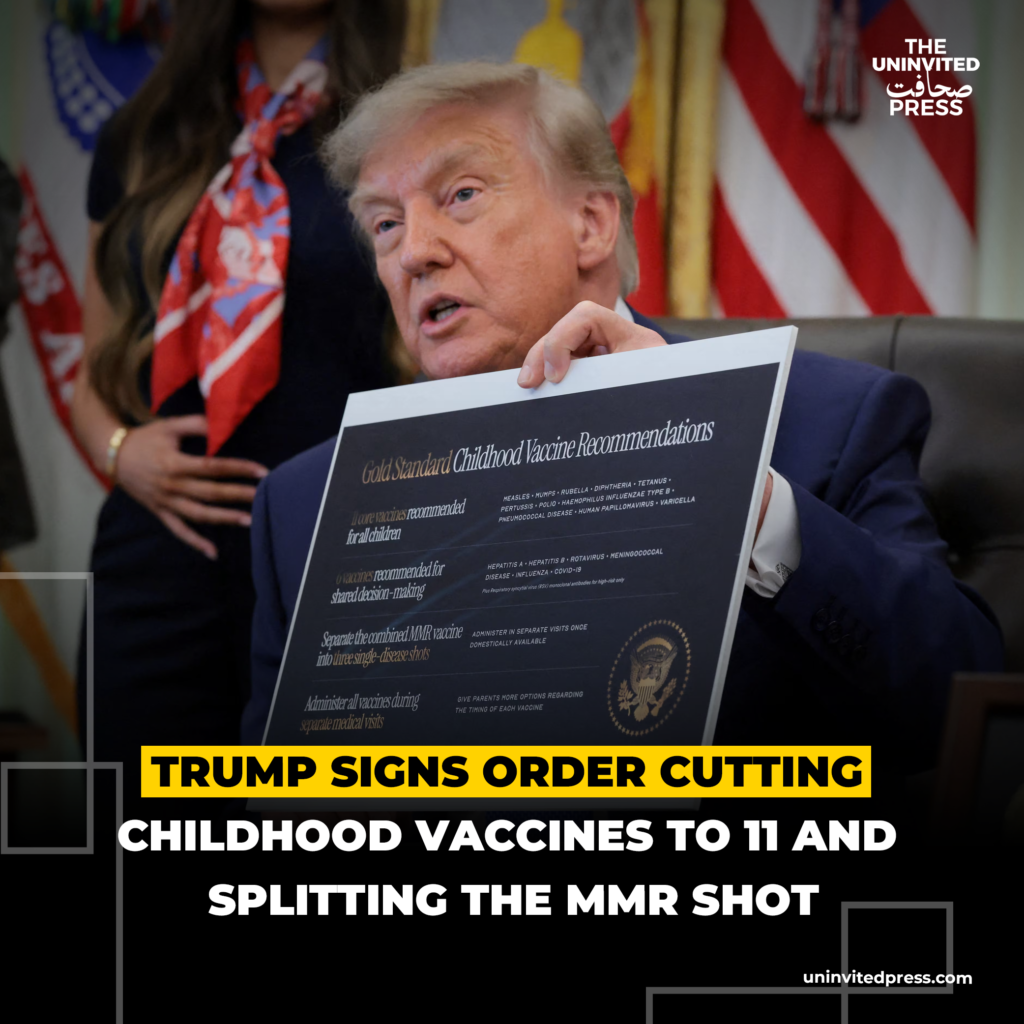
Executive action limits recommended immunisations and calls for separate measles, mumps and rubella vaccines amid criticism from medical groups.
US President Donald Trump has signed an executive order reducing the number of recommended childhood vaccines from 18 to 11 and calling for the combined measles, mumps and rubella (MMR) vaccine to be split into three separate shots administered at different medical visits.
The order, signed on Monday in the Oval Office and titled “Delivering Gold Standard Childhood Vaccine Recommendations for Americans,” directs federal agencies to recognise only 11 core immunisations for all children. These cover measles, mumps, rubella, diphtheria, tetanus, pertussis (whooping cough), polio, Haemophilus influenzae type B (Hib), pneumococcal disease, human papillomavirus (HPV) and varicella (chickenpox).
Trump Orders Changes to U.S. Childhood Vaccine Schedule:
Other vaccines, including those for hepatitis A and B, meningococcal disease, respiratory syncytial virus (RSV), influenza and COVID-19, would be recommended only for high-risk groups or left to shared clinical decision-making between parents and doctors.
Trump said the changes would align US recommendations more closely with those of some peer nations and provide “gold-standard” protection against the most serious diseases. “Effective immediately, my administration is recognising gold-standard childhood vaccine recommendations for only 11 core vaccinations against the most serious and dangerous diseases, along with the MMR, which hopefully will be split up,” he stated during the signing ceremony.
The order also recommends that, once single-disease versions of the measles, mumps and rubella vaccines become available in the United States, they should be given separately rather than as the current combined MMR shot. It further encourages spacing all childhood immunisations across separate medical visits “to the maximum extent feasible.”
Health Secretary Robert F. Kennedy Jr, a long-time critic of certain vaccine policies, was present at the signing. Trump has repeatedly questioned the safety of the MMR vaccine and linked rising autism diagnoses to the current immunisation schedule-claims that extensive scientific research has found no evidence to support. Large studies, including a major Danish analysis of more than 650,000 children, have found no causal connection between the MMR vaccine and autism.
Experts Warn Trump Vaccine Changes Could Risk Child Health:
Medical organisations and vaccine manufacturers quickly criticised the order. The American Academy of Pediatrics said it was evaluating its next steps, having previously challenged earlier administration changes to the immunisation schedule. Merck, a major vaccine producer, stated there is no published scientific evidence of benefit from splitting the MMR vaccine and warned that separate shots could increase the number of injections, delay protection and lead to missed doses.
Individual measles, mumps and rubella vaccines are not currently licensed for routine use in the United States, meaning the proposed split would require new manufacturing and regulatory approval that could take years. Public health experts have noted that combination vaccines reduce the number of visits and injections while maintaining high effectiveness, with the two-dose MMR regimen providing about 97 percent protection against measles.
The executive order follows earlier efforts by the administration to revise childhood vaccine guidance, some of which were halted by court rulings. It directs federal agencies to work with states on aligning their requirements and instructs the attorney general to challenge state laws seen as restricting religious or medical exemptions.
The Centers for Disease Control and Prevention (CDC) has long based its recommended schedule on decades of evidence showing that the current vaccines prevent serious illness, hospitalisation and death. Critics of the new order argue that reducing recommendations and spacing shots could leave more children vulnerable to preventable diseases and complicate access for families.