

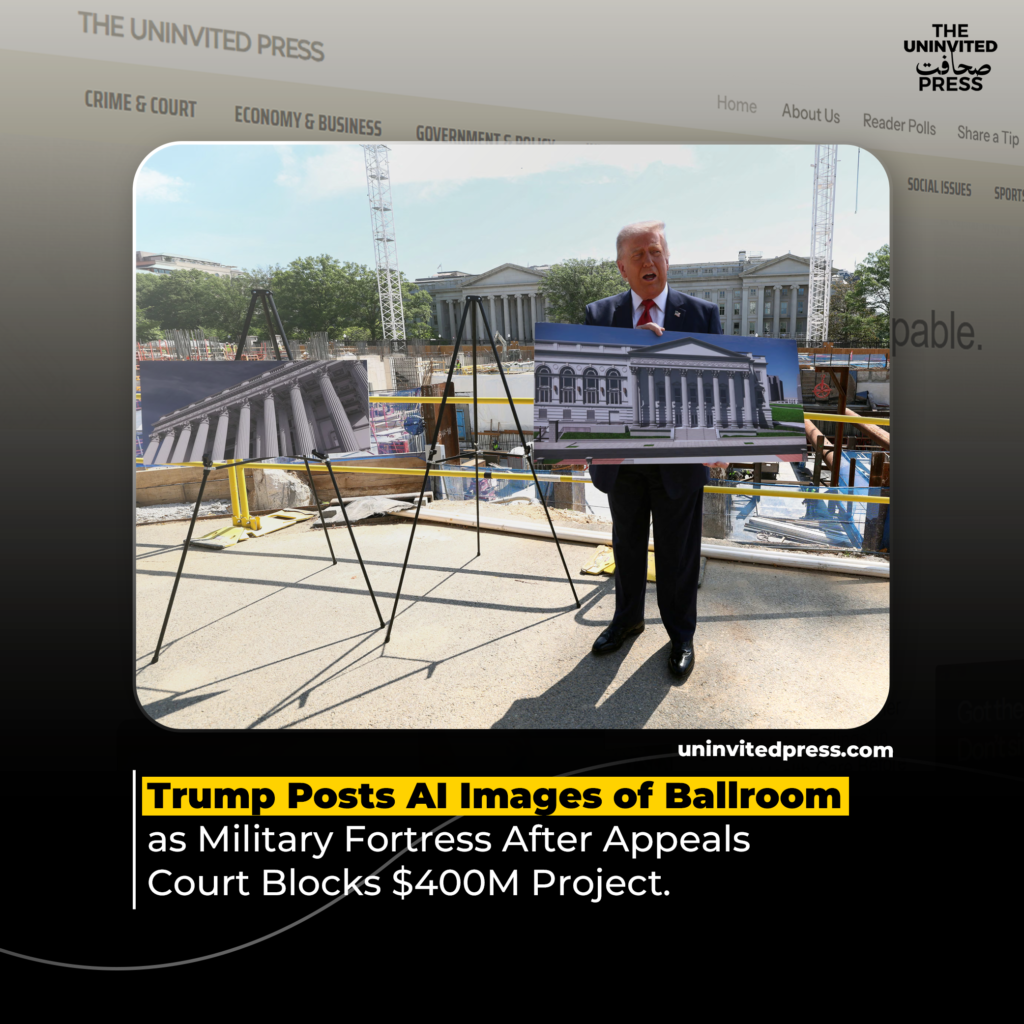
President shares AI-generated ‘DronePort’ visuals showing armed drones and troops on the roof, vowing to take fight to Supreme Court.
US President Donald Trump has posted AI-generated images depicting his planned White House ballroom as a heavily fortified military installation, complete with drones, armed personnel and vehicles on the roof, one day after a federal appeals court ordered a halt to above-ground construction of the $400 million project without congressional approval.
In posts on Truth Social on Saturday, Trump shared two images labelled “DronePort.” One shows rows of large military drones arranged on a flat rooftop, ringed by soldiers in tactical gear. The other depicts a similar scene at sunset, with additional military vehicles, including fuel trucks, and dozens of personnel. Both images carry the White House seal.
“This great and very important military asset sits atop the heavily protected Ballroom at the White House,” Trump wrote. “It provides National Security for Washington, D.C., and will protect future Presidents!!!”
Court Blocks Trump’s $400 Million White House Ballroom Project:
The posts came after a divided three-judge panel of the US Court of Appeals for the District of Columbia Circuit ruled 2-1 on Friday that the Trump administration lacks the unilateral authority to build the roughly 90,000-square-foot (8,400-square-metre) ballroom on the site of the demolished East Wing. The majority opinion stated that “whether or not a massive ballroom should be constructed is for Congress to decide and is not a matter for executive self-help.”
Judges Patricia Millett and Bradley Garcia formed the majority, while Judge Neomi Rao dissented. The court paused the effect of its ruling for 14 days to give the administration time to seek review from the Supreme Court. Trump quickly announced he would appeal, calling the decision “horrendous, politically motivated, and unlawful” and framing the entire complex as a vital “Military Center.”
Trump has increasingly described the project in national security terms. He has said the structure includes bomb shelters, a state-of-the-art hospital and medical facilities, top-secret military spaces, missile-resistant materials, and a drone-proof roof designed to serve as a launch and defence platform for the capital. In earlier comments, he claimed the roof could withstand a direct drone strike and would help protect Washington, DC.
The ballroom plan, first announced in 2025, involves replacing the historic East Wing, which was demolished over a short period last year. Trump has maintained that the project is being funded by private donations and will not cost taxpayers money, though the estimated price has risen to at least $400 million. Critics, including the National Trust for Historic Preservation, which brought the legal challenge, argue that such a major alteration to the White House requires explicit congressional authorisation and proper historic review.
Court Ruling Puts Trump’s White House Project on Hold:
The administration has countered that congressional funding for White House maintenance and the project’s security features amount to sufficient authority. Lower-court rulings had already restricted above-ground work while allowing underground construction of bunkers and related facilities to continue.
The latest court decision marks a significant check on presidential power over the White House complex, which the appeals court described as belonging to the American people rather than any individual occupant. “Each President is a temporary tenant, not the owner, of the White House,” the majority wrote.
As the legal battle heads toward the Supreme Court, the episode has drawn attention to the blending of ceremonial presidential architecture with expansive security claims. Trump’s decision to release AI-generated military imagery of the unfinished project underscores his insistence that the ballroom is inseparable from national defence-a framing that both supporters and critics say will shape how the highest court ultimately views the dispute.
For now, construction of the above-ground portion remains under a temporary pause, while the underground elements of what Trump calls a comprehensive security complex continue. The coming weeks will determine whether the president can proceed with one of the most ambitious physical transformations of the White House in decades, or whether Congress must first give its explicit consent.