

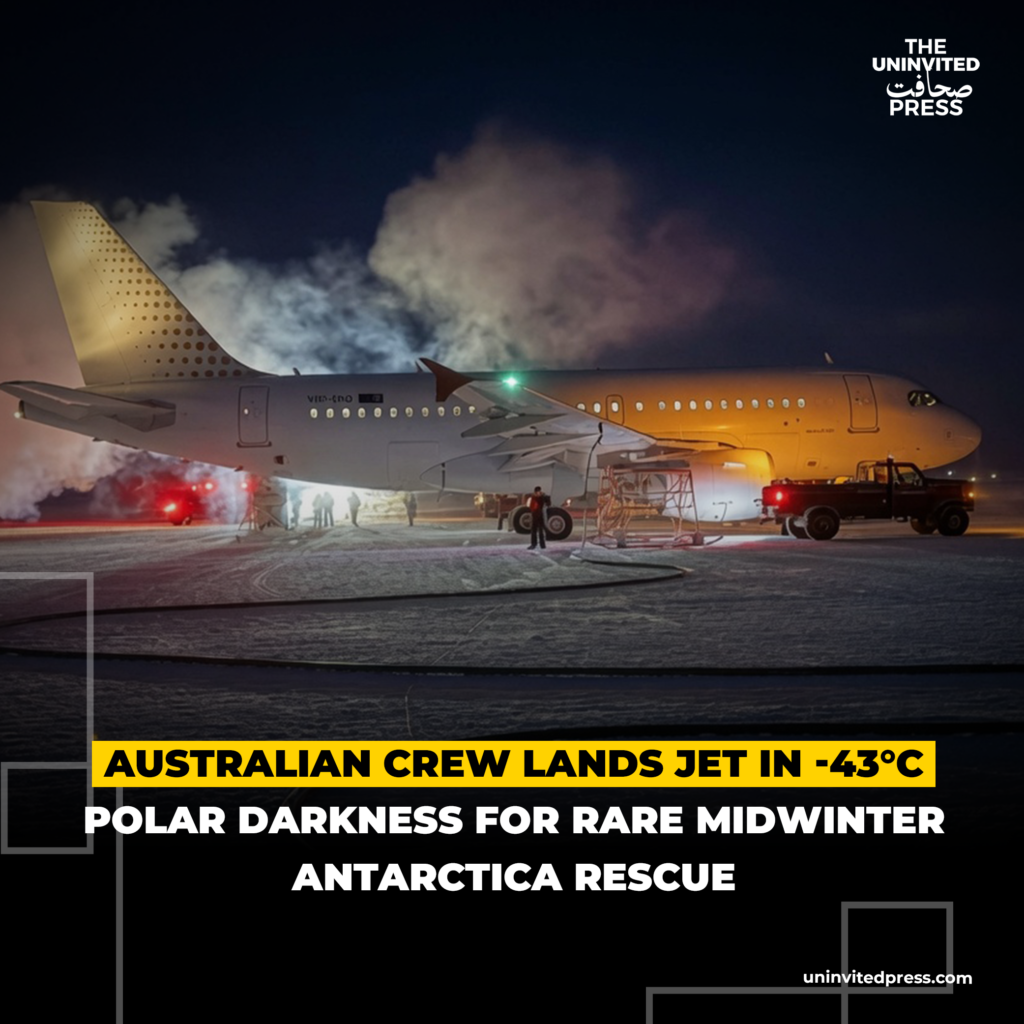
Skytraders Airbus A319 completes high-risk medical evacuation from US McMurdo Station amid total darkness and extreme cold.
An Australian aviation crew has carried out a rare and high-risk midwinter medical evacuation from Antarctica, landing a commercial jet in temperatures of -43°C and near-total darkness to rescue a US expeditioner.
The Melbourne-based company Skytraders said its Airbus A319 Long Range aircraft, operating under the call sign Snowbird 1, departed Hobart in Tasmania in the early hours of 31 July after receiving an urgent request for assistance from the US McMurdo Station on Ross Island.
Jet Evacuates Patient From -43°C Antarctica:
After an initial delay caused by severe weather, the crew took advantage of a narrow weather window. The flight lasted approximately five and a half hours before the aircraft landed at the Phoenix Airfield near McMurdo Station. Conditions at the time included complete polar darkness-with only minimal nautical twilight-and temperatures as low as -43°C (-45.4°F), accompanied by wind chill.
“Operating in extremely challenging conditions and temperatures as low as -43 degrees Celsius, the crew safely transferred the patient before departing Antarctica ahead of deteriorating conditions,” Skytraders said in a statement.
The patient, whose identity and specific medical condition have not been disclosed, was flown the same day to Christchurch, New Zealand, for treatment. The US National Science Foundation confirmed the individual was admitted to Christchurch Hospital in a serious condition. Later reports indicated the patient was recovering well.
Co-pilot Captain Louise Robertson, one of four pilots on the flight and part of a husband-and-wife team with Captain Rod Robertson, who landed the aircraft, described the conditions as pushing the limits of the aircraft and crew.
Historic Midwinter Antarctica Rescue Mission:
“It got down to -43, which is the coldest I’ve ever felt. It was about eight knots of wind, so quite a bit of wind chill as well,” she said. “To get there in complete darkness in these extreme cold temperatures is very, very rare. I believe it hasn’t been done before.”
Robertson noted that the mission required extensive preparation, including rapid reconfiguration of the aircraft into a medevac setup within 24 hours, coordination with meteorologists, engineers, ground crews and medical teams. Ground staff at the station worked in extreme cold to prepare the ice runway.
Skytraders, which is contracted by the Australian Antarctic Program, has conducted winter medical evacuations before, but officials said this was the earliest in the season and the closest to the winter solstice for a civilian airliner of this type. Midwinter flights to Antarctica are extremely rare because of prolonged darkness, extreme cold, limited daylight and unpredictable weather that can close ice runways for extended periods.
The successful operation highlights both the logistical challenges of supporting research stations on the continent during the polar winter and the specialised expertise required for such missions. The sun does not rise at the geographic South Pole between late March and late September, making any aviation activity during this period exceptionally demanding.