

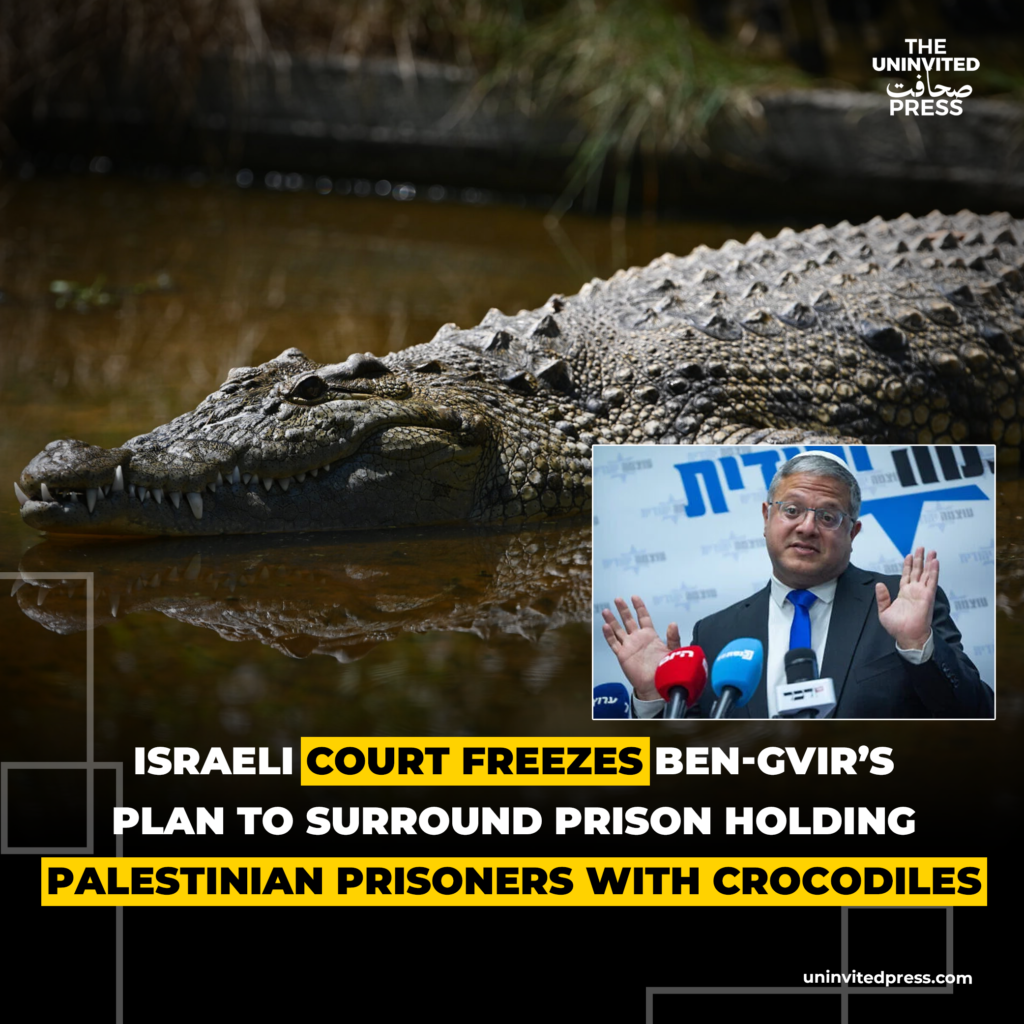
Jerusalem District Court issues interim injunction blocking transfer of Nile crocodiles to Ketziot Prison after animal rights petition, drawing sharp rebuke from far-right minister.
An Israeli court has temporarily halted a highly controversial plan by National Security Minister Itamar Ben-Gvir to deploy Nile crocodiles around a prison holding Palestinian detainees, including those accused of involvement in the October 7, 2023 attacks.
On Sunday, the Jerusalem District Court issued an interim order preventing the state from locating or preparing Nile crocodiles for transfer to Ketziot Prison in the Negev desert. The ruling came hours after the animal welfare organisation Let the Animals Live filed an administrative petition and an urgent request to stop the project. Judge Avraham Rubin ordered that the freeze remain in place until the state responds by August 16 and the court decides on a longer-term injunction.
The pilot scheme, promoted by Ben-Gvir and facilitated by Environmental Protection Minister Idit Silman, envisaged surrounding a high-security wing at Ketziot with water channels filled with the reptiles. Construction of approximately 170-metre trenches inside the prison compound had already begun in recent weeks. Officials described the channels as an additional security layer intended to deter escape attempts by Palestinian “security prisoners,” many of them held without charge or under sweeping allegations linked to the ongoing war on Gaza.
Ben-Gvir Slams Court Plan:
Ben-Gvir, a far-right figure known for advocating harsher conditions for Palestinian detainees, reacted with characteristic fury. “Once again, during wartime, the judicial system sides with the terrorists and blocks important steps for Israeli deterrence,” he said. “We know the terrorists are trembling at the arrival of the crocodiles, but the court today came to their aid. Cleaning up the corrupt judicial system is the most critical task immediately after the elections, and we will not compromise on this.”
His office had previously justified the scheme in stark terms: “Those who massacred, raped, murdered, and behaved like an animal should have his own kind watch over him.”
The plan advanced after Silman reclassified the Nile crocodile as a “tended” or “domesticated wild animal,” overriding objections from her own ministry’s legal advisers and the Israel Nature and Parks Authority. Under previous rules, the reptiles could only be kept in licensed zoological facilities for education or research. The change allowed security agencies, including the Israel Prison Service under Ben-Gvir’s authority, to keep them for “security purposes.” Prison officers had toured a crocodile farm at Hamat Gader, feasibility studies were conducted, and a budget of tens of millions of shekels was allocated.
Israeli Court Freezes Ben-Gvir’s Crocodile Plan for Palestinian Prisoners:
Ketziot, also known as al-Naqab Prison, is one of Israel’s largest detention facilities for Palestinians from the occupied West Bank and Gaza. It has long been criticised by human rights groups for overcrowding, punitive conditions, and reports of abuse, particularly since the escalation of Israel’s assault on Gaza. Ben-Gvir has repeatedly publicised harsh measures there, including restrictions on movement, blankets, and food for certain detainees.
Animal rights advocates and Palestinian rights organisations condemned the crocodile scheme as both cruel to the animals and a degrading form of collective punishment. Critics argued it reflected a broader pattern of dehumanisation in Israel’s treatment of Palestinian prisoners, many of whom are held under administrative detention without trial. Rights groups have documented widespread mistreatment across the Israeli prison system, including denial of medical care, solitary confinement, and physical abuse, especially in the years following October 2023.
The court intervention marks a rare judicial check on one of Ben-Gvir’s more extreme proposals. Whether the freeze becomes permanent will depend on the state’s response and further hearings. For now, the trenches dug at Ketziot stand empty, a physical reminder of a plan that sought to turn living predators into instruments of deterrence against Palestinian captives.