

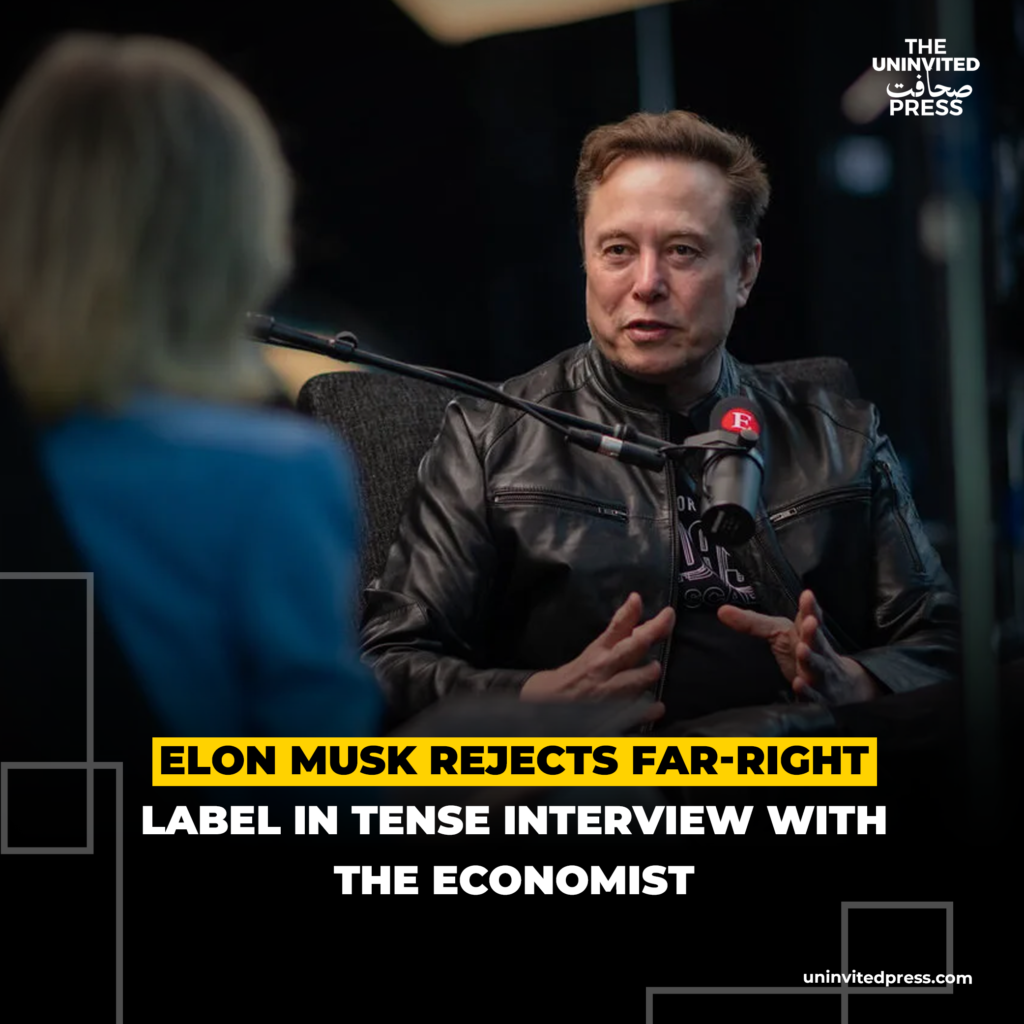
Tesla and SpaceX chief insists his views on borders, crime and spending are mainstream as editor challenges his political positions.
Elon Musk has firmly rejected accusations that he supports the far right, insisting during a wide-ranging and occasionally tense interview with The Economist that he backs “normal people” whose concerns have been mischaracterised by the media.
In the conversation with editor-in-chief Zanny Minton Beddoes, recorded at a Tesla facility in Texas and released on July 23, Musk pushed back when the interviewer suggested he supports not only the populist right but “the far right-in fact, very fringe parties in some countries.”
“No, I support the normal people. What you call the far right, falsely,” Musk replied. He challenged Beddoes to identify which of his core positions-secure borders, safe cities and sensible government spending-were extreme, arguing that these were once mainstream views shared by figures such as former US presidents Barack Obama and Bill Clinton.
Elon Musk Responds to Critics:
Musk, the world’s richest man and owner of the social media platform X, has faced repeated criticism for amplifying or endorsing right-wing figures and parties in Europe, including support for France’s Marine Le Pen. Critics accuse him of stoking division and promoting views that veer into the extreme. Musk has long denied being racist or aligned with far-right ideology, framing his positions as a defence of Western values against what he sees as uncontrolled immigration, rising crime and excessive government spending.
The interview touched on several sensitive topics. Musk reiterated warnings about social tensions in Britain, predicting a future “reckoning,” and discussed immigration, saying he supports newcomers who share Western values but cautioned against large inflows of people with opposing views. Beddoes, who is based in Britain, challenged some of these characterisations.
Elon Musk Defends Political Involvement:
Musk also reflected on his political involvement, acknowledging that he “got a little too involved” at times, while defending his work on government efficiency initiatives. Broader subjects included artificial intelligence, which he predicted could surpass the sum of human intelligence within five years, and the rapid technological progress of China.
The exchange highlights the polarising role Musk continues to play in global politics and media. Admirers see him as a free-speech advocate and truth-teller willing to challenge progressive orthodoxy. Detractors view his interventions as irresponsible and amplifying fringe narratives that undermine social cohesion in Europe and elsewhere.