

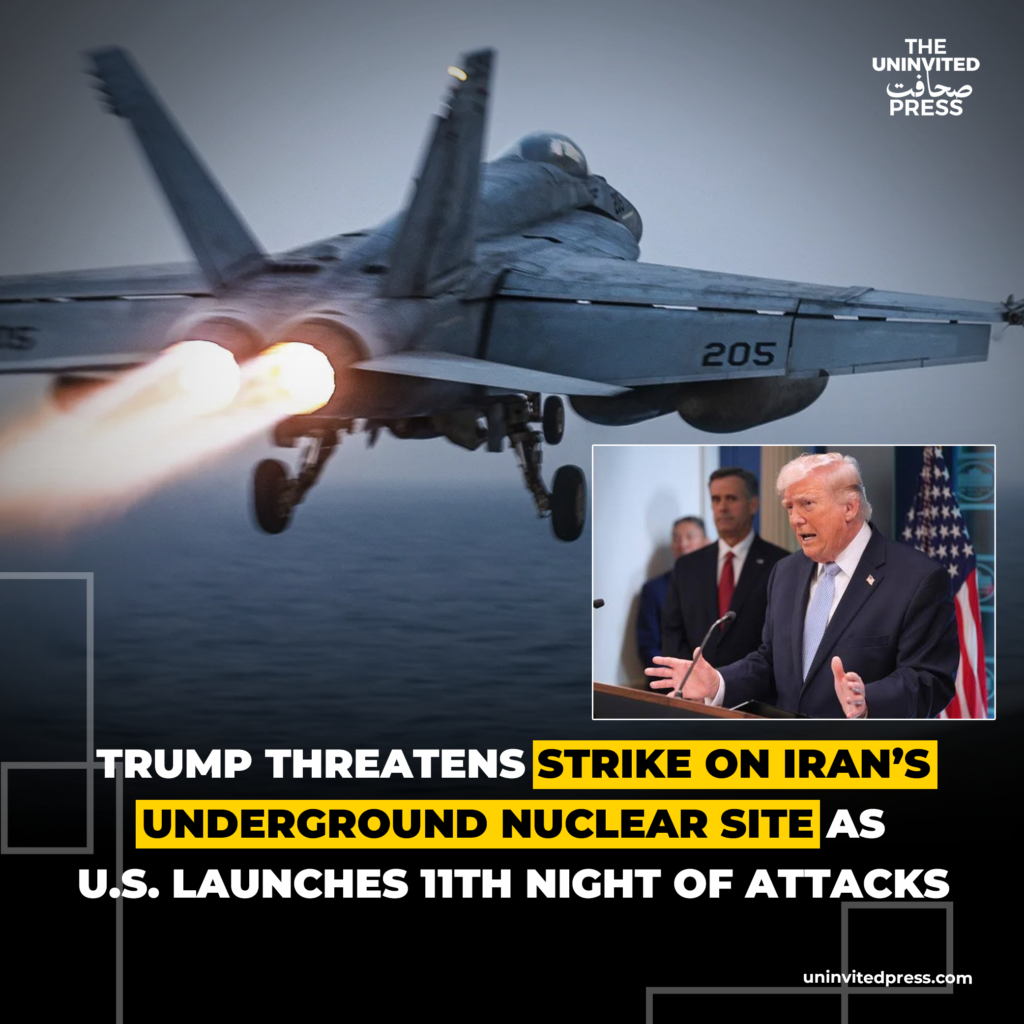
US president warns of direct action against Fordow facility amid ongoing military campaign, raising fears of wider regional war.
US President Donald Trump has issued a fresh warning of potential strikes on Iran’s heavily fortified underground nuclear facility at Fordow, as American forces reportedly conducted the 11th consecutive night of attacks in what has become a rapidly intensifying confrontation between the United States and Iran.
The comments come as tensions in the Middle East reach new heights, with the Trump administration appearing determined to neutralise what it describes as Iran’s nuclear threat and its support for regional proxy groups.
In public remarks, Trump signalled that the Fordow site-buried deep underground and considered one of Iran’s most protected nuclear installations-remains a prime target. “We are not going to allow Iran to develop nuclear weapons,” he stated, leaving open the possibility of direct US strikes on hardened facilities that Israeli and American intelligence have long monitored.
US-Iran Conflict Enters 11th Night:
According to reports, the United States has launched multiple rounds of strikes, targeting Iranian military infrastructure, missile sites, and assets linked to the Islamic Revolutionary Guard Corps (IRGC). The 11th night of operations suggests a sustained air and possibly naval campaign, though full details remain limited due to operational security.
The escalation follows a series of exchanges that began with Israeli actions against Iranian targets and subsequent Iranian retaliation, pulling the US deeper into direct involvement. Trump has framed the campaign as necessary to protect American interests and allies, particularly Israel, while preventing Tehran from acquiring nuclear weapons.
Iran has vowed a strong response to any further aggression, warning that strikes on its nuclear sites would trigger “unprecedented” retaliation across the region, potentially targeting US bases and closing key waterways such as the Strait of Hormuz.
Global Calls for De-Escalation Rise:
Military analysts note that Fordow, located near Qom, is designed to withstand conventional bombing. Destroying or significantly damaging it would likely require advanced bunker-buster munitions, such as the US GBU-57 Massive Ordnance Penetrator, and could carry significant risks of civilian casualties and environmental contamination.
The broader campaign has already caused disruption across the region, with fears of oil price spikes, refugee flows, and a wider war drawing in other actors including Hezbollah, the Houthis, and potentially Russia or China.
Inside the United States, the escalation has drawn mixed reactions. Supporters of the administration view it as a necessary show of strength against a long-standing adversary, while critics warn of mission creep, high costs, and the danger of another prolonged Middle East conflict reminiscent of past US interventions.
International calls for de-escalation have grown, with the United Nations, European powers, and several Arab states urging restraint. China and Russia have criticised the US actions as destabilising.
As the situation evolves rapidly, the coming days could prove decisive. Whether Trump’s threat against Fordow is carried out-or serves primarily as leverage in potential negotiations-will shape the trajectory of this dangerous chapter in US-Iran relations.