

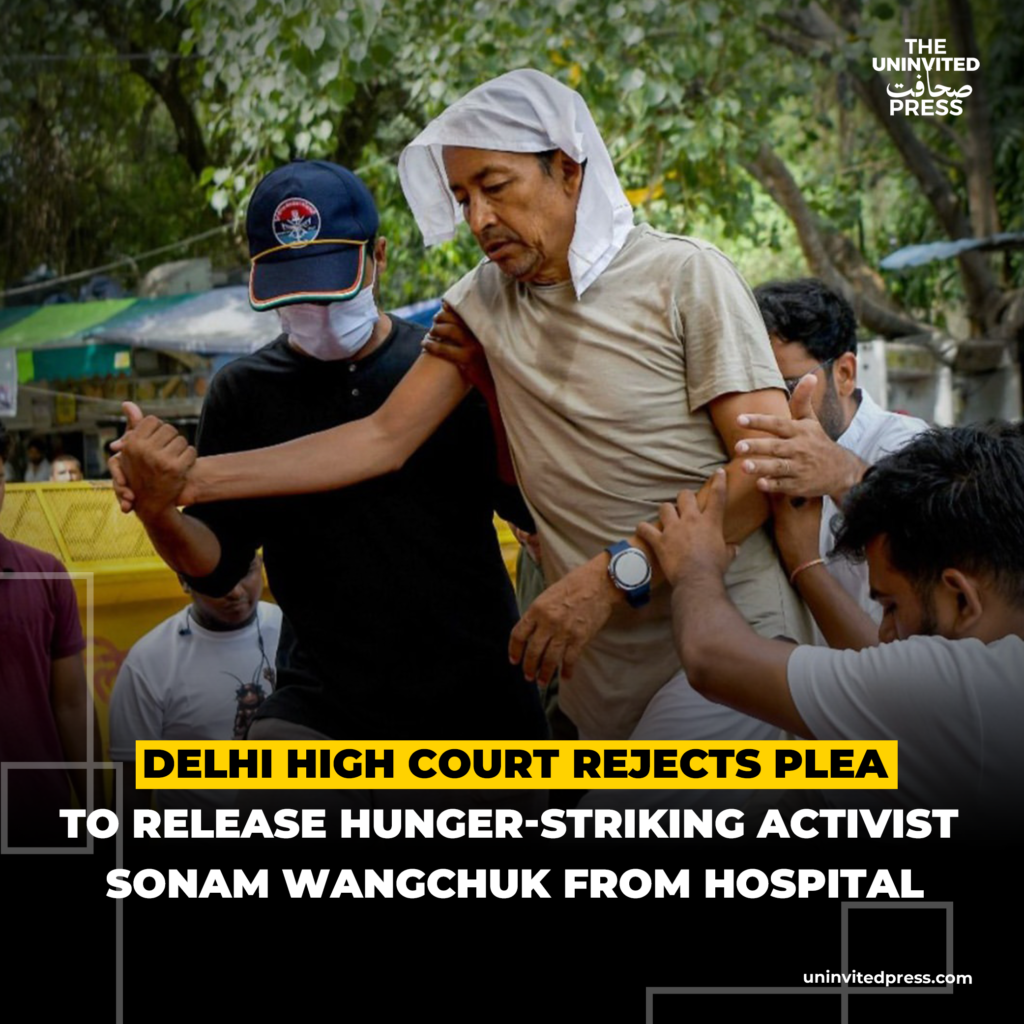
Court upholds government move to hospitalise Ladakh climate activist amid concerns over his health on the 21st day of fast.
India’s Delhi High Court has rejected a plea by the family of prominent climate activist and education reformer Sonam Wangchuk to transfer him from a government hospital to a private facility, as he continues an indefinite hunger strike now in its third week.
Justice Mini Pushkarna, hearing the petition filed by Wangchuk’s wife Gitanjali Angmo, ruled on Sunday that the authorities’ decision to shift the activist from the protest site at Jantar Mantar to Safdarjung Hospital was not arbitrary and did not violate his personal liberty. The court emphasised that the move was taken to protect his life, citing medical concerns over his deteriorating condition.
Wangchuk, known for his long-standing advocacy for environmental protection in the Himalayan region of Ladakh and reforms in India’s education system, began his fast on June 28 in solidarity with the Cockroach Janta Party (CJP) protests. The demonstrators have been demanding the resignation of Union Education Minister Dharmendra Pradhan over alleged irregularities and paper leaks in competitive examinations, including the NEET-UG scandal that affected millions of students.
Delhi HC Backs Government Hospital Care:
Angmo argued in court that her husband was being held at Safdarjung Hospital against his and the family’s will, describing the situation as a violation of his bodily autonomy. She sought his transfer to Medanta Hospital in Gurugram, expressing a lack of faith in the government facility and alleging restricted access for family members and independent medical assessment.
The court, however, noted that Wangchuk is not under formal detention and that doctors at Safdarjung Hospital have been monitoring him closely. It referred to an earlier division bench order directing authorities to ensure his health is protected through necessary medical intervention. Hospital bulletins have indicated signs of dehydration and weakness, though Wangchuk has reportedly refused intravenous fluids and certain treatments.
Following the ruling, Angmo expressed disappointment, stating that the petition was misinterpreted and questioning the need for government intervention when her husband’s health was stable enough to continue his protest. The family plans to pursue further legal recourse, with the matter listed for another hearing soon.
Ladakh Protest Gains National Attention:
Wangchuk’s hunger strike has drawn significant public attention, amplifying calls for accountability in India’s education sector and longstanding demands for greater constitutional safeguards for Ladakh, including its inclusion under the Sixth Schedule of the Constitution. The activist has previously undertaken several fasts to highlight issues related to climate change, glacial melting, and the strategic importance of the border region.
On Saturday, Delhi Police removed Wangchuk from Jantar Mantar on medical advice and in compliance with court directives, sparking criticism from supporters who viewed the action as heavy-handed. Police maintained that the intervention was necessary to safeguard his life.
Wangchuk has set conditions for ending his fast, including government accountability for examination failures or assurances from parliamentarians to raise the issues during the Monsoon Session. Despite reports of significant weight loss and health risks, he has remained resolute, telling supporters he is prepared to continue the protest.
The case highlights ongoing tensions between the right to peaceful protest and the state’s duty to protect life, particularly in high-profile hunger strikes. India has a history of such agitations, from Mahatma Gandhi’s freedom struggle to more recent farmers’ protests, often raising complex legal and ethical questions around bodily autonomy and state intervention.
As the Monsoon Session of Parliament begins, Wangchuk’s protest and the court proceedings are likely to keep the spotlight on issues of educational integrity and regional aspirations in Ladakh. Authorities continue to monitor the situation closely, while civil society groups call for dialogue to resolve the underlying grievances.