

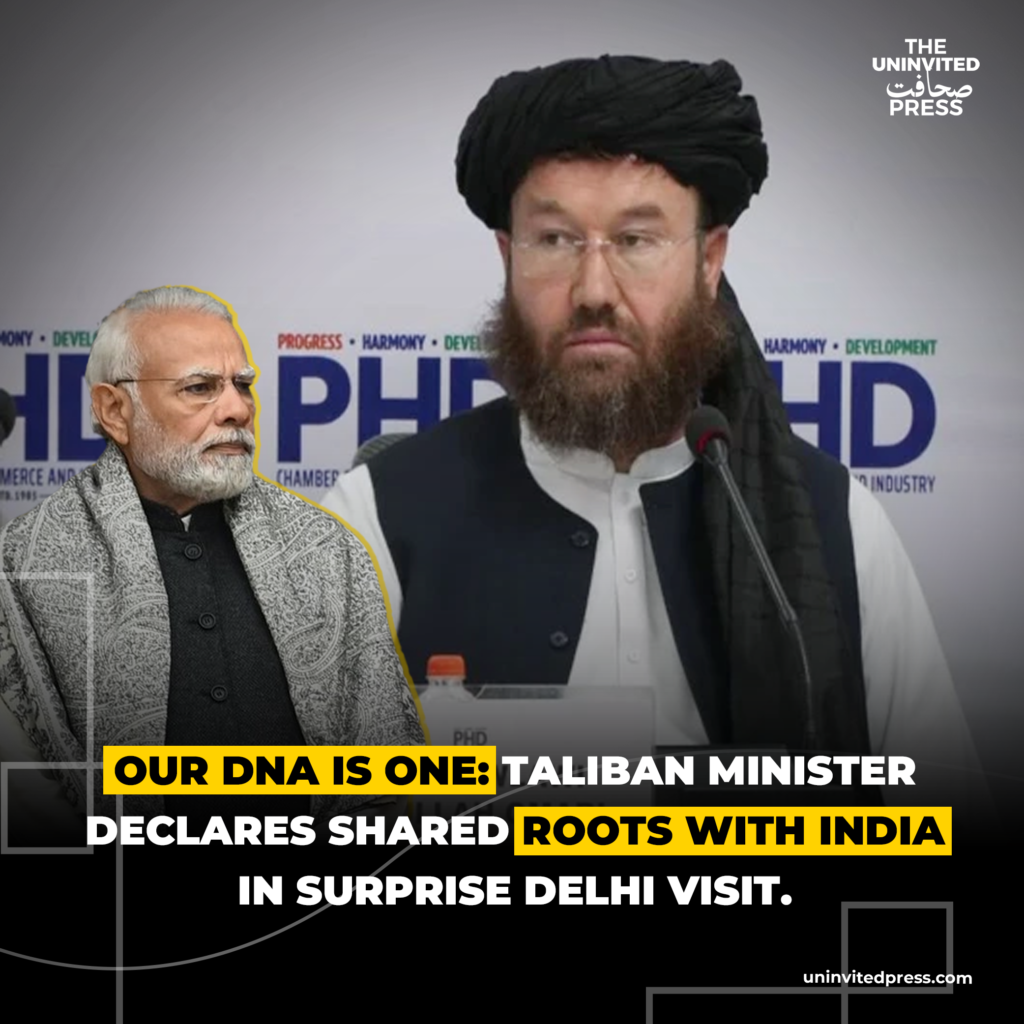
Afghan official’s remarks underscore deepening engagement between New Delhi and the Taliban-led government amid shifting regional dynamics.
In a notable diplomatic overture, Afghanistan’s Taliban-appointed Minister of Agriculture, Irrigation and Livestock, Mawlawi Ataullah Omari, has spoken warmly of shared historical and cultural bonds with India, declaring during a visit to New Delhi that the two nations “share one DNA.”
The statement, made at an India-Afghanistan trade and industry event organised by the PHD Chamber of Commerce and Industry, comes as bilateral ties continue to expand despite India’s longstanding policy of not formally recognising the Taliban government.
Taliban Minister Calls India ‘Like Home’:
Omari, who arrived in the Indian capital earlier this week, described feeling “at home” among Indians and praised the warm hospitality extended to his delegation. “It feels as if I am among my own people. It feels like our own country… our DNA is one,” he reportedly said.
The visit focused primarily on agricultural cooperation, including potential exchanges of seeds for wheat, maize and potatoes, irrigation expertise, and climate-resilient farming practices. Both sides agreed to establish a Joint Working Group to enhance long-term collaboration in research, education and trade.
This marks one of several high-level engagements in recent months, building on previous visits such as that of Taliban Foreign Minister Amir Khan Muttaqi in late 2025. India maintains a small diplomatic presence in Kabul and continues to provide humanitarian assistance, reflecting a pragmatic approach driven by economic interests, regional security concerns and countering influence from rivals like Pakistan.
New Delhi, Taliban Explore Cautious Engagement:
Cultural and civilisational links between the Indian subcontinent and Afghanistan date back centuries, encompassing trade routes, shared linguistic influences and historical migrations. Analysts note that India has long enjoyed goodwill in Afghanistan through development projects and assistance programmes.
However, the evolving relationship remains complex. India has expressed concerns over the Taliban’s policies on women’s rights, minority protections and the use of Afghan territory by militant groups. New Delhi has not extended formal diplomatic recognition, even as countries like Russia have taken steps in that direction.
The Taliban minister’s effusive remarks have sparked mixed reactions online and in regional media, with some viewing them as an attempt to build bridges while others see them through the lens of geopolitical manoeuvring.
As Afghanistan grapples with economic challenges and international isolation, and India seeks to secure its strategic interests in its neighbourhood, such interactions signal a cautious thaw. Whether this translates into deeper political alignment or remains limited to trade and humanitarian spheres will be closely watched by observers across South and Central Asia.