

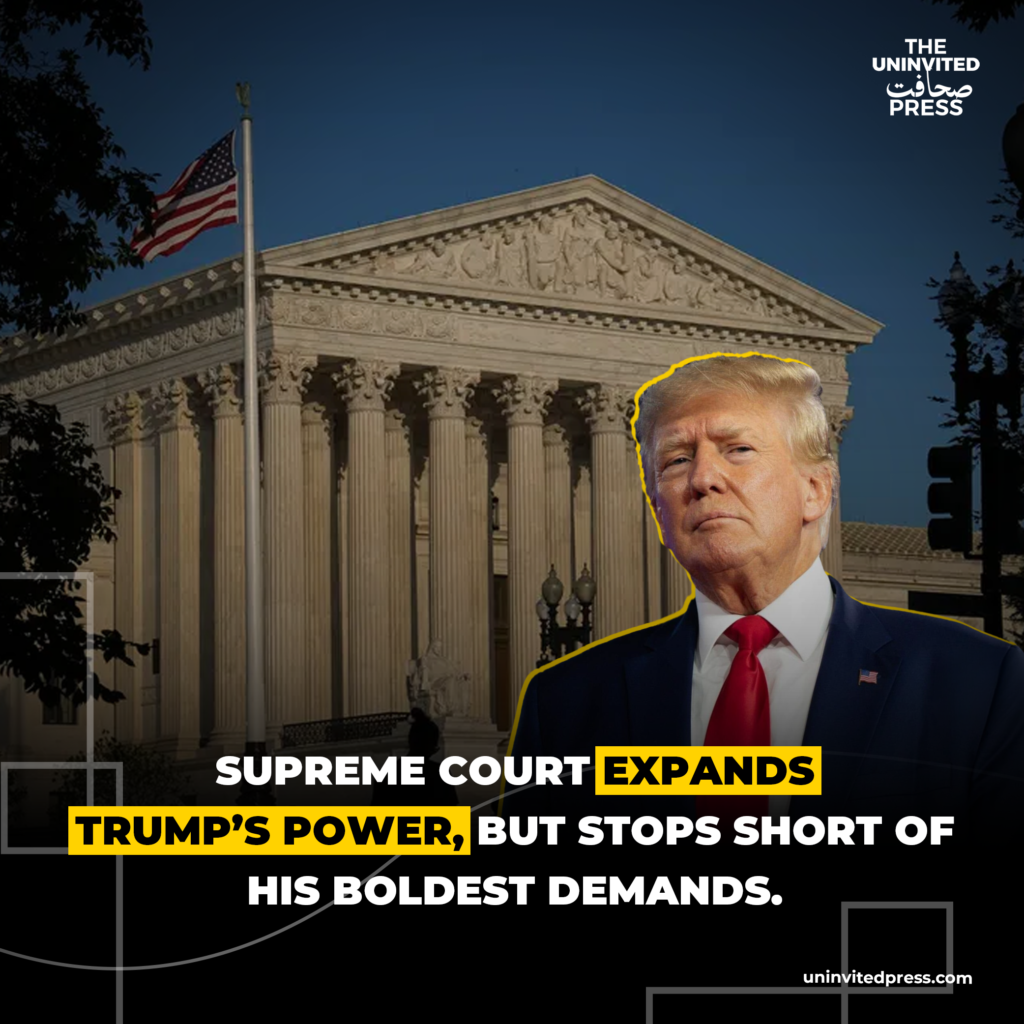
Decision overturns 91-year precedent but spares Federal Reserve, drawing praise from White House and sharp criticism from opponents.
The US Supreme Court has significantly broadened presidential power by allowing President Donald Trump to remove leaders of key independent regulatory agencies, overturning a long-standing precedent that had insulated such officials from at-will dismissal.
In a 6-3 ruling issued on Monday, the court’s conservative majority held that Trump could fire Federal Trade Commission (FTC) member Rebecca Slaughter, a Democratic appointee, without cause. The decision effectively dismantles the 1935 precedent in Humphrey’s Executor v. United States, which had permitted Congress to limit presidential removal powers for certain independent agencies.
Roberts Defends Expanded Presidential Authority:
Writing for the majority, Chief Justice John Roberts emphasised the constitutional structure of separated powers, arguing that limits on the president’s ability to control executive branch officials undermine Article II authority. The ruling applies broadly to roughly two dozen multi-member independent agencies, potentially allowing greater White House influence over bodies overseeing competition, consumer protection, securities, and more.
Legal experts described the move as a major victory for the “unitary executive” theory, which seeks to concentrate power in the presidency. “This enhances Trump’s control over the executive branch and his ability to fire civil servants at will,” constitutional lawyer Bruce Fein told Media.
The Trump administration hailed the decision. The president posted on Truth Social calling it a “BIG WIN” and “one of the most important” rulings on presidential powers in decades.
Supreme Court Reshapes Balance of Power:
Liberal justices dissented sharply, warning that the expansion risks politicising independent agencies designed to operate free from direct presidential interference. Critics argue the ruling could enable future administrations to reshape regulatory frameworks overnight, affecting everything from antitrust enforcement to financial oversight.
Democrats and good-government advocates expressed alarm at the potential erosion of institutional independence. The decision comes amid Trump’s broader efforts to assert executive dominance across federal institutions.
The carve-out for the Federal Reserve was viewed as a pragmatic limitation, recognising the unique role of monetary policy in the economy. The court stopped short of granting Trump his “boldest demands” for unfettered control over all agencies.
Analysts say the rulings could reshape how future presidents interact with the administrative state. Supporters view it as correcting an unconstitutional overreach by Congress, while opponents fear it tilts the balance too far toward executive power at the expense of congressional intent and expertise-driven regulation.
The decisions cap a consequential term for the Supreme Court, which has delivered several high-profile wins and setbacks for the Trump agenda on issues ranging from immigration to executive authority.