

Trilateral deal marks a potential breakthrough in longstanding hostilities but faces scepticism over Hezbollah’s role and implementation challenges.
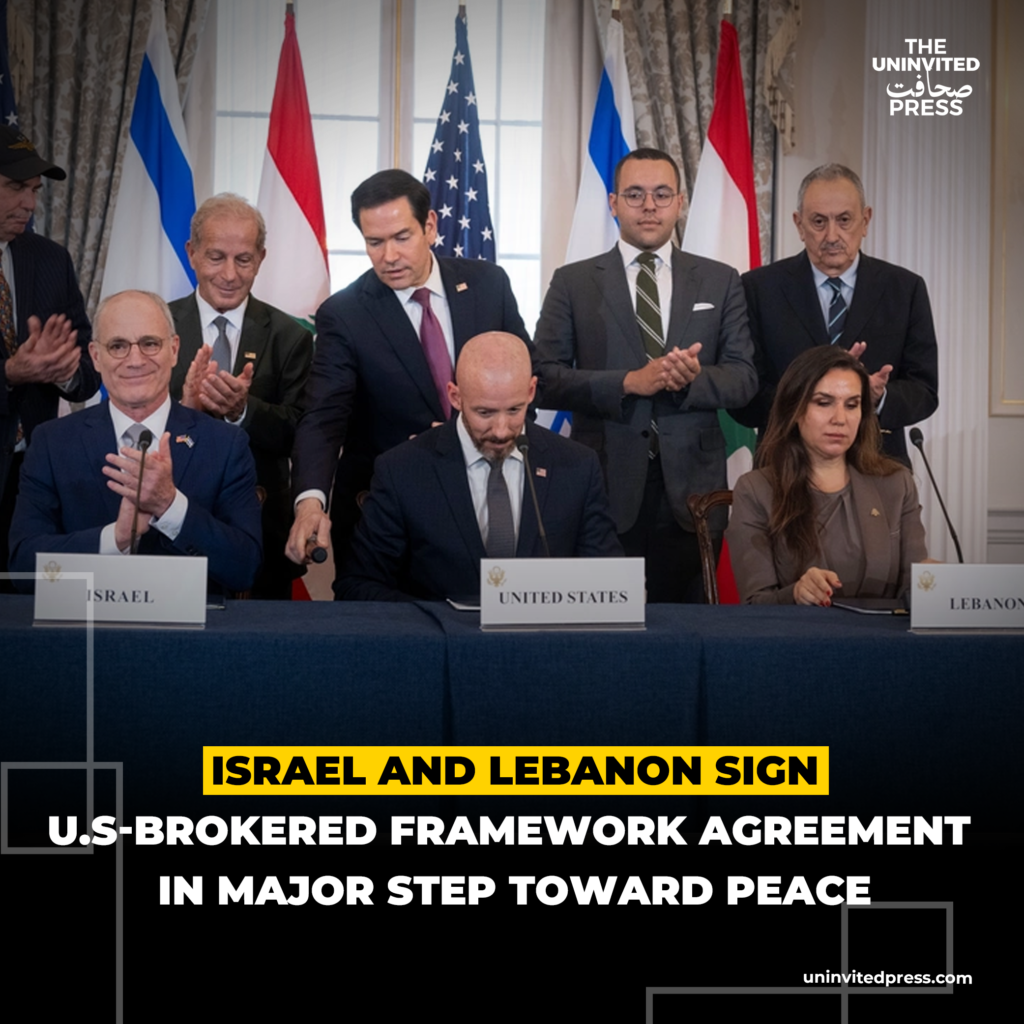
Israeli and Lebanese officials have signed a US-mediated framework agreement aimed at ending hostilities and laying the groundwork for a more comprehensive peace and security pact, in what mediators describe as a significant, albeit preliminary, step toward stability along their shared border.
The signing ceremony at the US State Department on Friday comes after months of intense indirect negotiations, building on earlier ceasefire understandings. US Secretary of State Marco Rubio hailed the agreement as a rejection of Iranian influence through Hezbollah and a pathway to normalised relations between the two neighbours.
US Unveils Israel-Lebanon Ceasefire Framework:
According to joint statements, the agreement envisions a ceasefire contingent on Hezbollah halting attacks and withdrawing its forces from southern Lebanon, particularly areas south of the Litani River. It includes provisions for “pilot zones” where the Lebanese Armed Forces would assume control, aiming to restore Lebanese sovereignty while addressing Israel’s security concerns.
Ambassadors from both countries-Yechiel Leiter for Israel and Nada Hamadeh for Lebanon-participated in the ceremony alongside US officials. The framework emphasises direct negotiations between the sovereign governments of Israel and Lebanon, sidelining non-state actors in the political track.
Lebanese representatives described the deal as a first step toward restoring territorial integrity, while Israeli officials stressed the need for verifiable security arrangements to prevent future threats.
The agreement emerges against the backdrop of recurring cross-border violence that escalated dramatically in recent years, particularly involving Hezbollah’s military activities. Previous US-brokered efforts, including temporary cessations of hostilities earlier in 2026, have struggled to take hold amid mutual accusations of violations and entrenched positions.
For Lebanon, already grappling with severe economic and political crises, any lasting de-escalation could offer a reprieve from destruction and displacement. Israel has long cited Hezbollah’s arsenal and presence near the border as an existential threat.
US Peace Plan Faces Major Challenges:
While US officials project optimism, analysts caution that the framework’s success hinges on enforcement mechanisms and Hezbollah’s compliance. The group has previously rejected aspects of similar deals that demand its withdrawal from southern Lebanon.
Regional observers note that broader geopolitical dynamics-including Iran’s influence, the situation in Gaza, and domestic politics in both Israel and Lebanon-will heavily influence implementation. Rights groups and some Lebanese voices have raised concerns about sovereignty and the potential for renewed cycles of violence if underlying issues remain unaddressed.
The framework calls for further talks in the coming weeks on political and security tracks, with the ultimate goal of a formal peace agreement. Mediators acknowledge significant work remains, including confidence-building measures and addressing disputed border areas.
In a region long defined by conflict, this US-brokered initiative represents a rare diplomatic opening. Whether it translates into enduring peace will depend on the political will in Beirut and Jerusalem, the role of international guarantors, and the ability to marginalise spoilers who benefit from perpetual tension. For millions affected by the violence, even cautious hope marks a departure from the status quo.