

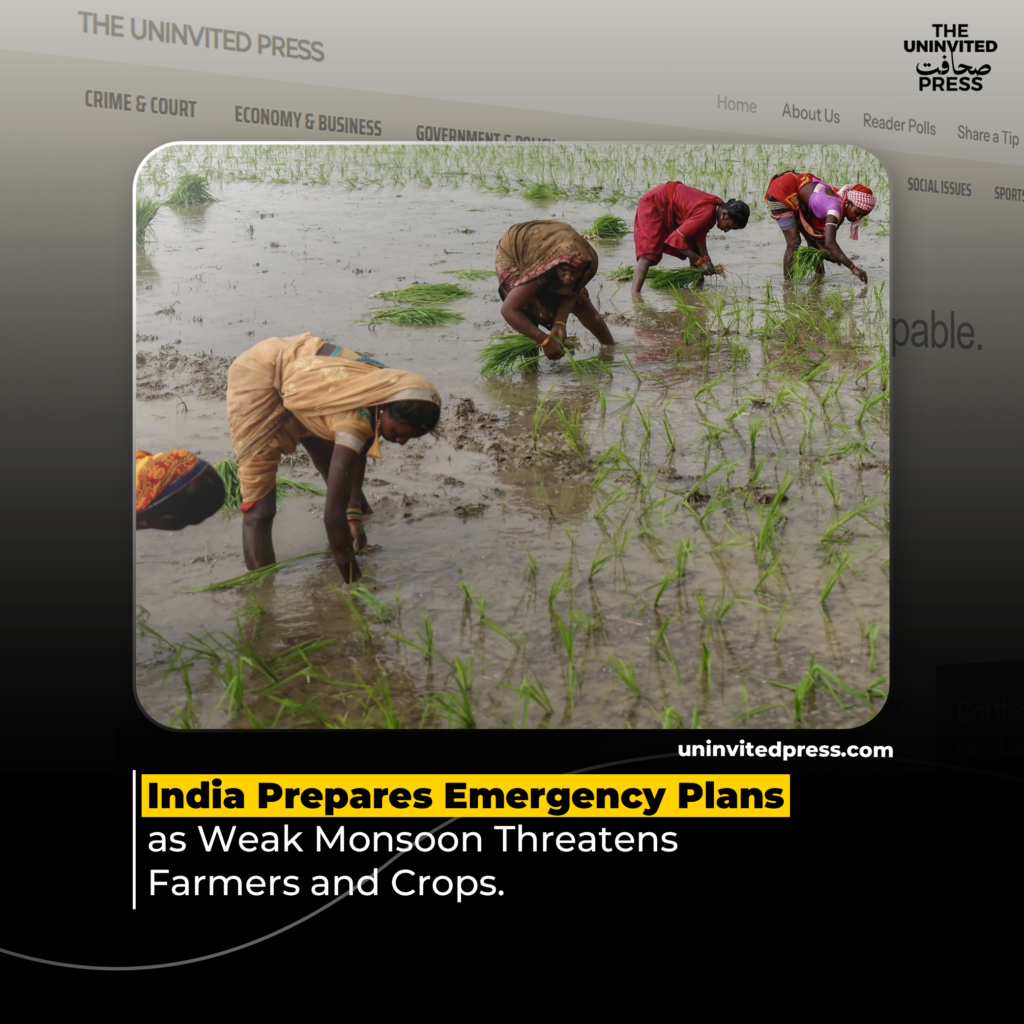
Below-normal rainfall and El Niño risks threaten kharif sowing in rain-fed regions, prompting government action to safeguard rural livelihoods.
Indian authorities are rolling out emergency contingency plans across hundreds of districts as the southwest monsoon remains significantly below average, raising fears of reduced crop yields and economic strain on millions of smallholder farmers.
With rainfall since June 1 running about 43% below normal, the government has identified over 300 vulnerable districts and is urging shifts to drought-resistant crops in areas with limited irrigation.
Government response and preparedness:
Agriculture Minister Shivraj Singh Chouhan has directed states to prepare district-level contingency strategies, classifying 111 districts as high-priority due to low irrigation coverage. Officials are promoting short-duration, less water-intensive crops such as pulses, oilseeds, and millets in rain-fed zones.
The plans include enhanced water conservation measures, revised sowing schedules, and support for alternative cropping patterns to minimise losses during the kharif (summer-sown) season, which accounts for a large share of India’s annual food production.
India’s Meteorological Department (IMD) has forecast the overall monsoon at around 90% of the long-period average, with concerns heightened by the potential development of El Niño conditions that typically suppress rainfall.
Impact on farmers and agriculture:
Millions of farmers, particularly in central, western, and parts of northern India, depend on monsoon rains for planting rice, maize, cotton, soybeans, and other staples. A deficient season could delay sowing, reduce yields, and exacerbate rural distress in a country where agriculture employs nearly half the workforce.
Experts warn of potential ripple effects on food inflation, rural incomes, and overall economic growth if the deficit persists into critical months like July and August. However, the government has noted sufficient buffer stocks of rice and wheat to help stabilise supplies.
This year’s weak monsoon adds to the growing challenges posed by climate variability. Rain-fed agriculture remains highly vulnerable, with uneven distribution of rainfall often proving more damaging than overall deficits.
Environmental and agricultural analysts stress the need for long-term resilience, including expanded irrigation infrastructure, promotion of climate-smart varieties, and better water management practices to reduce dependency on erratic rains.
As the monsoon progresses, the effectiveness of these contingency measures will be critical in determining the extent of impact on India’s farms and food security. Authorities continue to monitor weather patterns closely, with hopes that rainfall will pick up in the coming weeks.