

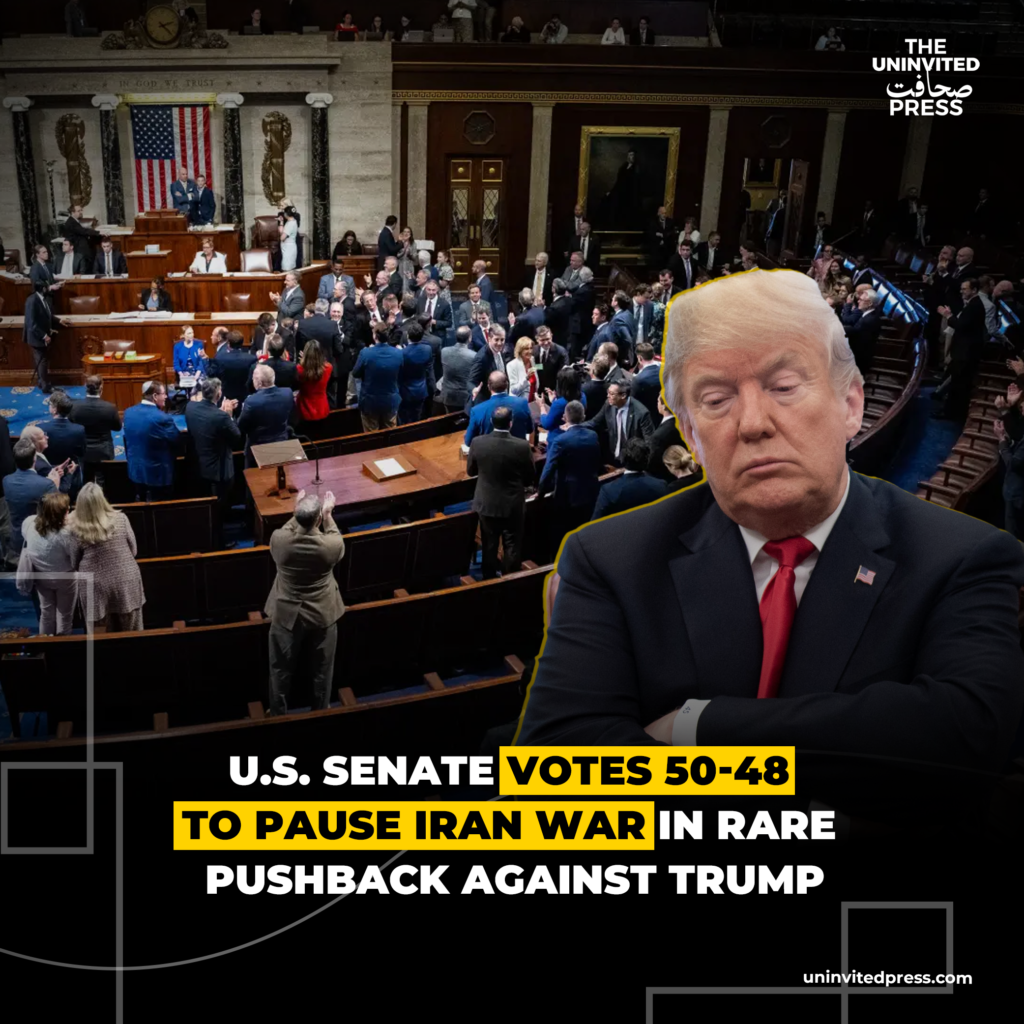
50-48 vote signals growing congressional resistance to Trump administration’s military approach amid fragile regional ceasefire.
The United States Senate has narrowly approved a resolution calling for a pause in military operations related to the recent conflict with Iran, marking a significant, albeit largely symbolic, pushback against President Donald Trump’s hardline policy in the Middle East.
The measure passed by a vote of 50-48, with a handful of Republican senators joining Democrats in support, reflecting unease over the risks of prolonged escalation following US and Israeli strikes on Iranian targets.
Legislators Challenge White House Authority:
The resolution urges de-escalation, a review of ongoing military engagements, and greater congressional oversight in line with the War Powers Resolution of 1973. While non-binding, the vote highlights deepening divisions within the Republican Party and Congress over the scope and duration of US involvement in the Iran conflict.
“This is about reclaiming our constitutional role in decisions of war and peace,” said one Democratic senator during debate. Several Republicans who backed the measure cited concerns about open-ended commitments, potential entanglement in a wider regional war, and the economic fallout from instability in the Gulf.
The Trump administration has dismissed the vote as political posturing, insisting that decisive action was necessary to neutralise Iran’s nuclear threat and regional proxy network.
War Powers Vote Signals Political Divide:
The Senate action comes weeks after a 12-day war that saw intense strikes on Iranian nuclear facilities, missile sites, and military infrastructure. A shaky ceasefire, facilitated through backchannel diplomacy, remains in place but is frequently tested by accusations of violations from both sides.
Iran has denied plans for enhanced IAEA inspections of damaged sites while maintaining its right to rebuild its nuclear programme for civilian purposes. Meanwhile, concerns persist over potential disruption to global energy supplies, shipping routes through the Strait of Hormuz, and the activities of Iranian-backed militias.
The narrow vote underscores the polarised state of US foreign policy as the country heads toward midterm elections. It also revives long-standing debates about the limits of presidential war powers and the role of Congress in authorising military force.
For the Middle East, the resolution may provide diplomatic space for negotiations, including indirect US-Iran talks and efforts to stabilise the fragile truce. However, analysts caution that without broader political consensus in Washington, its practical impact on ground operations or long-term strategy may be limited.
As regional actors-including Israel, Gulf states, and Iranian proxies-recalibrate their positions, the Senate’s move adds another layer of complexity to an already volatile situation. Whether this vote translates into sustained pressure for diplomacy or remains a temporary political gesture will likely shape the trajectory of US-Iran relations in the coming months.