

Think tank urges national plebiscite as critics accuse Albanese government of prioritising gas giants over public services.
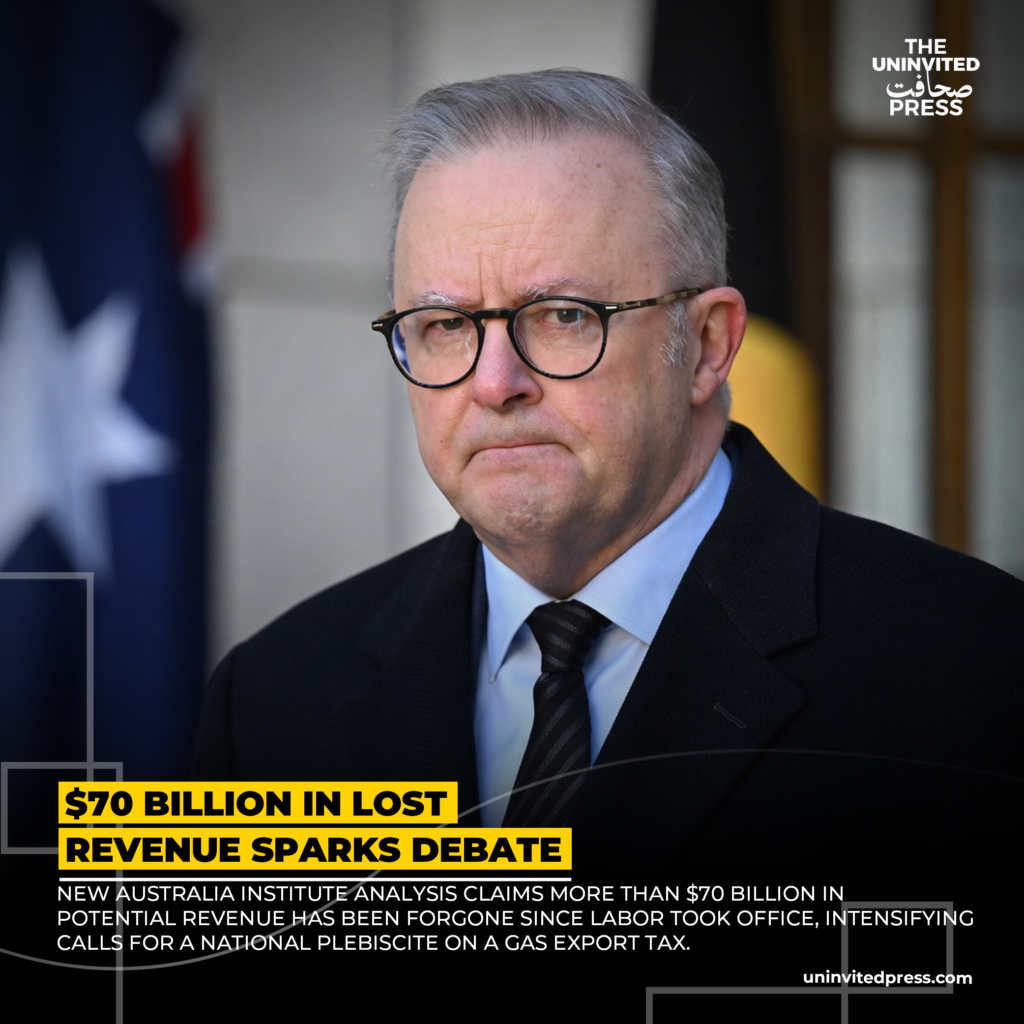
A new analysis has intensified debate over Australia’s management of its vast natural gas resources, claiming the country has forgone more than $70 billion in potential revenue from LNG exports since Prime Minister Anthony Albanese’s Labor government came to power in May 2022.
The report by the Australia Institute, a progressive policy think tank, estimates that implementing a 25 percent tax on gas exports shortly after the election could have generated tens of billions of dollars for public coffers. The figure continues to climb, with the institute’s live “Gas Giveaway Tracker” showing daily losses in the tens of millions.
Calls for Public Vote Gain Momentum:
The findings have fuelled growing calls for the government to hold a national plebiscite, allowing Australians to directly decide on introducing a dedicated gas export tax.
“Let Australians decide,” the institute and its supporters argue, framing the issue as a question of resource sovereignty and economic justice. A flat 25 percent tax could raise approximately $17 billion annually, according to their modelling-funds that could support universal dental care, free education, or childcare.
The campaign has support from trade unions, the Australian Greens, independent crossbenchers, and some within the Labor Party itself. Senator David Pocock and others have highlighted the disparity between record profits enjoyed by gas exporters and the modest returns to the Australian public under the existing Petroleum Resource Rent Tax (PRRT).
Government's Approach: Reliable Agreements, Stable Growth:
The Albanese government has repeatedly ruled out imposing a new tax on existing gas export contracts, citing risks to investment, energy security, and Australia’s reputation as a reliable supplier to key Asian markets such as Japan, South Korea, and China.
Prime Minister Albanese has defended the current approach, pointing to reforms made to the PRRT and arguing that gas companies already contribute significantly through royalties and company tax. Critics, however, say these measures fall far short of capturing windfall profits during periods of high global energy prices.
In recent public statements, Albanese has dismissed aspects of the tax campaign as “slogans,” while emphasising the need to honour long-term contracts amid global energy volatility
Energy Riches, Rising Public Concerns:
Australia is one of the world’s largest LNG exporters, yet many households and small businesses continue to face high energy costs and cost-of-living pressures. The Australia Institute argues that ordinary Australians are subsidising multinational energy giants through forgone revenue that could address pressing domestic needs.
The debate comes as global energy markets remain sensitive to geopolitical tensions, including conflicts in the Middle East, which have influenced both prices and Australia’s diplomatic positioning on fuel supplies.
Whether the pressure from think tanks, unions, and crossbench politicians will force a policy shift remains to be seen. For now, the $70 billion figure-and the tracker updating in real time-keeps the issue firmly in the spotlight as Australians question who truly benefits from the nation’s resource wealth.