

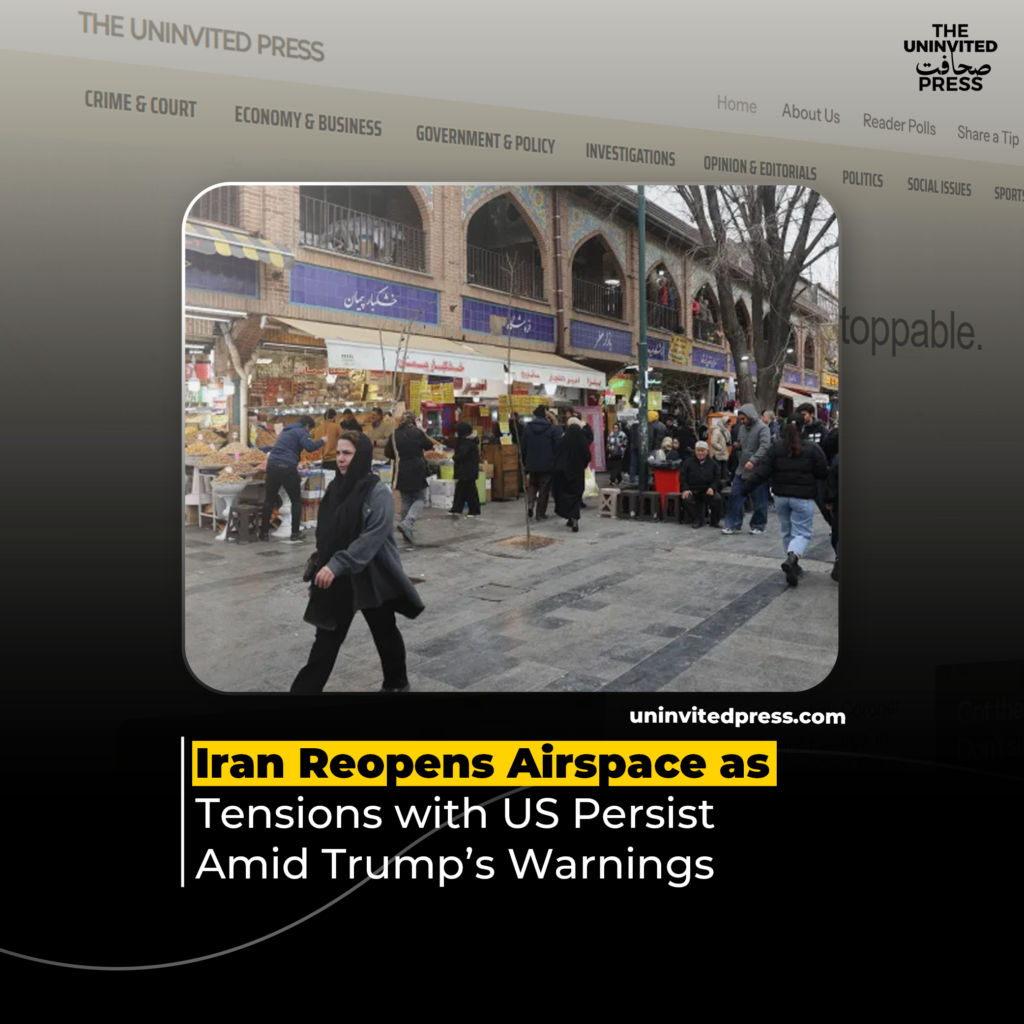
Tehran lifts temporary flight restrictions after brief closure triggered by fears of American military action, but underlying standoff remains unresolved.
Iran has reopened its airspace to commercial flights after a temporary closure that lasted several hours, amid ongoing high tensions with the United States and fresh warnings from President Donald Trump.
The move comes as the Islamic Republic navigates a complex mix of domestic challenges, regional rivalries, and direct confrontation risks with Washington. Aviation authorities lifted the restrictions early on Thursday, allowing flights to resume after a near five-hour shutdown that forced international carriers to reroute and cancel services.
Iran Moves to Reopen Skies After Security Precaution:
Iran’s Civil Aviation Organisation and international monitoring services reported the sudden restriction late Wednesday, which barred most incoming and outgoing flights except for limited international operations with prior approval. Flight tracking data showed planes diverting around Iranian airspace, disrupting regional air traffic.
The closure was widely interpreted as a precautionary measure amid fears of potential US strikes. It followed renewed verbal escalations from Washington, including President Trump’s public warnings regarding Iran’s handling of internal protests and broader regional behaviour.
Trump had earlier threatened “very strong” action in response to Tehran’s crackdown on anti-government demonstrators, which has drawn international condemnation over reported casualties and executions. While Trump later indicated that the situation appeared to be de-escalating, the underlying mistrust persists.
The reopening does not signal any fundamental improvement in relations. Analysts describe the episode as another flashpoint in a long-running confrontation marked by sanctions, proxy conflicts, and mutual accusations.
“Iran remains on high alert,” one regional security expert noted. “The temporary closure reflects genuine concern over possible American or Israeli military moves, even as diplomatic backchannels continue.”
Many international airlines have continued to avoid Iranian airspace regardless, citing ongoing security risks and insurance concerns. European and American carriers have maintained strict no-fly policies over Iran for months.
Iran Reopens Airspace Amid Ongoing Regional Tensions:
The airspace drama occurs against the backdrop of wider Middle East volatility, including recent direct exchanges between Iran, Israel, and the United States. Tehran has repeatedly warned that any aggression would trigger a strong response, while maintaining that its defensive posture is justified.
Iranian officials have used the episode to criticise US “provocations” and “bullying tactics,” framing the reopening as a demonstration of normalcy and resilience. However, opposition voices and rights groups inside and outside Iran continue to highlight domestic repression and the heavy human cost of the standoff.