

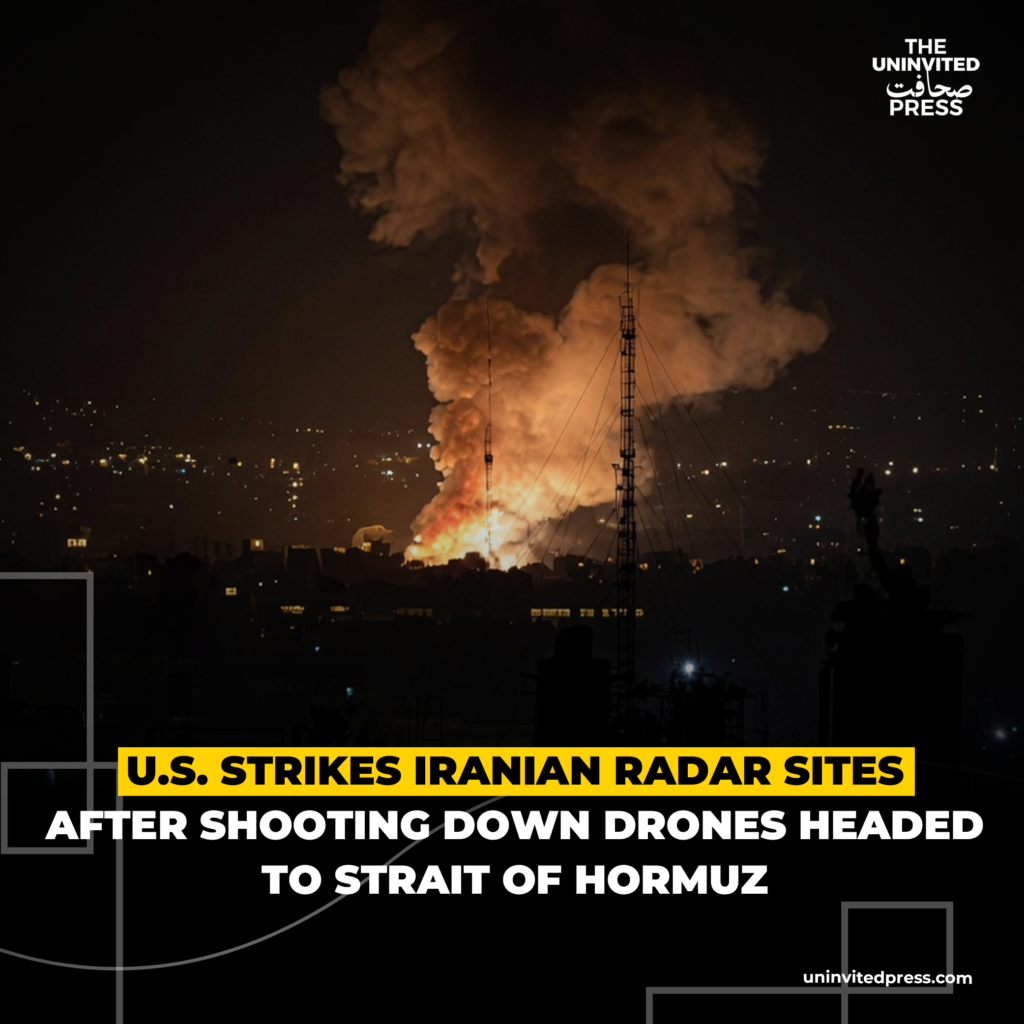
Washington responds to drone threat near Strait of Hormuz as fragile ceasefire talks continue.
The United States has carried out strikes on Iranian coastal radar sites after shooting down four Iranian one-way attack drones headed towards the Strait of Hormuz, the US military said, in the latest flare-up between the two adversaries.
US Central Command (CENTCOM) said the drones “posed an immediate threat to regional maritime traffic,” prompting American forces to target surveillance radar installations in Goruk and on Qeshm Island. The action was described as defensive.
The incident comes as diplomatic efforts to end the months-long US-Iran conflict appear increasingly strained, with both sides trading accusations and limited strikes even as ceasefire negotiations continue in the background.
Drones and radar under fire:
According to CENTCOM, the Iranian drones were intercepted before they could reach their intended targets in the vital waterway, through which roughly one-fifth of the world’s oil passes. US forces then struck the radar sites “to defend against further attacks,” the statement added.
Iran has not yet issued an official detailed response to the specific strikes on its radar facilities, but state media and the Islamic Revolutionary Guard Corps (IRGC) have previously described similar US actions as aggression and vowed retaliation.
The Strait of Hormuz remains one of the world’s most strategically sensitive chokepoints. Any disruption there risks sending shockwaves through global energy markets, already jittery from the broader regional conflict.
Gulf Tensions Rise After Drone Incident Near Hormuz:
The latest exchange fits into a pattern of tit-for-tat actions that have persisted since the outbreak of direct hostilities earlier this year. The US and Israel launched initial strikes on Iranian military and leadership targets, prompting Iranian responses including missile and drone attacks on US allies and bases in the Gulf.
Analysts warn that such incidents risk derailing fragile diplomatic initiatives. Multiple rounds of indirect talks have taken place, but deep mistrust remains on issues ranging from Iran’s nuclear programme to regional proxy conflicts.
A senior Gulf diplomat, speaking on condition of anonymity, told Media that “every new strike makes the path to de-escalation narrower.”
Oil prices jumped in early trading following reports of the incident, reflecting fears over potential disruptions in the Strait of Hormuz. Shipping companies and energy traders are closely monitoring developments.
Neighbouring Gulf states, many of which host US military facilities, have expressed quiet concern about being drawn further into the conflict. Kuwait and Bahrain reportedly intercepted Iranian missiles in related exchanges.
Iran has long maintained that its military activities in the Gulf are defensive in nature and aimed at protecting its territorial waters and responding to what it calls US-Israeli provocations. The US administration has described its operations as necessary to safeguard freedom of navigation and deter Iranian aggression.