

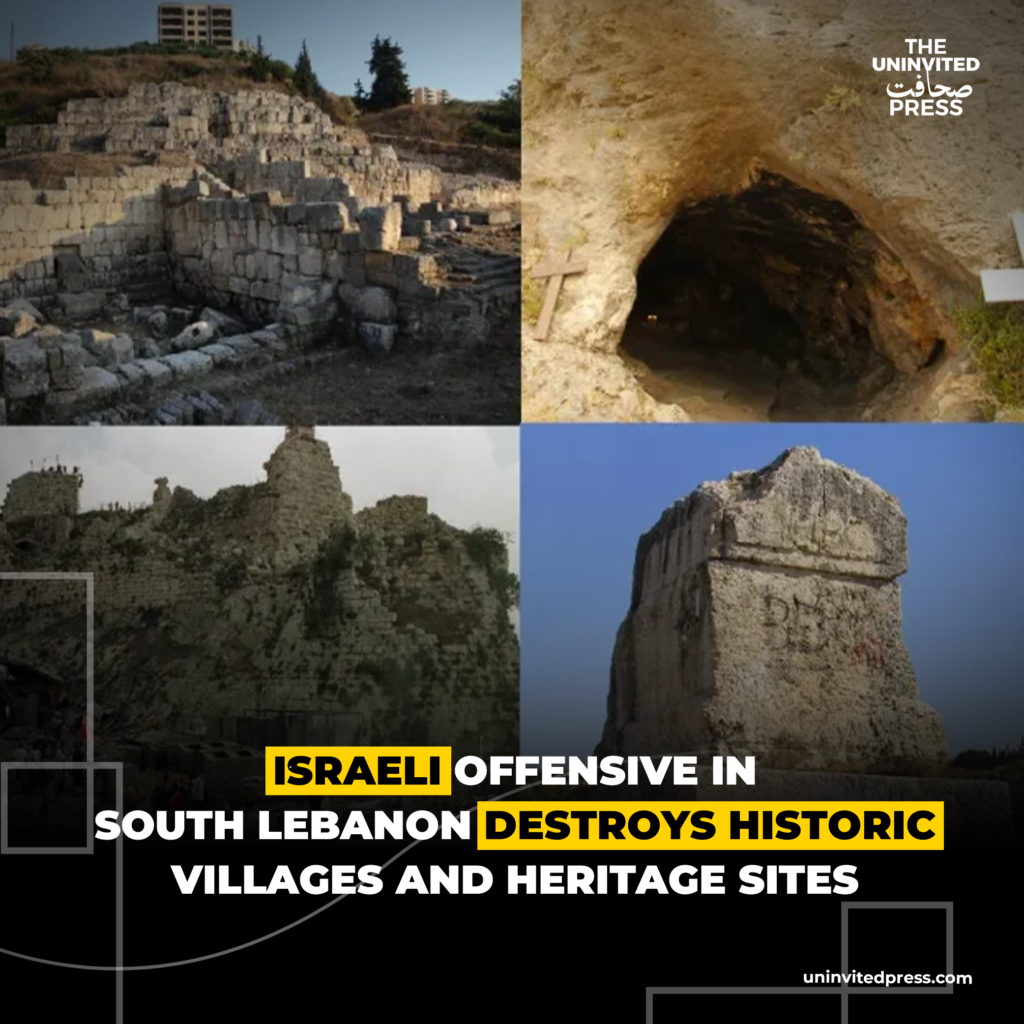
Centuries-old churches, mosques and ancient ruins razed as entire communities reduced to rubble.
Israel’s ongoing military offensive in southern Lebanon has devastated centuries of cultural and architectural heritage, with entire historic villages levelled and UNESCO-protected sites damaged or destroyed, Lebanese officials and cultural experts say.
Satellite imagery and eyewitness accounts reveal widespread destruction across border towns and villages, where centuries-old stone houses, religious sites and archaeological remains have been erased through airstrikes, artillery shelling and controlled demolitions. The offensive, which intensified despite a fragile ceasefire, has targeted areas rich in Phoenician, Roman, Crusader and Islamic history.
Villages such as Muhaibib have been almost entirely wiped out, their historic homes, churches and communal structures reduced to dust by explosive charges and bulldozers. Similar scenes have been documented in towns including Yaroun, Dhayra and Bint Jbeil, where traditional architecture that formed the backbone of local identity has vanished.
Lebanon’s Heritage Sites at Risk Amid Israeli Strikes:
Lebanon’s Culture Minister Ghassan Salame has warned that Israeli attacks are placing heritage sites in “serious danger”, including the ancient city of Tyre-a UNESCO World Heritage site-where bombings have fallen perilously close to its Phoenician ruins and Roman remains. The medieval Beaufort Castle, a towering Crusader fortress overlooking Nabatieh, was directly hit in recent strikes.
Archaeologists and local activists report the destruction of churches, mosques, convents and ancestral homes dating back hundreds of years. In some cases, religious sites were reportedly demolished with explosives even after Israeli forces had secured the areas, raising questions about military necessity.
The Director General of Antiquities, Sarkis Khoury, described the systematic razing of villages as “the complete and systematic destruction of the historical memory” of southern Lebanon. NGOs documenting the damage say the loss extends beyond physical structures to the intangible cultural fabric that binds communities to their land.
Pattern of destruction:
The offensive has mirrored tactics used elsewhere in the region, with Israeli forces publishing videos of large-scale demolitions. More than 10,000 structures have been heavily damaged or destroyed in southern Lebanon since late 2024, according to rights groups, with entire neighbourhoods erased in a matter of seconds.
Lebanese authorities and human rights organisations have condemned the destruction as a violation of international law protecting cultural property during armed conflict. UNESCO has expressed repeated concern over the targeting of heritage sites.
As displaced residents await permission to return, many fear that the erasure of their historic villages will make reconstruction and the preservation of cultural identity nearly impossible.