

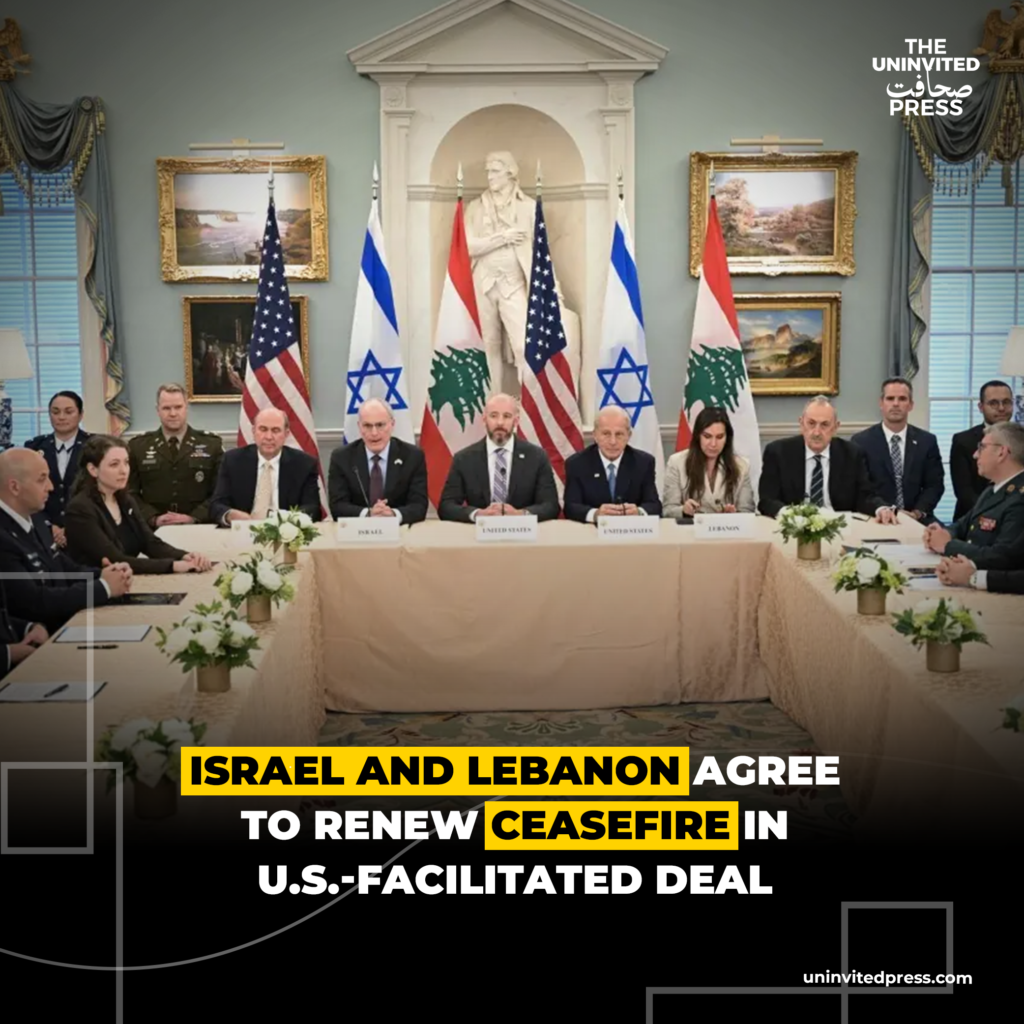
Extension aims to prevent renewed fighting as southern Lebanon remains tense and reconstruction stalls.
Israel and Lebanon have reached an agreement to renew their fragile ceasefire, brokered by the United States, in a bid to extend a tenuous halt to hostilities that has held since April 2026 but remains marred by violations and deep mistrust.
The latest extension, announced following high-level talks in Washington, comes as the original truce and its subsequent prolongations face repeated challenges, including reported clashes in southern Lebanon and ongoing disputes over border security and Hezbollah’s presence.
According to US officials, the renewal provides additional time for negotiations toward a more permanent arrangement, including the establishment of “pilot zones” along the border where Lebanese army forces would deploy in place of non-state actors.
Lebanon Ceasefire Under Strain:
The ceasefire, first declared in April 2026 as a short-term measure, has been extended multiple times-first by three weeks, then by 45 days in mid-May. The latest deal follows US-mediated discussions between Israeli and Lebanese delegations, with both sides expressing cautious commitment to de-escalation.
However, Lebanese officials and residents in the south report persistent Israeli military activity, including strikes and restrictions that have hindered the return of displaced families and stalled reconstruction efforts. Hezbollah has also been accused of sporadic violations, though the group has publicly stated it will abide by the truce framework if Israel withdraws fully from Lebanese territory.
Analysts warn that without addressing core issues-such as the implementation of UN Resolution 1701, full Israeli withdrawal, and the disarmament of armed groups south of the Litani River-the ceasefire risks collapsing, potentially reigniting a wider conflict.
US Mediation and Regional Implications:
The United States has played a central mediating role, with officials describing the talks as “productive.” President Donald Trump has touted the agreement as a step toward broader regional stability. Yet critics in Lebanon and across the Arab world view the US-brokered process as heavily tilted toward Israeli security demands, with limited guarantees for Lebanese sovereignty.
Lebanese Prime Minister Najib Mikati has emphasised the need for a comprehensive deal that ensures the withdrawal of Israeli forces and supports reconstruction, while warning against any permanent alterations to the border status.
As talks continue, humanitarian organisations continue to highlight the dire conditions in southern Lebanon, where thousands remain displaced and infrastructure lies in ruins from months of intense bombardment.
The renewed ceasefire offers a temporary reprieve, but many fear it may only delay-rather than resolve-the underlying tensions that have repeatedly brought the two neighbours to the brink of war.