

Small island nation’s aggressive coastal transformation raises questions about sustainability, environmental costs and long-term resilience against climate change.
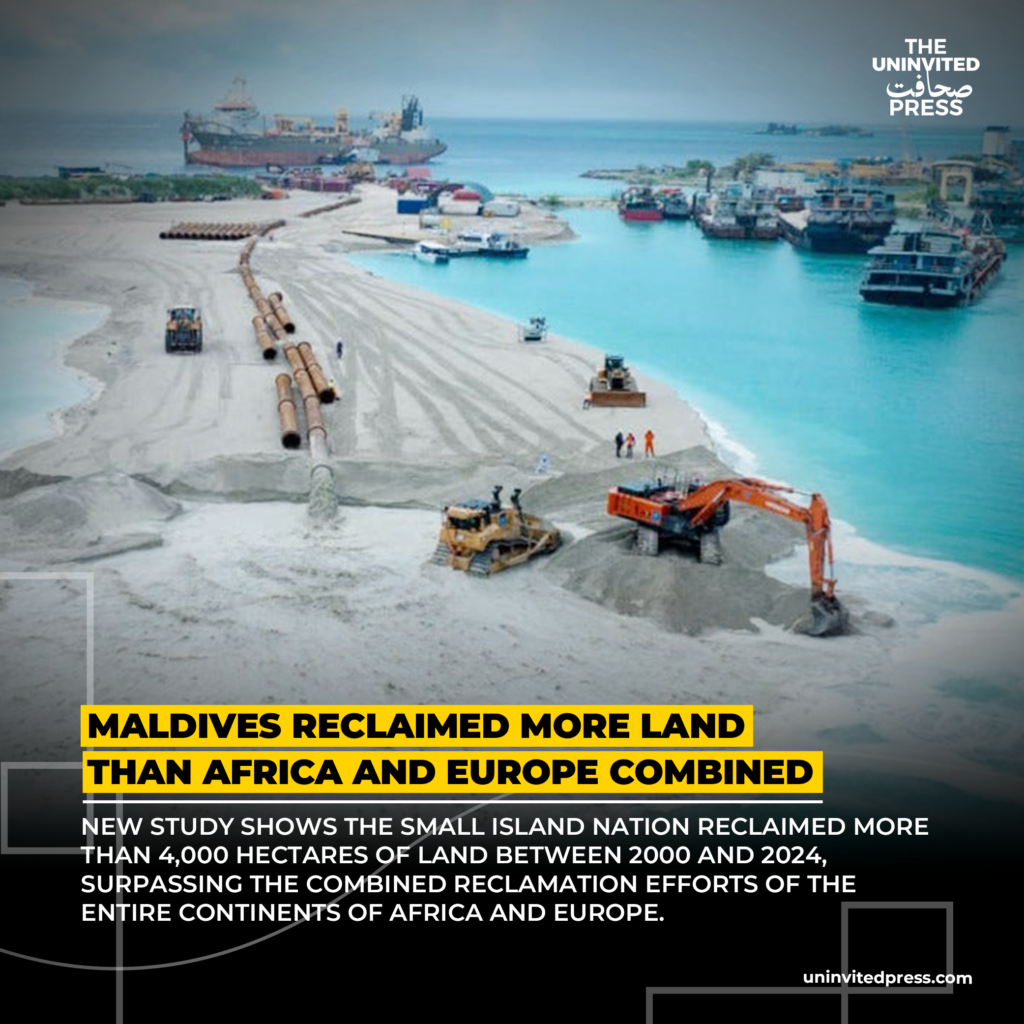
A new study has revealed that the Maldives, one of the world’s most climate-vulnerable nations, has reclaimed more than 4,000 hectares of land between 2000 and 2024-exceeding the total land reclamation carried out across the entire continents of Africa and Europe combined during the same period.
The findings, published in the study Land Reclamation in the Maldives: Trends and Impacts from 2000 to 2024, highlight the rapid pace of artificial island expansion in the low-lying archipelago, where nearly 80 percent of the land is less than one metre above sea level.
Researchers documented 109 reclamation projects across 69 inhabited islands, meaning roughly one in every three inhabited islands in the country has undergone significant land creation. The Central Region, particularly Kaafu Atoll, accounted for the vast majority of the activity, with more than 70 percent of all reclaimed land concentrated there.
Land Reclamation Reshapes the Maldives:
Facing existential threats from rising sea levels, the Maldives has turned to large-scale land reclamation as a primary strategy for survival and economic development. The projects aim to create space for housing, tourism infrastructure, harbours, and airports in a country where natural land is extremely limited-just 300 square kilometres for a population of around 500,000.
However, the study warns of significant environmental and social consequences. Reclamation often involves dredging sand and coral from lagoons, which can damage marine ecosystems, disrupt fisheries, and weaken natural coastal defences such as coral reefs.
Critics, including environmentalists and some scientists, argue that while reclamation provides immediate relief, it may increase long-term vulnerability by altering natural coastal dynamics and contributing to reef degradation.
Regional concentration and policy concerns:
The study points to a misalignment between reclamation efforts, population distribution, and the government’s stated goals of decentralisation. Much of the new land has been created in already densely populated central atolls rather than in outer islands, potentially exacerbating regional inequalities.
The government maintains that such projects are essential for protecting citizens and sustaining the tourism-dependent economy, which accounts for nearly 80 percent of GDP. Major initiatives include the ongoing Ras Malé project and expansions at Velana International Airport.
As climate change accelerates, the Maldives finds itself in a paradoxical position-a vocal advocate for global climate action on the international stage while aggressively modifying its own fragile environment at home.
The study calls for better planning, stronger environmental oversight, and more balanced approaches to coastal management to ensure that short-term gains do not undermine the country’s long-term habitability.