

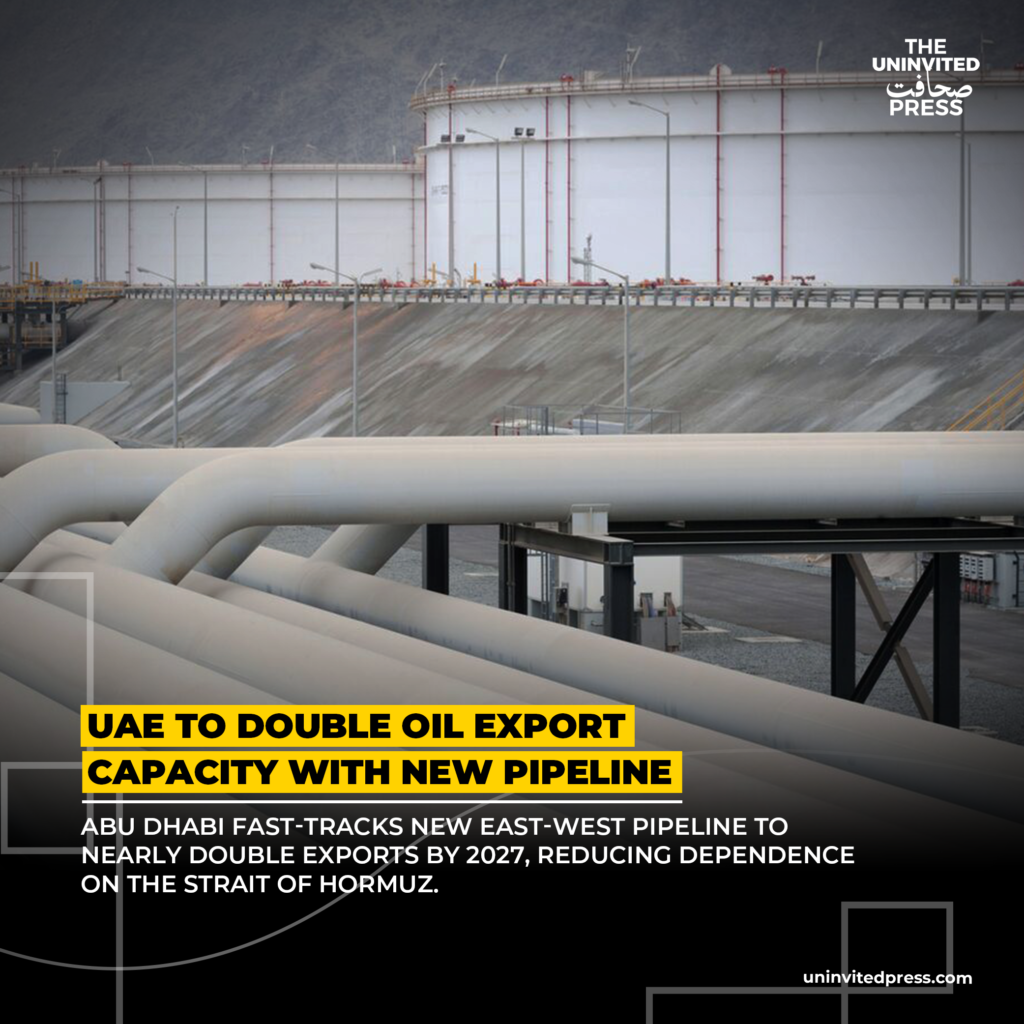
Abu Dhabi fast-tracks West-East project to nearly double export capacity through Fujairah by 2027, enhancing energy security amid regional tensions.
The United Arab Emirates is accelerating construction of a major new oil pipeline that will significantly boost its ability to export crude without relying on the Strait of Hormuz, one of the world’s most critical-and vulnerable-energy chokepoints.
The project, known as the West-East Pipeline, is being fast-tracked by order of Abu Dhabi Crown Prince Sheikh Khaled bin Mohamed bin Zayed Al Nahyan. It is expected to become operational in 2027, effectively doubling the UAE’s export capacity through the eastern port of Fujairah on the Gulf of Oman.
The existing Habshan-Fujairah pipeline (also referred to as the Abu Dhabi Crude Oil Pipeline or ADCOP) currently has a capacity of around 1.8 million barrels per day. The new parallel line will nearly double that figure, allowing the UAE to route a much larger share of its production away from the narrow Strait of Hormuz, through which about one-fifth of global oil supplies traditionally passes.
UAE Accelerates Oil Export Route Outside Strait of Hormuz:
Announced by the Abu Dhabi Media Office on Friday, the move comes as the UAE seeks to strengthen its energy infrastructure and meet growing global demand while reducing exposure to potential disruptions in the Gulf.
“The project will help meet global demands,” the Crown Prince said during an executive committee meeting of the Abu Dhabi National Oil Company (ADNOC), according to official statements.
Fujairah has grown into a key oil export hub precisely because of its location outside the Strait of Hormuz. Tankers loading there can access the Indian Ocean directly, bypassing the narrow waterway between Iran and Oman that has long been a flashpoint for regional tensions.
The expansion aligns with ADNOC’s broader ambitions to increase the UAE’s overall oil production capacity to 5 million barrels per day by 2027.
UAE Boosts Energy Security Amid Gulf Shipping Risks:
The timing of the acceleration underscores growing concerns over maritime security in the Gulf. Recent tensions and incidents involving the Strait of Hormuz have highlighted the risks of over-reliance on a single shipping route.
By bolstering its eastern export corridor, the UAE is following a similar strategy to Saudi Arabia, which operates the East-West Pipeline (Petroline) linking its eastern oil fields to the Red Sea port of Yanbu. Analysts say the project will enhance the UAE’s resilience as a major energy supplier and could help stabilise export flows even in times of heightened regional instability.
The UAE is a key OPEC+ producer and has been positioning itself as a reliable global energy partner, even as it diversifies its economy under the “We the UAE 2031” vision.
Construction of the new pipeline is already underway, with the accelerated timeline reflecting Abu Dhabi’s determination to complete the project swiftly.
As one of the world’s top oil exporters, the UAE’s ability to maintain uninterrupted supplies could have significant implications for global energy markets in the coming years.