

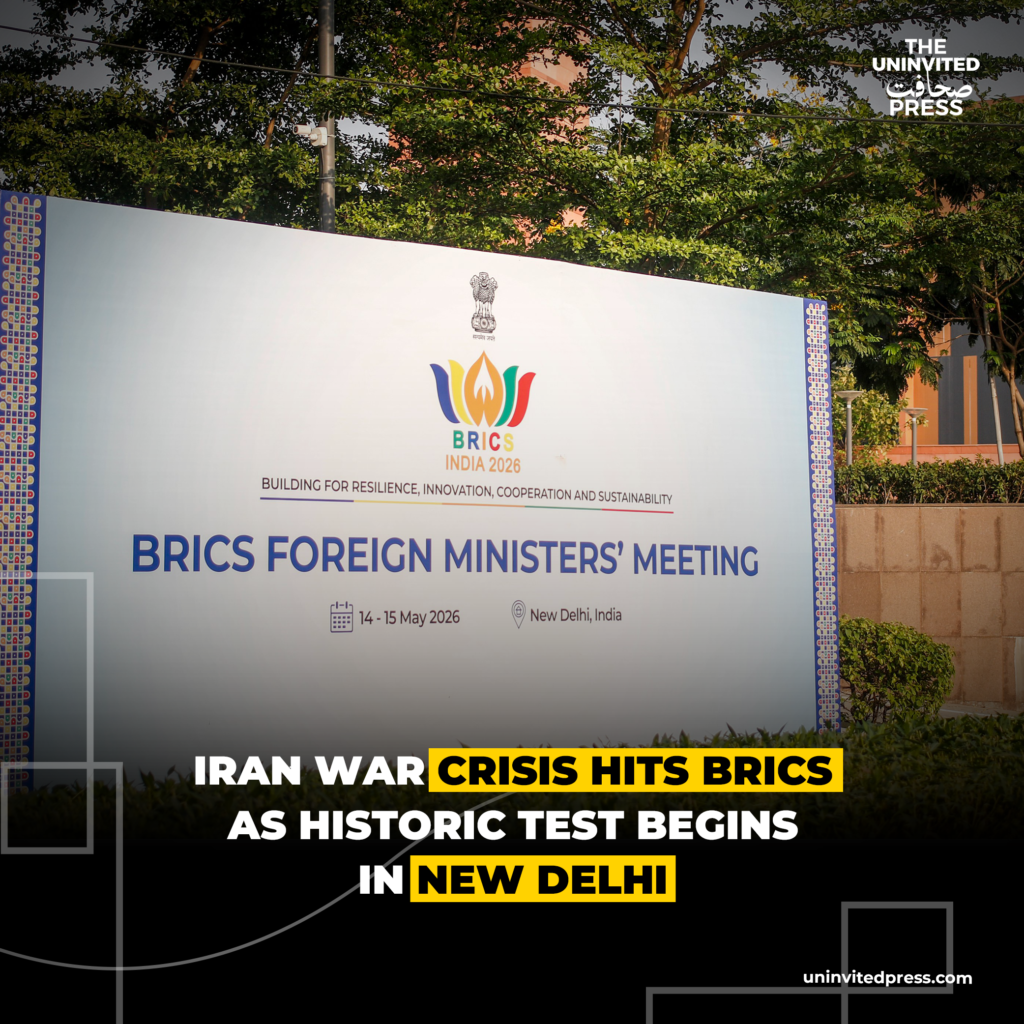
Growing disagreements among member states over the West Asia crisis expose fault lines within BRICS as leaders struggle to present a unified diplomatic position.
The shadow of the recent Iran war is set to dominate discussions as BRICS foreign ministers convene in New Delhi on May 14-15, 2026, posing a significant challenge to the expanded bloc’s cohesion and its ambitions to shape a multipolar world order.
Under India’s chairmanship, the two-day meeting brings together top diplomats from Brazil, Russia, India, China, South Africa, and new members including Iran, the United Arab Emirates, Egypt, Ethiopia, and Indonesia. The official theme-“Building for Resilience, Innovation, Cooperation and Sustainability”-risks being overshadowed by deep divisions stemming from the US-Israeli military campaign against Iran.
Iranian Foreign Minister Seyed Abbas Araghchi arrived in New Delhi on Wednesday, while Russian Foreign Minister Sergey Lavrov is also expected to attend. Notably, China’s Foreign Minister Wang Yi is absent, with Beijing sending a lower-level representative.
Iran Conflict Exposes Deep BRICS Divisions Over West Asia Policy:
The Iran conflict has exposed fault lines within the group. Iran is pressing fellow BRICS members to issue a strong condemnation of US and Israeli actions, while Gulf members such as the UAE-which faced Iranian attacks during the conflict-hold differing positions. Previous lower-level BRICS meetings on West Asia earlier this year failed to produce a joint statement due to these disagreements.
The New Delhi gathering represents a critical test for BRICS, which expanded significantly in recent years to amplify the voice of the Global South. Failure to reach consensus could undermine the bloc’s credibility at a time when it seeks greater influence in global governance, including reforms to the United Nations Security Council and international financial institutions.
Iran Conflict Tests BRICS Unity:
The war has already triggered volatility in global energy markets, disrupting shipping through the Strait of Hormuz and driving up oil prices-a major concern for energy-importing BRICS nations like India and China. Discussions are expected to address maritime security, economic resilience, and the broader implications for developing economies.
Indian officials have emphasised the need for de-escalation and dialogue in West Asia while maintaining strategic ties with all parties. As host, India is walking a tightrope, balancing its growing partnerships with Gulf states and Israel alongside its longstanding relations with Iran and Russia.
Whether BRICS can bridge these divides and issue a meaningful joint outcome remains uncertain. The meeting’s results will likely set the tone for India’s full BRICS presidency in 2026 and the leaders’ summit later this year.
As geopolitical tensions reshape global alliances, the New Delhi talks highlight both the aspirations and the limitations of emerging powers attempting to chart an independent course amid great-power rivalry.