

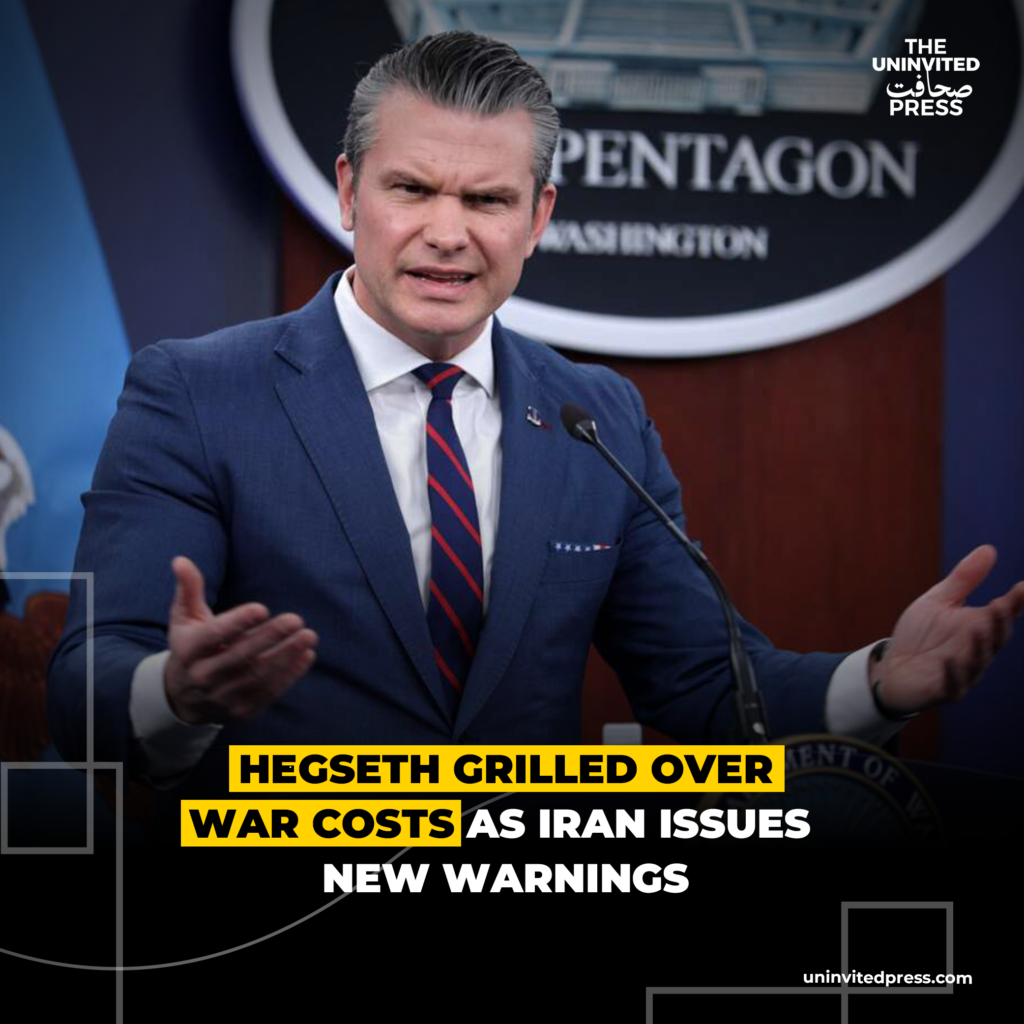
Lawmakers press Pentagon chief on economic fallout for American families as conflict enters critical phase and Iran issues new threats over Strait of Hormuz blockade.
United States Defence Secretary Pete Hegseth faced sharp questioning from lawmakers on Thursday as he defended the financial and strategic toll of the US-led military campaign against Iran, now in its ninth week.
During a heated congressional hearing, Hegseth was repeatedly pressed on the war’s ballooning price tag-estimated by the Pentagon at $25 billion and potentially higher according to internal figures-even as global oil prices surge and ordinary Americans grapple with rising costs for fuel and food.
Mounting costs and domestic pain:
Democrats on the House and Senate Armed Services Committees, highlighted the disconnect between the Trump administration’s promises to lower household expenses and the reality of disrupted energy markets triggered by the conflict.
One lawmaker asked Hegseth directly: “Do you know how much it will cost Americans in terms of their increased cost in gas and food over the next year because of the Iran war?” Hegseth countered by framing the expense as necessary to prevent a nuclear-armed Iran, asking in return: “What is the cost of an Iranian nuclear bomb?”
Pentagon officials testified that the bulk of spending has gone toward munitions, operations, maintenance, and replacing equipment damaged in strikes on Iranian nuclear sites and missile infrastructure as part of Operation Epic Fury, launched alongside Israel on February 28.
Iran’s new warnings:
The grilling comes as Iran issues fresh warnings over the US naval blockade and the closure of the Strait of Hormuz, a vital chokepoint for global oil supplies. Tehran has threatened further escalation if the blockade continues, raising fears of prolonged disruption to energy markets.
Hegseth rejected descriptions of the conflict as a “quagmire,” insisting the operation has delivered significant blows to Iran’s military capabilities while denying it lacks a clear endgame. He described congressional critics as “defeatists” who underestimate the threat posed by the Islamic Republic.
War Costs, Political Divide & Rising Regional Risks:
The hearings mark Hegseth’s first major public testimony since the war began, exposing deep partisan rifts. Republicans largely backed the administration’s aggressive posture, while Democrats questioned the legal basis for sustained operations without fresh congressional approval and the accuracy of intelligence used to justify the initial strikes.
Some lawmakers from both sides expressed concern over the human and financial toll, including reported American casualties and the broader regional fallout.
The Trump administration has requested a record $1.5 trillion defence budget for the coming year, citing the need to deter adversaries and replenish stocks depleted by the Iran campaign.
From a Middle Eastern perspective, the conflict has deepened instability in an already fragile region. Experts caution that prolonged fighting could pull in additional players and worsen the humanitarian situation, while the economic impact is being felt well beyond the United States-especially in oil-dependent nations across Asia, Africa, and Europe. As tensions persist and Iran shows no signs of backing down, uncertainty surrounds the direction of the conflict and whether the significant costs will translate into long-term strategic benefits or draw the US into another extended and complex regional war.