

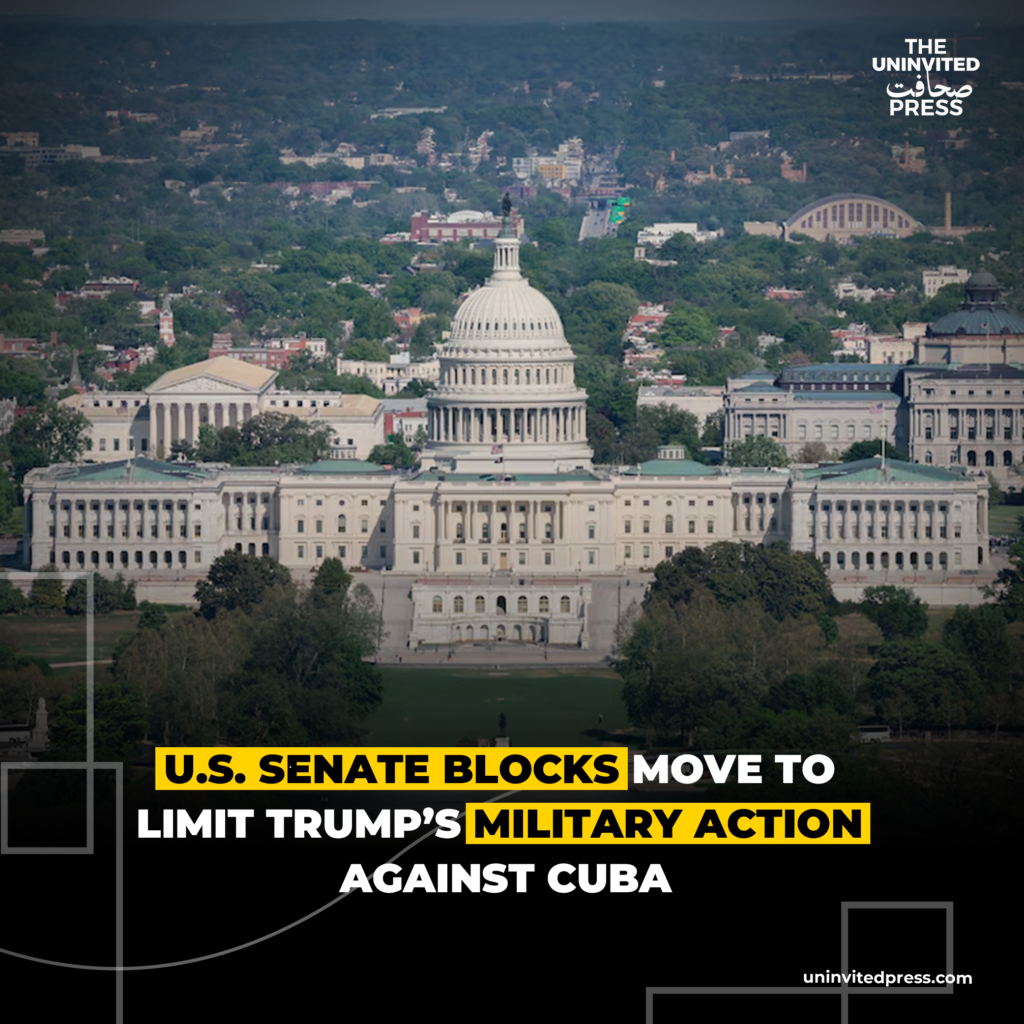
Republican majority votes down Democratic war powers resolution in 51-47 procedural vote, amid escalating US pressure on Havana.
The Republican-controlled US Senate has blocked a Democratic-led effort to restrict President Donald Trump from launching military action against Cuba without congressional approval, in a move that highlights deep partisan divisions over executive war powers and Washington’s hardening stance toward the island nation.
The resolution, sponsored by Democratic senators including Tim Kaine of Virginia, sought to invoke the War Powers Resolution to require legislative consent before any potential US military engagement with Cuba. It was sidelined on a 51-47 procedural vote on Tuesday, largely along party lines.
Partisan Divide Over Executive Authority:
Republicans argued the measure was premature, insisting there are currently no active US hostilities against Cuba and that limiting presidential flexibility was unnecessary. Senator Rick Scott of Florida, a vocal critic of the Cuban government, led the procedural objection.
Democrats countered that Trump’s increasingly aggressive rhetoric-including threats of further escalation following economic sanctions and naval actions in the region-warranted congressional oversight.
“If anyone did to the United States what we are doing to Cuba, it would be considered an act of war,” Senator Kaine reportedly stated during the debate.
The vote reflects broader tensions in Washington over Trump’s foreign policy approach, which has already involved military operations in other hotspots such as Venezuela and Iran.
Cuba Faces Renewed Pressure:
US-Cuba relations have deteriorated sharply since Trump’s return to the White House. The administration has intensified economic measures, including an energy blockade, while demanding political reforms from Havana. Cuban officials have rejected these demands, accusing Washington of attempting regime change through hybrid warfare.
Cuban Foreign Minister Bruno Rodríguez described the Senate’s decision as “a blank check for aggression,” warning that any military adventure would meet fierce resistance.
Analysts say the failed resolution strengthens Trump’s hand as he navigates a region long viewed by Washington as its backyard.
“This vote signals to allies and adversaries alike that congressional checks on executive military power remain weak under Republican control,” said Dr. Maria Elena Rodriguez, a Latin America expert at the Doha-based Al Jazeera Centre for Studies.
Rising Global Concerns Over US-Cuba Tensions:
The situation has sparked concern across Latin America, with countries like Venezuela, Nicaragua, and Bolivia voicing support for Cuba and warning against threats to regional sovereignty.
Global powers including China and Russia have criticised the move, cautioning that it could disrupt stability in the Caribbean and violate international norms. Meanwhile, the European Union has called for restraint and renewed dialogue.
As Donald Trump continues a hardline approach combining economic pressure with potential military options, analysts warn that tensions could rise further. The Senate’s decision keeps presidential authority intact at a time of already heightened uncertainty.